Fund accounting tracks financial activity separately by the purpose or restrictions attached to the money. It is especially relevant to nonprofits and organizations administering grants or other third-party funds: the organization can see what came in, what was spent, and what remains for each purpose. The same phrase is also used for accounting investment funds, a distinct subject not covered in depth here.
What is fund accounting?
Fund accounting is a way to record and report resources by fund, so an organization can track each fund’s purpose, restrictions, income, expenses, and remaining balance. The Association of Nonprofit Accountants and Finance Professionals describes separating revenues and expenses into funds primarily for reporting. In the U.S. Department of Education’s 2025–2026 Federal Student Aid Handbook, a fund is defined as “a separate accounting entity with a self-balancing set of accounts consisting of assets, liabilities, and fund balances.” That handbook’s description concerns institutions administering Title IV programs.



For nonprofits, the distinction is meaningful because an organization may receive money that must be used for a particular purpose. Fund accounting makes it possible to follow that money separately from resources available for general use. As the Association of Nonprofit Accountants and Finance Professionals explains, “The concept of fund accounting is one of the main differences between for-profit and non-profit accounting.”
Why does fund accounting matter?
Its central purpose is accountability. An organization needs to demonstrate that resources subject to donor, grantor, program, legal, or other third-party requirements were used as intended. Tracking by fund can also help staff monitor program budgets, spending, and unspent restricted balances, and prepare reports for people or agencies entitled to receive them.
#1 Best Overall
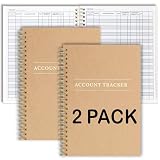
- PERFECT FOR RECORD KEEPING: The 2 Pack account ledger books are versatile and can be used to track finances, budgets, expenses, and other business or personal records. They are perfect for individuals, entrepreneurs, or small business owners who need a reliable and efficient way to keep track of their finances. With 100 pages, customers can record transactions over an extended period, making it a handy tool for financial planning and organization.
- COMPACT AND LIGHTWEIGHT: The account ledger books are compact and lightweight with each book weighing 7 ounces and measuring 8.5 x 6.25 inch, making them easy to carry around. You can take them with them in a bag or briefcase, making them ideal for on-the-go use. This feature ensures that you can access your records at any time, whether you are at work or on the move.
- DURABLE KRAFT COVER: The kraft cover is a distinguishing feature of these account ledger books. It provides a durable layer of protection that can withstand daily wear and tear, making it suitable for long-term use. Additionally, the classic, rustic appearance of the cover gives it a timeless and professional look that can fit in any setting.
- PREMIUM QUALITY: Elegant style with the words ''Account Tracker'' embossed in fancy Gold Foils. The gold coil ring binding is a practical design feature that enhances the functionality of the account ledger books. It allows pages to turn smoothly and easily, making it effortless to flip through the book while keeping pages in place. The ring binding also ensures that pages won't fall out, preventing the loss of vital information.
Fund accounting does not mean every nonprofit gift is restricted or that all organizations must use the same fund structure. The terms attached to funds and the reporting obligations depend on the source of the money, governing documents, applicable accounting standards, and jurisdiction. The Federal Student Aid Handbook addresses its specific Title IV setting and states that its guidance does not replace standards from FASB, GASB, AICPA, or GAAP.
How does fund accounting work?
- Identify the money’s source and terms. Determine whether a donor restriction, grant condition, program rule, legal requirement, or internal board designation applies.
- Set up funds or fund codes. Create a structure that supports the organization’s actual tracking and reporting needs. The Association of Nonprofit Accountants and Finance Professionals describes assigning unique codes to transactions so staff can review expenses and remaining amounts by fund.
- Code transactions to the right fund. Record relevant income, expenses, assets, liabilities, and balances against the fund they belong to. In the Federal Student Aid Handbook’s description, each fund is a self-balancing accounting entity.
- Monitor budgets, restrictions, and balances. Review activity at the fund level and prepare reports that show how resources were used and what remains.
- Prepare external financial reporting under applicable rules. Group funds or present net assets as required by the relevant reporting framework. Internal fund codes do not automatically determine how financial statements must be presented.
Example: a scholarship gift
If a donor gives money specifically for scholarships, the organization can code the eligible scholarship income and related costs to a scholarship fund. Staff can then report how much was received, how much was spent on eligible costs, and what remains available for scholarships. This illustrates the tracking idea; it is not a universal accounting entry or a statement of a particular accounting standard.
Restricted and unrestricted funds: what is the difference?
Restricted resources have limits imposed by a donor, grantor, law, or another external party. The organization must use them in line with those terms. Unrestricted resources do not carry those external limits, so the organization generally has more discretion over their use, subject to applicable obligations.
An internal board designation can set aside resources for a chosen purpose, but it should not be casually described as a donor restriction. The distinction matters because the source of the limit affects how the organization manages and reports the money.
What’s actually slowing this PC down?
Pick the symptom - the matching free tool is one click away.
Rank #3

- Easy To Track Your Finances: HAUTOCO accounting ledger book keeps you on top of your expenses and income! Help you keep your money organized, spend well, and set and achieve financial goals
- Premium Material: The A5 accounting ledger book has a total of 120 pages and 2040 lines of entries. It is made of 100gsm thick paper to reduce ink leakage; it is equipped with a waterproof and sturdy PP cover to protect the inner pages
- Practical Design: Compact 8.3 x 6.2'' expense tracker notebook is easy to carry and features information pages, 2025 calendar, yearly financial goals page, and PVC pocket for storing important tickets and loose items
- Manage Your Finances Effectively: Undated accounting books with number, date, description, account, payment or deposit amount, and total balance. You will be able to easily analyze your financial activities and quickly prepare accurate financial statements
- Ideal For Small Business or Personal Use: An accounting log journal can track your business or personal financial status. With a clear record of transactions, you can find unnecessary expenses or fraudulent charges
How do grant, endowment, and donor-advised funds fit in?
Grant and program funds
Separate tracking can help show that grant or program resources were spent for their specified purposes and stayed within applicable limits. In its Title IV context, the Federal Student Aid Handbook discusses maintaining separate accounts for third-party programs. That context should not be read as a universal requirement for every nonprofit or every grant.
Endowment funds
An endowment may include a requirement to preserve principal, while investment returns may be available for use under the governing terms and applicable law or policy. The IRS Form 990 instructions describe donor-stipulated endowments as gifts required to be invested in perpetuity or for a specified term. The exact treatment depends on the gift terms and relevant rules; the Council on Foundations discusses nonprofit investment income and UPMIFA-related spending considerations.
Donor-advised funds
A donor-advised fund is not simply an organization’s internal restricted fund. The IRS describes it as a separately identified account maintained by a sponsoring 501(c)(3). After a contribution, the sponsoring organization has legal control over the assets.
Independent reader supportYour contribution helps us test, update, and keep practical guides available for everyone.How should an organization choose a fund structure or software?
The fund structure should reflect the restrictions and reporting the organization actually has to manage. Too little detail can make it hard to show that money was used as required; an unnecessarily complicated structure can make coding and reporting harder to maintain. The design should be reviewed against governing documents and applicable accounting requirements.
Best Value
Fund-accounting software may help organize fund tracking and reporting as an organization handles grants and programs. Sage and QuickBooks publish guidance on nonprofit accounting and tracking by purpose, but vendor materials do not establish comparative performance, error reduction, suitability, pricing, or regulatory compliance. When evaluating a system, consider whether it supports:
- the organization’s fund and restriction model;
- fund-level reports and grant or program budgets;
- transaction coding and an audit trail; and
- integration with the existing ledger and reporting process.
Fund accounting for nonprofits versus investment funds
“Fund accounting” can also refer to accounting for pooled investment funds, where matters such as investor capital, investment valuation, and net asset value may be relevant. That is a separate use of the term. The nonprofit and public-program guidance discussed here does not establish a detailed explanation of investment-fund accounting, so the two contexts should not be conflated.
Quick Recap
Product prices and availability are accurate as of the date/time indicated and are subject to change. Any price and availability information displayed on Amazon at the time of purchase will apply.




