Keep records that show what crypto you acquired or received, when and how much, its value and tax basis, and what happened when you sold, exchanged, spent, or otherwise disposed of it. There is no single retention period for every country. In the United States, ordinary tax records are generally kept through the applicable limitations period—often three years, but longer in some cases—and basis records may need to be kept until after a later taxable sale. Canada’s guidance calls for keeping crypto-asset records for at least six years from the end of the last related tax year.
The periods below describe U.S. federal and Canadian national guidance, not state, provincial, or worldwide rules. Check the tax authority for your jurisdiction and tax year.
Which crypto tax records should you keep?
Keep enough evidence to substantiate each position on your tax return, not just a year-end balance or a summary from a tax app. IRS guidance identifies purchases, receipts, sales, exchanges, other dispositions, transfers, and the fair market value of digital assets received as income or business payment as relevant records. Its digital-asset FAQ was added December 15, 2025. IRS digital-asset transactions FAQ
- Acquisitions and receipts: date and time, asset, quantity, source or transaction type, amount paid or fair market value when received, and applicable fees.
- Dispositions: date and time, asset and quantity, proceeds or value received, fees, and the records and method used to determine basis.
- Income events: records of rewards, mining, staking, or crypto received for services, including the dollar valuation used for reporting.
- Transfers: transaction details and evidence that helps identify your wallets and explain movements between them.
- Supporting documents: exchange statements, wallet exports, on-chain transaction references, invoices, receipts, and filed returns when they support a reported figure.
The IRS identifies asset type, date and time, units, U.S.-dollar fair market value, and basis as relevant calculation inputs. For specific-unit substantiation, its FAQ also lists acquisition and disposition dates and times, basis and fair market value on acquisition, fair market value on disposition, and money or property received. IRS digital-asset transactions FAQ
#1 Best Overall

- All-In-One Monthly Organizer: Keep all your important documents in one place with Sooez Accordion File Organizer. 13 pockets design works great for Monthly organizing and protecting all your important paperwork, bills, taxes, receipts, invoices and more. Perfect for letter size.
- Expandable Capacity: The accordion file folder can be stretched up to 12 inches. 13 pockets allow you to store more than 2000 sheets. No matter how many documents you need to store, this folder can accommodate your needs as it can be easily expanded according to your requirements.
- Efficient Organization & Easy Lookup: To enhance your file organization, we provide blank labels along with this folder. You can personalize them to suit your requirements, such as labeling sections by month for effortless file retrieval.
- Stable & Portable: Stand on its own on the desk and not easy to tip over. Designed with portability in mind, allowing you to effortlessly move it between your desk, cabinet, and any other preferred locations.
- Maximum Protection and Durability: Well made, made from durable wipe-clean polypropylene. Waterproof & sturdy. Tear-resistant plastic provides durable structure. Acid-free, PVC-free, and archival quality for safe storage. Adjustable snap closure helps keep contents secure. Use 2 additional front pockets for business cards, project title cards or notes.
Why wallet transfers and platform exports matter
A transfer between wallets you own may not, by itself, be a taxable sale, but its record can help establish ownership and explain where assets went. Keep enough information to connect the sending and receiving addresses and distinguish your own transfer from a payment or disposition. An exchange export may show activity on that platform without documenting a separate wallet’s activity or explaining every movement.
Export custodial platform histories regularly rather than relying on future access to an account. The Canada Revenue Agency (CRA) specifically advises exports in case a platform closes, stops serving Canada, or you lose account access. CRA: Keeping books and records of crypto-assets
Rank #2

- Yearly Tax Organizer: includes 2 spiral bound tax organizer designed to help you collect, sort, and store important tax records throughout the year, keeping receipts, income records, bills, and other paperwork in one easy to manage place
- Large Size for Everyday Documents: cover measures about 13 x 9.65 inches, with inside pages about 9.65 x 6.5 inches; The spacious pocket design provides room for receipts, statements, records, and tax-related papers without taking up too much desk or shelf space
- 12 Monthly Pockets for Easy Sorting: the tax record organizer features 12 pockets, making it simple to separate documents by month or category; Useful for organizing medical expenses, charitable donations, prescriptions, invoices, income folders, and monthly bill receipts
- Spiral Bound for Convenient Access: the secure spiral binding lets pages turn smoothly, so you can quickly add, remove, or review documents whenever needed; A practical design that helps simplify filing and reduce last-minute stress during tax season
- Widely Applied: this annual tax organizer is suitable for managing annual taxes, tracking receipts and preparing for audits all year round, making your tax preparation more systematic and manageable, and it is very suitable for annual tax returns, document storage and filing, professional tax services and tax agencies
How long should you keep crypto tax records?
| Jurisdiction and authority | Retention rule | How the period is anchored | Important conditions |
|---|---|---|---|
| United States, federal (IRS) | Generally through the applicable limitations period; commonly three years, six years for certain substantial omissions, and no limit for a fraudulent return or failure to file a valid return. | The ordinary assessment period is generally three years from filing. For property basis records, the relevant period runs to the limitations period for the year of taxable disposition. | The six-year period applies to specified omissions, including certain income omissions exceeding 25% of gross income or certain foreign financial asset income omissions above $5,000. IRS, Topic no. 305 |
| Canada (CRA) | At least six years. | From the end of the last taxation year to which the records relate. | CRA also recommends regular exports of custodial platform activity histories. CRA: Keeping books and records of crypto-assets |
What the U.S. three-year rule does—and does not—mean
The IRS’s three-year period is a general federal assessment rule, not a blanket instruction to delete crypto records three years after buying an asset or filing the purchase-year return. The IRS says ordinary records supporting income, deductions, or credits should generally be kept until the limitations period for the return expires. Tax Topic 305 states that the assessment period is generally three years from filing, six years for certain omissions, and unlimited when a fraudulent return is filed or no valid return is filed. IRS, Topic no. 305
Keep property records that establish basis until the limitations period expires for the year you dispose of the property in a taxable disposition. If you have not disposed of an asset, the basis records may still be needed for a later return. The applicable period can also be affected by circumstances such as amended returns or business-record requirements; consult the IRS or a qualified tax professional for your situation.
The Tool Desk
Outbyte PC Repair FREEClear out junk files and repair common Windows errorsFree Scan →Outbyte Driver Updater FREEFix the driver behind crashes, sound loss and screen glitchesFind Drivers →Rank #3

- Comprehensive Tax Package Inclusions: The pack includes 1 all in one income tax organizer, 1 sheet of tax category pre printed label sticker, 1 common tax category list, 12 alphabet labels, giving you everything you need for tax preparation
- Build to last: Our tax record organizer is mainly made of plastic, waterproof, tear resistant, and resistant to deformation, while maintaining flexibility, secure button closure design facilitates access and placement of documents while ensuring safe placement of documents, and the closed bottom keeps the file in place
- Large capacity: This tax document organizer has 13 pockets, each holding about 40 sheets of paper, it can be flexibly expanded and shrunk as the number of files increases, holding a total of about 500 sheets of paper, ideal for organizing and protecting important documents, paperwork, bills, tax records, receipts, invoices and more
- Pre Printed Labels and Customizable labels: these pre printed label stickers have common tax categories, such as Medical Expenses, Employment Income, Rental Income, and more, we also included alphabet labels and customizable labels for your personal uses, please note that the customizable labels do not come with adhesive
- Broad uses: this expandable file folder organizer is proper for organizing various financial and tax related documents, with strippable labels and divider labels for sorting, making your tax preparation more systematic and managed, ideal for annual tax returns, document storage and filing, professional tax services, and tax agencies
Canada’s six-year minimum
CRA guidance says crypto-asset books and records must be kept for at least six years from the end of the last taxation year to which they relate. That is a different counting rule from the U.S. federal approach, so do not treat the two periods as interchangeable. Follow CRA’s recordkeeping guidance and retain platform exports and supporting documents that substantiate your reported activity. CRA: Keeping books and records of crypto-assets
Independent reader supportYour contribution helps us test, update, and keep practical guides available for everyone.If you file outside the United States or Canada
The periods above are examples of U.S. federal and Canadian national guidance, not universal rules. Tax retention requirements vary by country, and state or provincial rules and special circumstances may also affect how long records should be kept. Check the relevant tax authority for the rules that apply to your residence, return, and tax year.
Quick Recap
Best Value

- High-Quality Materials: Protect your files with ENGPOW fireproof accordion file organizer.It is made of 3-layered non-itchy silicone-coated fiberglass which withstand the temperature up to 2200℉.It has passed the UL94 -V0/5VA flame retardant test.Fireproof File Folder is fireproof&Water-resistant,which can effectively protect your important documents in a fire,flood,and wet weather. They will further keep your files intact.Giving you time to save your important documents when disaster strikes
- Accordion File Organizer: A Safe Enough Folder to Keep Your Files. Say goodbye to cluttered files and disorganization with ENGPOW's file organizer folders. Compared with other folders,our fireproof folders is allows you to neatly store and classify letter/A4 files, receipts, cards, USB drives, pen, passports and more in a safe and orderly way. Perfect for daily file filing and storage.The Non-dusty material can prevent dust from sticking to the outside of our folder,always keep it neat and tidy.
- Large Capacity: 14.2" x 10.4" x 2", Compared with other folders, our Accordian File Organizer adopts a multi-layer design that can meet all your storage needs.These include 13 accordion Pockets with labels(each expanding to 1.2 inches),1 zipper pocket,2 pen slot,6 card slots,4 small mesh bags,4 medium mesh bags,and 1 main pocket. You can securely store all your important documents and other items in this fireproof expanding file folder while effectively classifying and finding your files.
- Innovative Humanized Design: Design with a strong grab handle for carrying everything you needed easily. Featuring a double zipper for convenient opening and closing,you won't have to worry about losing any important documents. The included colorful labels make categorizing your files effortless. The fireproof file folder is suitable for business, travel, office, school, home storage, you can be 100% sure that your important documents are in a safe place.
- Trusted after sales service: In the event of an emergency, our fireproof accordion file organizer folders are lighter, easier to carry than fireproof safes and quick to grab and go. We only wish to present the best to customers,to protect your valuables.If there any quality problem, please feel free to let us know.We promise to arrange a REPLACEMENT or 100% REFUND immediately. Ready to respond within a 24 hour time,your suggestion has a great impact on the upgrade of our products.
Rank #4
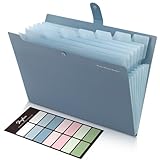
- Size: 13 x 10 x 0.7 inches. Fits A4 and letter-size paper, standard documents and filing needs.
- User-Friendly Features: Included sticker labels allow you to easily distinguish between different categories of files, maintaining neatness and enhancing productivity!
- Sleek and Portable: Designed to slip seamlessly into backpacks, laptop bags, or file cabinets, our lightweight folder keeps your documents tidy and accessible wherever you go.
- Built to Last: Crafted from polypropylene, our folders resist tears and deformation while remaining flexible. The secure snap closure offers easy access while keeping your papers securely in place.
- Versatile Utility: This folder isn't limited to organizing course papers for college students; it's perfect for storing business tax documents, recipes, important receipts, and more!
Product prices and availability are accurate as of the date/time indicated and are subject to change. Any price and availability information displayed on Amazon at the time of purchase will apply.




