The Tool Desk
Outbyte Driver Updater FREEScan for outdated or missing drivers - takes under a minuteDriver Scan →Outbyte PC Repair FREEClear out junk files and repair common Windows errorsFree Scan →TTI’s FCT portfolio is a range of D-Sub connectors and related contacts, backshells, accessories, and tooling—not a stock-market product. The phrase “TTI stocks FCT product portfolio” comes from a February 20, 2018 announcement that TTI made FCT products available in Europe. TTI’s current catalog presents many of these products under Molex FCT or FCT Electronics branding, and availability must be checked for each part number.
What the 2018 TTI announcement covered
The February 20, 2018 EE Times announcement said TTI was distributing FCT products in Europe. It described a portfolio of connectors, contacts, hoods, tools, and customized solutions, with D-Sub connectors at its center. It also described FCT in connection with Molex. That is a historical distribution announcement, not evidence that every part is currently stocked in every region.
The announcement cited steel, brass/non-magnetic, and stainless-steel connector constructions; multiple platings; solder-cup, straight and right-angle PCB, and wire-wrap terminations; FRP insulation; and shielded pin connectors. It said the described FRP insulation tolerated 260°C for up to 10 seconds. Treat that temperature statement as historical product information, not a universal rating: confirm the current datasheet for the specific connector before using it in a soldering process.
How the current portfolio is organized
TTI’s FCT resources and Molex FCT D-Sub catalog group products by connector design and assembly function. The catalog includes D-Sub families, contacts, backshells, accessories, and tooling; exact options depend on the part family.
#1 Best Overall
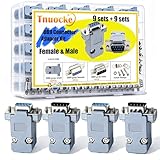
- Product Features: D-Sub 9 pins female normal density solder cup connectors tin plated housing + Light-Weight Gray Plastic Hoods individually bagged for each set of hood and srews
- High quality:Plug gold plating has good contact, wear resistance, corrosion resistance, oxidation resistance and rust resistance
- DB9 Connector:The surface of DB9 plastic shell is made of insulating material, which makes it safer to use
- Package:You will get 9 male connectors, 9 female connectors, 18 gray shells and their metal parts in a plastic box
- Wide use: it is widely used in all kinds of Electronic devices with DB9 connectors
| Category | What it is for | Key check |
|---|---|---|
| Standard-density D-Sub | Conventional D-Sub layouts with a range of shell and termination options. | Position count, envelope, termination, and current per contact. |
| High-density D-Sub | More contacts in a comparable connector envelope. | Contact spacing, electrical ratings, wire or PCB layout, and assembly method. |
| Mixed-layout D-Sub | A single connector body combining different contact types or circuit functions. | Exact layout and ratings for each contact position. |
| Waterproof D-Sub | Designated sealed variants, including cited IP67 families. | Whether the exact assembled interface and environment meet the requirement. |
| Non-magnetic D-Sub | Designated low-permeability products for magnetically sensitive settings. | Permeability requirement; this is not a substitute for an EMI-shielding specification. |
| High-performance D-Sub | Products using machined contacts for demanding electrical or mechanical needs. | Whether the load and durability requirements justify the selected design. |
| Contacts, backshells, accessories, and tools | Parts used to terminate, mount, protect, and assemble a connector system. | Compatibility with the connector, cable, contacts, and assembly process. |
What distinguishes the connector families
Standard density and high density
High-density connectors fit more contacts into a comparable envelope, but more positions do not automatically mean equivalent electrical capacity. TTI’s high-density family page describes solder-cup variants with current ratings from 3 A to 5 A and crimp variants from 3 A to 7.5 A. It gives a temperature range of −55°C to +130°C for cited through-hole versions and −55°C to +115°C for cited crimp versions. These are family-page ranges, not blanket ratings for every part; use the exact ordering code and datasheet.
Selection also depends on voltage, signal frequency, cable size, mechanical clearance, mating cycles, and termination. TTI’s high-density part search lets buyers review listings, but a category page does not replace part-level documentation.
Mixed-layout connectors
Mixed-layout designs place different contact types or functions in one connector body. Depending on the configuration, that can combine signal circuits with power, coaxial, high-voltage, or pneumatic connections. TTI describes standard and custom configurations and compatibility with standard backshells on its mixed-layout product page.
Rank #2

- 10 Sets Solder Cup DB9 Female + Plastic Hoods, 9 Pins D-Sub Connector & Hood Set, 20-Pack (10 DB9 Females + 10 Hoods)
- RS232 D-Sub 9 pins female normal density solder cup connectors tin plated housing + Light-Weight Gray Plastic Hoods individually bagged for each set of hood and srews
- 10 Standard DB9 female solder cup connectors and 10 of the grey plastic hoods with screws and accessories
- Maximum wire size is 20 AWG; UL94V-0 rated connector insulator
- Price is for 10 sets of DB9 female solder connectors and plastic hoods in Retail Box
That page lists a maximum current of 7.5 A, dielectric withstand of 50 kV/mm, insulation resistance of at least 5,000 MΩ, and an operating temperature range of −55°C to +150°C for the described mixed-layout products. These figures should not be assigned to every contact or configuration; check the specific layout and datasheet. Combining functions in one shell can simplify an interface, but it makes layout, electrical separation, and the rating of each contact especially important.
Recommended Free Tools
Waterproof variants
Water resistance is limited to designated products, not the entire FCT D-Sub range. TTI lists IP67 mixed-layout D-Sub connectors in different sizes, mating directions, pin/socket arrangements, and straight or right-angle signal-contact options. The high-density family page also describes IP67 variants, including front- and reverse-mating configurations.
An IP67 designation does not, by itself, establish suitability for salt spray, chemicals, UV exposure, vibration, every temperature, or every mating condition. Confirm the rating for the complete connector interface and the actual installation.
Rank #3

- Price is for 6 sets of DB25 male solder connectors and plastic hoods
- RS232 D-Sub 25 pins male normal density solder cup connectors tin plated housing + Light-Weight Gray Plastic Hoods individually bagged for each set of hood and srews
- 6 Sets Solder Cup DB25 male + Plastic Hoods, 25 Pins D-Sub Connector & Hood Set, 12-Pack (6 DB25 males + 6 Hoods)
- Maximum wire size is 20 AWG; UL94V-0 rated connector insulator
- 6 Standard DB25 male solder cup connectors and 6 of the grey plastic hoods with screws and accessories
Non-magnetic and high-performance versions
TTI describes selected non-magnetic FCT D-Sub products as having permeability μr ≤ 1.0025. That specification addresses magnetic permeability; it does not promise a particular shielding performance or immunity to electromagnetic interference. TTI says non-magnetic accessories may also be available on request.
For high-performance D-Sub products, TTI says machined contacts are intended to provide higher current capability, lower resistance, and greater durability than stamped contacts. That can matter in demanding applications, but machined contacts may be unnecessary for ordinary low-power signal connections. Choose against the electrical load, mating-cycle needs, and mechanical environment rather than assuming one construction is universally better.
Contacts, terminations, backshells, and tools
Choose a termination that fits the assembly
- Solder cup: For wire termination and custom harness work; assembly is typically more labor-intensive.
- Straight PCB or through-hole: For board mounting where the connector projects in line with the board layout.
- Right-angle PCB: For board layouts that require the mating or cable direction to run parallel to the board.
- Crimp: For repeatable harness assembly, provided the contact, wire, tooling, and validated crimp process match.
- Wire-wrap: For legacy or specialized interconnect systems where that termination remains appropriate.
TTI’s crimp-contact listings include D-Sub contacts and standard and MIL-type crimp-contact options for high-density connectors. Before ordering, match contact series, wire gauge, insulation diameter, tool or locator, strip length, crimp geometry, pull-force requirements, and inspection procedure.
Rank #4

- 4 Sets Crimp Type DB15 Male + Plastic Hoods + Pins , 15 Pins D-Sub Connector, Pins & Hood Kit: 4 DB15 Males + 4 Hoods + 60 Crimp Pins)
- RS232 D-Sub 15 pins male normal density crimp connectors tin plated housing, Pins + Gray Plastic Hoods individually bagged for each set of hood and srews
- Standard DB15 male crimp connectors and the grey plastic hoods with screws, accessories and pins Kit
- Maximum wire size is 20 AWG; UL94V-0 rated connector insulator
- Price is for 4 sets of DB15 male crimp connectors combo kit in Connectors Pro Retail Box
Match backshells and accessories to the assembly
The catalog includes plastic, rugged metal, specialty/non-magnetic, and IP67 backshell categories, along with accessories and tooling. A suitable hood or backshell can help with cable routing, strain relief, shielding, or protection, but compatibility depends on shell size, connector configuration, cable exit, and the intended environment. Check mounting and retention hardware, locking features, dust caps, and any EMI requirements as part of the complete assembly.
TTI’s Juwel backshell page describes cable outlets adjustable from straight to 45 degrees and a temperature range of −35°C to +100°C for that cited product family. Do not apply those figures to other backshells.
Select tooling with the contact
TTI describes FCT D-Sub crimp tools as manual tools with automatic processing locks and adjustable configurations for different wires; the page also describes eight-impression crimping. Tooling needs vary by contact and wire specification. Confirm the exact tool and application instructions before production or field assembly, rather than selecting a tool from connector family name alone.
Best Value

- 4 Sets Crimp Type DB15 Female + Plastic Hoods + Pins , 15 Pins D-Sub Connector, Pins & Hood Kit: 4 DB15 Females + 4 Hoods + 60 Crimp Pins)
- RS232 D-Sub 15 pins female normal density crimp connectors tin plated housing, Pins + Light-Weight Gray Plastic Hoods individually bagged for each set of hood and screws
- Standard DB15 female crimp connectors and the grey plastic hoods with screws, accessories and pins Kit
- Maximum wire size is 20 AWG; UL94V-0 rated connector insulator
- Price is for 4 sets of DB15 female crimp connectors combo kit in Connectors Pro Retail Box
A practical part-selection checklist
- Define the circuits: Record contact count, signal and power functions, voltage, current per contact, frequency, and any coaxial or specialized-contact needs.
- Choose the connector family: Decide whether standard density, high density, or a mixed layout fits the circuit and space requirements.
- Specify the mating arrangement: Confirm pin/socket configuration, shell size, mating direction, mounting, and any required locking hardware.
- Select the termination: Choose solder cup, straight or right-angle PCB, crimp, or wire-wrap based on the board or harness process.
- Set environmental requirements: Specify temperature, sealing, vibration, corrosion, shielding, magnetic permeability, and any required industry qualification.
- Complete the connector system: Check compatible contacts, backshell or hood, strain relief, accessories, and—where crimping is used—the correct tool and wire range.
- Verify compliance and documentation: Check the exact part’s datasheet and current listing for RoHS status, material, ratings, and any required qualification. A historical statement about plating is not proof of current compliance for every part.
- Check procurement details: Review live stock, price, minimum order quantity, order multiple, lead time, and regional availability for the exact manufacturer part number.
How to source through TTI today
Start with TTI’s FCT resources or its Molex/FCT product pages, then use the part search for the specific family or ordering code. Current listings may show stock, price, minimum quantities, order multiples, and compliance indicators. Those details can change and vary by region; a catalog listing is not a guarantee of immediate shipment.
Use the product catalog to understand the family, then open the individual part record and datasheet before committing it to a design or bill of materials. If a configuration is custom, unavailable online, or unclear from the listing, contact TTI about sourcing or technical support. Product pages and live search results should be treated as commercial information, not an independent qualification of suitability.
Where the product types may fit
- Industrial automation and robotics: High-density, mixed-layout, waterproof, or ruggedized options may suit compact or demanding interfaces, subject to system ratings.
- Aerospace and transportation: High-performance, ruggedized, or custom configurations may be relevant; confirm applicable qualification requirements for the exact part.
- Medical and instrumentation: Designated non-magnetic parts may be relevant where permeability matters, but shielding and system compatibility require separate review.
- Test and measurement: High-density, shielded, precision, or mixed-signal assemblies may help address space and circuit needs.
- Telecommunications: High-density and signal-oriented configurations may suit equipment interfaces after checking electrical and mechanical requirements.
These are application categories, not blanket certifications. TTI also lists aerospace, industrial automation, medical, railway, robotics, and test-and-measurement uses in connection with its crimp-tool offerings; that does not certify every connector or tool for those sectors.
When to compare another connector source
If a design is not yet fixed, or a supply plan needs a second source, compare exact compatible products from suppliers such as TE Connectivity, ITT Cannon, or Amphenol. Assess form-factor fit, contact and termination options, electrical and environmental ratings, tooling, qualification documents, customization, current inventory, lead time, and total installed cost. Do not assume an alternative is interchangeable based on the D-Sub label alone; confirm dimensions, pinout, mating interface, and system requirements.
Do these 3 things before closing this tab:
1Clear out junk files and repair common Windows errors2Fix the driver behind crashes, sound loss and screen glitches3Repair Windows errors before they cause bigger problemsQuick Recap
Product prices and availability are accurate as of the date/time indicated and are subject to change. Any price and availability information displayed on Amazon at the time of purchase will apply.




