Recycled polyester can reduce reliance on virgin fossil-based feedstock, but it is not automatically the better choice for every garment. Its impact depends on what was recycled, how the material was collected and processed, how long the clothing lasts, and what happens when it is washed and discarded. For shoppers, the useful questions are what the recycled-content claim covers, whether it is certified, and whether the garment suits its intended use for long enough to justify its cost.
What is recycled polyester made from?
Recycled polyester is polyester made using recovered material rather than only virgin fossil-based inputs. The label alone does not tell you the material’s origin. Recycled feedstock may come from pre-consumer or post-consumer sources; a recycled-content claim does not, by itself, mean the garment was made from discarded textiles.
Textile-to-textile recycling—turning discarded textile material into new fibre—is a developing part of the picture, not a mature, universally available closed loop. Textile Exchange’s 2025 market report describes chemical-recycling operations beginning commercial production while other companies remained in research and development. The reviewed information does not establish what share of recycled-polyester apparel feedstock currently comes from bottles versus discarded textiles, so a specific market-share figure should not be assumed.
What are the pros and cons?
Potential advantages
- Using recovered feedstock may reduce demand for virgin fossil-based inputs.
- Recycled-polyester production can make use of collected material that might otherwise become waste, depending on the feedstock and waste-management system.
- A specific recycled-content claim can be checked against chain-of-custody certification, giving shoppers more evidence than an unsubstantiated label alone.
Important limitations
- Recycled polyester remains a synthetic fibre. It can release microfibres during production, wearing, washing, and at end of life.
- “Recycled” does not identify the feedstock, the percentage in the garment, or the full impact of making and using it.
- Collection, sorting, transport, energy supply, and recycling technology all affect production impacts. Long-distance transport can matter for mechanical recycling; energy and process chemicals can matter for chemical recycling.
- A certified recycled-content claim is not proof that a garment has no environmental or social impacts.
Is recycled polyester better than regular polyester?
There is no single answer for every production system or finished garment. Textile Exchange published a polyester life-cycle assessment on June 11, 2026, comparing virgin polyester with thermomechanical and chemical recycling systems. The assessment covers resource extraction through pellet, chip, or staple-fibre production, depending on the pathway; it does not compare the full life of finished garments.
Do these 3 things before closing this tab:
1Clear out junk files and repair common Windows errors2Scan for outdated or missing drivers - takes under a minute3Repair Windows errors before they cause bigger problems#1 Best Overall

- REGULAR FIT: Straight fit through the shoulders, chest, and waist
- QUICK DRY PIQUE: Polyester pique offers textured surface and moisture-wicking for active comfort
- SPORT POLO SHIRT: Designed for golf and active wear
- DETAILS: Three-button placket, ribbed collar, moisture-wicking fabric, and side vents for mobility
| Production pathway | Hotspots identified by Textile Exchange | What the finding does—and does not—tell you |
|---|---|---|
| Virgin polyester | Petrochemical inputs contribute substantially to many impact categories. | Shows why feedstock matters; it is not a full garment-to-garment comparison. |
| Thermomechanical recycling | Electricity and feedstock collection, especially long-distance transport, are important hotspots. | Recycling does not remove the impact of collection, transport, or energy use. |
| Chemical recycling | Energy and process chemicals, including solvents such as methanol, are important hotspots. | Results need particular care because most chemical-polyester recyclers included in the assessment were at a pre-commercial stage. |
The assessment’s data collection ran from early 2022 through the end of 2024 for recycled-polyester producers, and from January through December 2022 for virgin-polyester producers. Although the report was published in 2026, its underlying producer data come from those earlier periods. Textile Exchange’s FAQ also explains that the assessment stops before fabric and garment production and consumer use. It excluded fibre shedding because there is not yet a common accepted methodology and calculation approach. The findings therefore illuminate production-stage trade-offs, not the total environmental impact of a particular item of clothing.
Does recycled polyester shed microplastics?
Yes. Recycled polyester is still synthetic, and synthetic textiles can release microfibres during production, wearing, washing, and end of life. The European Environment Agency (EEA) reports that synthetic fabrics tend to release the highest amounts in their first five to ten washes. Wastewater treatment can retain a large share of released microplastics, but not all; captured particles may also move into sewage sludge. Natural fibres can shed microfibres too, so changing fibre type alone does not guarantee zero shedding.
Rank #2

- QUICK-DRY COMFORT: Lightweight performance fabric wicks moisture and dries fast during gym workouts, treadmill runs and outdoor cardio, helping reduce the heavy, clingy feel of a sweat-soaked shirt
- BREATHABLE FOR WARM DAYS: A fine mesh-knit texture helps air move through the fabric, keeping the shirt light and comfortable through lifting, circuits, running and other high-sweat training
- EASY V-NECK COMFORT: A clean V-neck gives you a more open, comfortable feel, while soft 4-way stretch and short sleeves move easily through lifting, running and everyday training
- CLEAN ATHLETIC FIT: A regular cut gives you room to move without feeling baggy. The no-logo look and tear-away tag keep the shirt simple and comfortable from the gym to a run or post-workout errands
- BUILT FOR REPEAT WEAR: 100% recycled polyester is machine washable and made for regular training. Durable colorfast fabric helps the shirt hold up through frequent workouts, runs and weekly wash cycles
Practical ways to limit laundry-related shedding
- Follow the garment’s care label and avoid unnecessary washing where that is practical.
- Consider a washing-machine filter as one possible mitigation. The EEA reports that a cited study found a filter could reduce fibre release by up to 80%. That is a study’s reported maximum, not a guaranteed result for every filter, washer, fabric, or wash.
- Treat a filter as one part of the response: it does not address production impacts or what happens to textile waste at end of life.
How can you tell whether clothing really contains recycled polyester?
Start with the product’s stated recycled-content percentage and the material it says was recycled. “Made with recycled polyester” is less informative than a specific percentage paired with an explanation of the claim’s scope. If the garment carries a certification mark, check which standard applies and what that standard covers.
| Standard | What Textile Exchange says it covers | What to keep in mind |
|---|---|---|
| Recycled Claim Standard (RCS) | Recycled materials and chain of custody. | Certification supports the covered recycled-material claim; it is not a blanket assessment of the garment’s total impacts. |
| Global Recycled Standard (GRS) | Recycled materials and chain of custody, with additional social, environmental, and chemical-processing requirements. | Textile Exchange states a minimum of 50% recycled content for GRS. Certification bodies audit stages in the supply chain. |
Under these standards, recycled material may be pre-consumer or post-consumer. Certification is useful evidence about the claim and its chain of custody, but it does not necessarily tell you that the feedstock was textile waste or that every impact has been eliminated.
Rank #3

- MATERIAL: This earth day shirt made of breathable and stretchy fabric, it's super soft and comfortable to wear. The overall style is fashionable and casual.
- DESIGN: Show your love for Mother Earth with our Earth Day/Environmental themed T-shirt. With a striking eco-friendly design and a strong conservation message, they are a wearable reminder of our responsibility to protect the natural world.
- FEATURES: earth day shirt for women, environment day tshirt, environmental t-shirt, recycle top, save the planet shirts, climate change clothes, protect the environment tee top.
- DEAL GIFT: Give this gift to a special teacher or student, or anyone who is passionate about environmental awareness and animal conservation.
- OCCASION:On Earth Day, you can wear an environmentally themed T-shirt to remind people that they should take care of the environment and wear it in their daily life, such as school, home, holidays, etc.
Textile Exchange is transitioning its standards toward the Materials Matter Standard. The organization released the criteria on December 12, 2025, and says the standard becomes effective on December 31, 2026 and mandatory on December 31, 2027. As of October 2026, the effective date is approaching; check Textile Exchange’s current standards information for which requirements apply to a particular claim.
What should you weigh before buying?
For a personal-finance decision, consider the garment’s likely useful life alongside its material claim. A recycled-content label does not establish that an item will last longer, cost less to maintain, or be easier to repair. Compare the specific garment with the alternative you would actually buy rather than treating one fibre as universally superior.
Rank #4
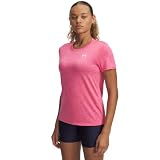
- Regular Fit: Classic, right-down-the-middle fit: not too tight, not too loose.
- UA Tech fabric is quick-drying, ultra-soft & has a more natural feel
- Material wicks sweat & dries really fast
- Main body fabric contains at least 30% recycled polyester, excluding trims & embellishments
- All-over twist effect
- Claim: Is the recycled-content percentage stated, and is the feedstock described?
- Verification: Does RCS or GRS certification apply to the claim, and what does it cover?
- Use: Does the fabric construction suit the garment’s purpose, and does the item seem durable enough for regular wear?
- Useful life: Can you repair it, reuse it, or pass it on if you stop wearing it?
- Care and end of life: Are the care instructions manageable, and is there a collection or recycling route available where you live?
If you are comparing prices, one practical way to frame value is cost per expected wear: divide the purchase price by the number of times you realistically expect to wear the item. This is a planning tool, not a guarantee of durability or a measure of environmental impact. A more detailed recycled-content claim can improve transparency, but it cannot substitute for judging whether the garment fits your needs and is likely to stay in use.
Independent reader supportYour contribution helps us test, update, and keep practical guides available for everyone.Bottom line
Recycled polyester can reduce dependence on virgin fossil-based feedstock, but “recycled” is not a complete verdict on a garment. Look for a clear percentage, understand the feedstock and certification, and weigh construction, expected useful life, care, repair, reuse, and end-of-life options. The material’s production pathway matters, and so does what happens after it becomes clothing.
What’s actually slowing this PC down?
Pick the symptom - the matching free tool is one click away.
Quick Recap
Best Value

- Crew neck. Short sleeves.
- Straight hem.
- Recycled Repreve Polyester
- 60% cotton, 40% recycled polyester. | Machine wash. | Imported.
Product prices and availability are accurate as of the date/time indicated and are subject to change. Any price and availability information displayed on Amazon at the time of purchase will apply.




