The Tool Desk
Outbyte Driver Updater FREEScan for outdated or missing drivers - takes under a minuteDriver Scan →Outbyte PC Repair FREEClear out junk files and repair common Windows errorsFree Scan →National oil stockpiles are emergency supplies intended to soften the economic shock of a sudden disruption—not a promise that a country can meet all oil demand from reserves for a fixed number of days. The International Energy Agency (IEA) requires its member countries to hold stocks equivalent to at least 90 days of net imports, using a defined calculation. Governments can release stocks or take other steps when a disruption threatens global markets. The U.S. Strategic Petroleum Reserve (SPR) is one example, with its own release and delivery constraints.
What is the role of the IEA in the event of a serious disruption to oil supply?
The IEA coordinates an emergency response among its member countries when a severe supply disruption is large enough to significantly affect global oil markets. It is not a global oil owner or a price-setting authority: its role is to assess the disruption and coordinate member action to reduce the economic effects of a sudden short-term shortage. The IEA says its emergency-response system is not intended for price intervention or long-term supply management. IEA emergency response
How the IEA decides whether to act
The IEA Secretariat assesses the likely market impact, including the estimated loss of supply, commercial inventories and spare production that can be brought online quickly. It consults producer governments and industry experts. If the disruption is sufficiently large, the Secretariat may recommend collective action. Member contributions are proportional to each country’s share of oil consumption among IEA members. IEA emergency response
What actions are available
Collective action can add supply, reduce demand, or do both. Options include releasing emergency stocks, demand restraint, switching fuels, activating spare crude production capacity available within 30 days, and temporarily relaxing fuel specifications. Which measures are used depends on the circumstances; an announcement that stocks will be made available does not by itself mean all the oil reaches buyers at once.
Recommended Free Tools
#1 Best Overall

- These are hobby grade products securely packed for protection in shipping
- Please handle with care when removing from package or breakage could occur
Where does the additional oil supply come from?
It can come from emergency stocks held by governments, agencies or industry, and from other measures that increase available supply or reduce consumption. The IEA’s 90-day obligation is flexible about how members organize qualifying stocks: a country may use a mix of crude oil and refined products and, under specific arrangements, stocks held abroad. IEA oil security and stocks
Who holds the stocks?
- Government stocks: oil held by the state for emergencies.
- Agency stocks: oil held by a separate body on behalf of government or industry.
- Industry stocks: oil held by companies, including commercial stocks that may count under the country’s applicable arrangements.
These categories describe who holds the inventory, not necessarily who can use it immediately. Physical location, contractual rights and release procedures also matter.
Rank #2

- A wide 575,000-gallon tank
- A stairway molded to fit the tank body
- Berm crossover stairways
- Realistic decals
- Modular retention berms which can be used to combine multiple tanks into a complete scene
Can stocks held abroad count?
In specified cases, yes. Bilateral arrangements may guarantee access to stocks in another country during a crisis. A related mechanism is a “ticket”: a contract reserves a stated quantity, quality and location of crude or products for a period, usually a calendar quarter, and gives the buyer an option to take delivery during a crisis. Ticketed oil is not necessarily physically owned or stored by the buyer in its own country. IEA oil security and stocks
What does the IEA’s 90-day requirement mean?
IEA member countries must hold emergency stocks equivalent to at least 90 days of net imports. The obligation applies to IEA members, not every country in the world; the IEA says net exporters are not required to hold this minimum. The benchmark is based on a member’s previous-calendar-year average daily net imports, rather than its total oil use. IEA oil stocks methodology
PC Slower Than It Used to Be?
A free scan shows the junk files, broken settings and background clutter dragging Windows down - then fixes them in one click.Free scan · Windows 10 & 11Crashes, No Sound, or Screen Glitches?
Random freezes, missing sound and display glitches usually trace back to one bad driver. Find and replace yours safely.Free scan · under a minuteRank #3

- New in manufacturer packaging.
- Realistic Detail.
- Robust materials.
- Original packaging.
- Scale Miniature for For Model Trains and Dioramas.
How days of net-import cover is calculated
The IEA defines days of net-import cover as counted emergency reserves divided by average daily net imports. Its calculation uses the previous calendar year’s adjusted imports of primary oil products and refined products, divided by the number of days in that year. Refined products are converted to crude-oil equivalent; naphtha and international marine bunkers are among the exclusions. For most members, the calculation also deducts a 4% naphtha yield. The IEA reduces counted reserves by 10% to account for stocks that are not available, such as tank bottoms. IEA oil stocks methodology
That ratio is not a guarantee that a country can supply all consumers for 90 days from a single reserve. It measures stocks against net imports under the IEA’s rules, not against total domestic consumption. A country’s reported cover can change as imports and inventories change; use the IEA monthly data tool for a country-specific figure and note its reporting date. The tool page was last updated 12 August 2026. IEA oil security data tool
Rank #4

- 【Durability】 Train Building Kit is crafted from pp, ensuring long term use and resistance to wear during frequent handling or display
- 【Versatile】Great for dioramas, sand table models, and train scene displays; the HO Scale Water Tank Kit is ideal for hobbyists and collectors alike
- 【Compact】Assembly Measuring 8cm in length, 4cm in width, and 7.5cm in height, the HO Scale Model Kit fits seamlessly into various model railway setups without taking up excessive space
- 【Realistic】Designed in HO scale 1:87, this miniature water tank model accurately replicates railway scene architecture for authentic train layouts
- 【Complete】Includes 1 miniature water tank model assembly per package, ready to integrate into your HO scale railway environment
What kind of emergency oil stockholding systems are there in IEA member countries?
Members have flexibility in how they meet the obligation, so a days-of-cover figure alone does not show exactly what a country can release or how quickly. For a meaningful comparison, consider the stock’s owner, form, location, legal access and delivery readiness alongside the dated cover figure. IEA oil security and stocks
- Ownership: government, a designated agency or industry.
- Form: crude oil, refined products or a combination.
- Location and access: domestic stocks, qualifying stocks abroad, or contractual ticketed access.
- Release readiness: the process to authorize release and the infrastructure needed to move oil to refiners and markets.
When has IEA collective action taken place?
On 11 March 2026, the IEA announced that its 32 member countries had unanimously agreed to make 400 million barrels of emergency oil stocks available to the market. The IEA described it as its sixth collective action and largest to date. Its announcement said member emergency stockpiles exceeded 1.2 billion barrels, with a further 600 million barrels of industry stocks held under government obligation. These are figures in the announcement, not a live inventory reading. IEA announcement, 11 March 2026
Best Value
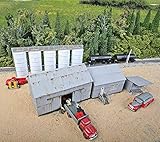
- Narrow design fits easily between or along tracks - perfect for shelf layout
- Separate office and warehouse buildings
- Parts for five tanks, plus piping and other details
- Printed signs
- Molded in 5 colors and clear plastic
The announcement connected the action to disruption around the Strait of Hormuz. The IEA said an average of 20 million barrels per day of crude oil and products transited the Strait in 2025—around 25% of world seaborne oil trade—and that, at the time of the 11 March 2026 announcement, conflict that began on 28 February had reduced crude and product export volumes through the Strait to less than 10% of pre-conflict levels. These describe the IEA’s dated account at that time, not current flows. IEA announcement, 11 March 2026
Independent reader supportYour contribution helps us test, update, and keep practical guides available for everyone.How does the U.S. Strategic Petroleum Reserve work?
The U.S. SPR is a federally managed system of four sites along the Gulf Coasts of Texas and Louisiana. It stores crude oil in deep underground salt caverns, near marine terminals, pipelines and Gulf Coast refineries. It is one national example—not the source or measure of the IEA-wide 90-day obligation. U.S. Department of Energy SPR overview
Inventory and authorized capacity
| Measure | Figure | Date and qualification |
|---|---|---|
| SPR inventory | 294.1 million barrels | Across four sites as of 20 August 2026; a dated snapshot, not a live inventory value. |
| Authorized storage capacity | 714 million barrels | DOE figure on its page accessed 7 October 2026. |
| Earlier inventory and import-cover estimate | 411 million barrels; approximately 125 days | DOE says this was the inventory on 31 December 2025 and its equivalent in U.S. crude-oil net imports under DOE’s calculation. |
How fast can oil be released from the Reserve?
DOE lists a maximum nominal drawdown capability of 4.4 million barrels per day, but says oil can enter the U.S. market 13 days after a presidential decision. DOE must conduct a competitive sale and award contracts. The maximum drawdown rate can be sustained for up to 90 days before declining as the caverns empty. These are release and delivery constraints—not a measure of how fast gasoline appears at a pump. DOE SPR Quick Facts DOE SPR FAQ
What type of crude oil is stored in the Reserve?
The SPR stores crude oil classified as sweet or sour, not finished gasoline. Crude must be sold, delivered to refineries, processed and distributed before it becomes consumer fuel. The Gulf Coast location puts the reserve near refining and transport infrastructure, but it does not remove those steps. DOE SPR FAQ
What’s actually slowing this PC down?
Pick the symptom - the matching free tool is one click away.
Quick Recap
Product prices and availability are accurate as of the date/time indicated and are subject to change. Any price and availability information displayed on Amazon at the time of purchase will apply.




