Intel forecast more than $500 million in AI accelerator revenue in the second half of 2024, a target tied to its Gaudi business. By October, the company said it would not reach its $500 million Gaudi revenue target for the year. The original figure was guidance, not a report of sales earned.
What Intel forecast—and what happened
On its April 25, 2024 earnings call, Intel said it expected over $500 million in accelerator revenue in the second half of 2024, with momentum increasing into 2025. The figure was a forecast for the latter half of the year, not a full-year sales result. Intel’s Q1 2024 earnings-call comments describe the expectation.
| # | Preview | Product | Price | |
|---|---|---|---|---|
| 1 |
|
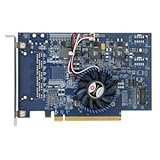
Intel QuickAssist CPIC-8955 Cryptographic Accelerator Card | $199.00 | Buy on Amazon |
Intel later revised the outlook. On its October 31, 2024 Q3 earnings call, the company said it would not achieve its $500 million Gaudi revenue target for 2024. Intel’s Q3 2024 earnings-call transcript records that update. The official statements cited here do not establish the amount of Gaudi 3 revenue Intel ultimately earned, so the forecast should not be described as achieved sales.
What Gaudi 3 is and how it is sold
Gaudi 3 is Intel data-center hardware designed to accelerate AI model training and inference. Intel introduced it in April 2024, initially describing OEM systems in Universal Baseboard and open accelerator module configurations, with availability expected to begin in the second quarter. The company announced its commercial launch in September 2024. Its Gaudi product page also lists a PCIe Gen5 accelerator card, model HL-338, and a 32-node cluster reference design.
Do these 3 things before closing this tab:
1Clear out junk files and repair common Windows errors2Scan for outdated or missing drivers - takes under a minute3Repair Windows errors before they cause bigger problems#1 Best Overall
- Uses QuickAssist technology to provide up to 50Gbps of hardware acceleration
- Designed for easy drop-in implementation in new and existing equipment
- Makes establishing connections to web services hosted on NGINX lightning fast
- Helps maximize storage space and improves the performance of transmitting data
- Ideally suited for PCIe coprocessor-based IPsec or TLS security applications such as SSL, OpenSSL*, and NGINX
Intel named Dell Technologies, Hewlett Packard Enterprise, Lenovo and Supermicro as Gaudi 3 OEMs. In May 2025, Intel said Gaudi 3 was available through Dell AI Factory. That announcement confirms a sales route, not current stock or availability in every configuration. Intel’s May 2025 announcement describes the Dell availability.
This is specialized enterprise equipment, not a consumer add-on. A prospective buyer generally needs a compatible server or complete system. Intel’s product page lists IBM Cloud and Denvr Dataworks as cloud options, but that listing alone does not confirm a Gaudi 3 instance is currently offered in a particular region. Buyers should verify configuration, regional availability and procurement terms with the provider or OEM.
Independent reader supportYour contribution helps us test, update, and keep practical guides available for everyone.How to interpret Intel’s performance comparisons
Performance figures in Intel’s launch materials are vendor claims, not independent test results. In April 2024, Intel said Gaudi 3 offered four times the BF16 AI compute, 1.5 times the memory bandwidth and twice the networking bandwidth of Gaudi 2. In September, Intel claimed up to 20% more throughput and twice the price/performance of Nvidia H100 for Llama 2 70B inference. The latter comparison is specifically about that workload and model; it should not be generalized to other AI applications or to overall system cost. See Intel’s April launch announcement and September launch announcement.
For a purchasing decision, compare the systems under the workload you intend to run. Relevant factors include:
- Support for the model, framework and software stack you use.
- Performance at the precision, batch size and system configuration relevant to your workload.
- Memory capacity and bandwidth, plus the accelerator interconnect and network topology.
- Power, cooling and infrastructure requirements.
- Migration effort, system availability and total cost of ownership.
The cited launch materials do not provide a neutral, apples-to-apples comparison across all of these factors. A headline throughput or price/performance figure is therefore a starting point for evaluation, not a substitute for checking results on a comparable system and workload.
What the $500 million figure means for investors
The forecast signaled Intel’s ambition to build an AI accelerator business, but the subsequent miss means it cannot be used as evidence that Gaudi had already become a $500 million business in 2024. Intel’s 2024 Form 10-K is a separate annual filing; the cited evidence does not establish a specific realized Gaudi 3 revenue total. Investors should distinguish the April forecast, the October revision and any separately reported financial results.
For a buyer, the same distinction matters in a different way: a revenue target does not establish product inventory, a delivery date, or cloud-instance availability. Confirm those details directly with an OEM or cloud provider before planning a deployment.
Quick Recap
Product prices and availability are accurate as of the date/time indicated and are subject to change. Any price and availability information displayed on Amazon at the time of purchase will apply.
What’s actually slowing this PC down?
Pick the symptom - the matching free tool is one click away.




