Choose a hard drive that your storage system explicitly supports and that matches the workload—not simply the drive with the most terabytes or the lowest sticker price. Compare usable capacity, compatibility, workload rating, operating costs, warranty and recovery requirements. For backups, keep separate copies, include an offsite copy when appropriate, and protect removable drives from ongoing exposure; a single drive or RAID array is not a complete backup plan.
Start with the data you need to store
Estimate current data and expected growth, then account for retention, snapshots or versions, redundancy overhead, spare capacity and reserve space. The result should be a target for usable capacity, not just the sum of the drive labels.
As an Amazon Associate I earn from qualifying purchases.
Raw capacity is reduced by choices such as RAID or erasure coding, filesystem overhead, hot spares and space reserved for growth or operations. The amount to buy therefore depends on your retention and availability requirements; there is no universal multiplier that fits every deployment.
Match the drive to the workload
Distinguish among sequential archive or backup writes, random access, sustained multi-user service and mixed workloads. Seagate identifies dense RAID or erasure-coded storage, enterprise backup and restore, large distributed file systems, high-bay-count NAS and archiving as Exos use cases. Those are manufacturer-stated applications, not proof that every Exos model suits every system or workload (Seagate Exos product information).
#1 Best Overall

- High-capacity add-on storage.Specific uses: Business, personal
- Fast data transfers
- Plug-and-play ready for Windows PCs
- WD quality inside and out
Verify exact system compatibility
Check the exact model against the server, NAS, controller and enclosure documentation before comparing prices. Drives of the same capacity are not automatically interchangeable: interface, sector format, recording technology, firmware, backplane and operating-system support can differ. Also check cooling and the system’s supported maximum drive capacity.
- Confirm the supported interface, such as SATA or SAS, and the exact model’s sector format.
- Check the controller, firmware, backplane and operating-system or NAS compatibility list.
- Verify that the enclosure can cool the drive under the intended workload.
- Confirm that the model’s capacity and recording method are supported.
- Check warranty coverage and support terms for your region.
For example, Seagate’s support listing names the EXOS 32TB model ST32000NM004K and lists a five-year limited warranty. Seagate’s 2025 family data sheet states capacity of up to 32TB in a 3.5-inch form factor; that is a family-level maximum, not a claim that every Exos model or configuration has that capacity (Seagate Exos support listing; 2025 Exos data sheet). Treat it as an example to investigate, not a universal recommendation.
Compare the cost of a usable deployment
Sticker price per raw terabyte can obscure the cost of getting supported, recoverable storage into service. Compare cost per usable terabyte and per supported bay, then include the costs that vary with the deployment.
Rank #2

- Massive capacity, up to 22TB capacity. (1TB = one trillion bytes. Actual user capacity may be less depending on operating environment.).Specific uses: Personal
- Includes software for device management and backup with password protection (Download and installation required. Terms and conditions apply. User account registration may be required.)
- 256-bit AES hardware encryption
- SuperSpeed USB (5 Gbps); USB 2.0 compatible
- Trusted storage built with WD reliability
- Drive purchase price and the usable capacity after redundancy and overhead.
- Power and cooling for the expected operating pattern.
- Bay count, rack space, and any required controller or enclosure upgrades.
- Warranty, support and the logistics of keeping and replacing drives.
- Restore time and the operational cost of recovering data.
Seagate markets high areal density as a way to increase capacity within a standard 3.5-inch footprint. Whether that improves your economics depends on supported bay density, actual system measurements and purchase quotes—not the capacity claim alone (Seagate Exos product information).
Read reliability figures as inputs, not guarantees
Workload ratings, warranty terms and field-failure statistics answer different questions. Use them alongside monitoring and a replacement policy; none makes a deployment failure-proof.
Western Digital lists the Ultrastar DC HC690 at up to 32TB, with a 550TB/year workload rating, up to 2.5 million hours MTBF and a five-year limited warranty (WD Ultrastar DC HC690 specifications). These are manufacturer specifications. MTBF is a rated reliability measure, not a prediction that an individual drive will last that many hours, and a warranty is not a guarantee of uninterrupted operation.
Rank #3
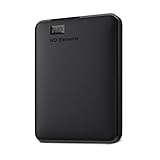
- World’s First 6TB 2.5” Portable Hard Drive
- Plug-and-play expandability
- Vast capacities up to 6TB[1] to store your photos, videos, music, important documents and more
- SuperSpeed USB 3.2 Gen 1 (5Gbps)
Backblaze reported a 1.36% annualized failure rate for 2025 across 344,196 qualifying drives and 30 models in its fleet (Backblaze 2025 Drive Stats). This describes the drives that met the report’s criteria in Backblaze’s operating environment. It is useful fleet context, not a forecast for a particular model in your system.
Do not confuse that annual figure with Backblaze’s earlier lifetime measure: its Q1 2025 report said the fleet’s overall lifetime AFR was 1.31% as of that quarter (Backblaze Q1 2025 Drive Stats). Annual and lifetime rates cover different periods and should not be compared as though they were the same statistic.
Independent reader supportYour contribution helps us test, update, and keep practical guides available for everyone.Build a backup plan around recovery
Redundancy can help a system stay available when a drive fails, but an array is not a separate backup. Keep backup copies distinct from primary data, and consider an offsite copy for risks that can affect the primary site as well as its local backups. Define how much data loss is acceptable (recovery point) and how quickly service must return (recovery time); those targets determine how often to back up and how to design restoration.
Rank #4
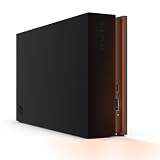
- MASSIVE SPACE Up to 8TB of capacity builds the ultimate gaming library without sacrificing titles
- LIGHT IT UP Create an epic gaming atmosphere with customizable RGB LED lighting
- BILLIANT DESIGN A bold and refined design, crafted to compliment gaming battlestations
- DUAL FRONT-FACING PORTS Connect and power your peripherals with front-facing USB-C and USB-A ports
- WARRANTY Enjoy peace of mind with the included Rescue Data Recovery Services and 1-year limited warranty
Protect removable HDD copies
CISA recommends disconnecting removable media after a backup and securing it physically. A drive left continuously connected remains exposed to events that can affect the primary system. CISA also notes that rolling backups may carry corruption or malware forward, so preserving versions and checking restores matter (CISA Ransomware Guide).
Use an offsite copy for a separate failure domain
An offsite copy can help when a local event affects both primary storage and nearby backup media. Backblaze describes a 3-2-1 arrangement that includes an external drive and online backup as one example (Backblaze’s explanation of the 3-2-1 backup strategy). Backblaze sells backup and storage products, so treat its description as an example rather than an independent endorsement of a particular service.
Free tools Windows power users keep installed
One-click scans. No signup required.
Quick Recap
Make restoration part of the design
- Monitor backup jobs and investigate failures instead of assuming a scheduled job completed.
- Protect access credentials and encryption keys so they remain available during recovery.
- Keep appropriate versions so corruption or malware is not simply copied into every retained copy.
- Periodically restore representative files or systems and confirm that the recovered data is usable.
Use a purchase checklist
- Size the usable target: calculate data, growth, retention and reserve space, then subtract redundancy and overhead.
- Classify the workload: decide whether the drive will mostly serve sequential backups or archives, random access, sustained multi-user use or a mix.
- Verify the exact model: check capacity, interface, sector format, recording method, firmware and system qualification against your actual hardware and software.
- Compare deployment cost: weigh cost per usable terabyte and supported bay alongside power, cooling, space, support and replacement logistics.
- Plan recovery: define recovery time and point needs, choose separate copies and any required offsite or disconnected copy, then test a restore.
Product prices and availability are accurate as of the date/time indicated and are subject to change. Any price and availability information displayed on Amazon at the time of purchase will apply.




