Recommended Free Tools
For U.S. federal income tax, ordinary dividends are generally taxed as ordinary income. Qualified dividends are a subset of ordinary dividends that may receive lower 0%, 15%, or 20% federal rates if they meet IRS eligibility and holding-period rules. Which rate applies depends on your taxable income and filing status—not just the size of the dividend.
Tax year 2024 covers income earned during 2024 and generally reported on a return filed in 2025. Tax year 2025 covers income earned during 2025 and generally reported on a return filed in 2026. The tables below show the federal qualified-dividend thresholds for both years.


How are dividends taxed?
Most taxable corporate and mutual-fund distributions paid from earnings and profits are ordinary dividends unless the payer identifies a different category. Ordinary dividends are taxed under the progressive ordinary-income tax rates. Qualified dividends are reported as ordinary dividends too, but eligible amounts may receive the preferential federal rates used for net capital gain.
These rates apply through the federal income-tax calculation, which considers taxable income, filing status, deductions, and other income. A threshold is not a tax bill, and it does not mean every dollar of a dividend is taxed at one rate. Use the IRS Form 1040 instructions and Qualified Dividends and Capital Gain Tax Worksheet for your full return; some taxpayers must use the Schedule D Tax Worksheet instead.
#1 Best Overall
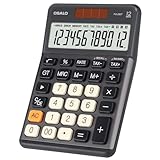
- 【Advanced Tax & Business Functions】Quickly set tax rates with dedicated TAX+/- keys and simplify budgeting via GT, MU, and memory keys (MRC/M+/M-). These tools enable seamless tax calculations and customizable rate settings for precise, tailored results—ideal for accountants, business owners, and professionals requiring accurate tax computations.
- 【Visualized Operation Symbol Display】When you would like to calculate the number, it will express the symbol (plus, subtract, multiply, or divide) on the screen. It can help you see the operation steps when you operate continuously.
- 【Efficient Dual Power System】The calculator uses high conversion rate solar panels, and solar power can be used in well-lit areas. At the same time, we provide a matching battery double safe uninterruptible power supply. The calculator will shut down automatically after 8 minutes without operation.
- 【Small Size, Large Display & Premium Build】It features a large LCD display with a 30° angled screen for clear visibility, paired with a high-grade metal panel and durable ABS buttons. The ergonomic button curvature aligns with natural finger movements, reducing errors and enhancing efficiency.
- 【Durable Construction and Portability】 Made of high-grade metal panel and durable ABS buttons, this 12-digit calculator is lightweight yet durable, capable of withstanding multiple impacts from desktop height. The large, clear LCD Display offers crisp, easy-to-read numbers, minimizing eye strain and ensuring professional-grade performance whether at home, in the office, or while traveling.
Qualified dividend tax rates for 2024 and 2025
The following are federal taxable-income thresholds for the 0% and 15% qualified-dividend rates. The 20% rate applies to the portion of taxable income above the 15% ceiling. The IRS adjusts these thresholds by tax year.
| Filing status | Tax year | 0% rate through taxable income | 15% rate above 0% threshold through | 20% rate above |
|---|---|---|---|---|
| Single | 2024 | $47,025 | $518,900 | $518,900 |
| Married filing jointly or qualifying surviving spouse | 2024 | $94,050 | $583,750 | $583,750 |
| Married filing separately | 2024 | $47,025 | $291,850 | $291,850 |
| Head of household | 2024 | $63,000 | $551,350 | $551,350 |
| Single | 2025 | $48,350 | $533,400 | $533,400 |
| Married filing jointly or qualifying surviving spouse | 2025 | $96,700 | $600,050 | $600,050 |
| Married filing separately | 2025 | $48,350 | $300,000 | $300,000 |
| Head of household | 2025 | $64,750 | $566,700 | $566,700 |
Thresholds are from the IRS’s Topic No. 409, Capital Gains and Losses for 2025 and Revenue Procedure 2023-34 for 2024. The 0% rate applies only to qualified dividends falling within the applicable taxable-income band; it is not a general exemption for dividend income.
What makes a dividend qualified?
A dividend must meet requirements about the issuer, the type of payment, and how long you held the shares. A payer’s designation on Form 1099-DIV is useful, but it does not guarantee that every amount qualifies for the preferential rate if an exception applies.
Issuer and payment type
The dividend generally must come from a U.S. corporation or a qualified foreign corporation. Some distributions are excluded from qualified-dividend treatment, so check the payer’s tax statement and IRS guidance rather than assuming that every corporate distribution qualifies.
Holding period
For ordinary common stock, you generally must hold the shares for more than 60 days during the 121-day period that begins 60 days before the ex-dividend date. The ex-dividend date is the first date a buyer is not entitled to the next declared dividend. Certain preferred stock with dividend periods totaling more than 366 days has a stricter test: more than 90 days during a 181-day period.
The IRS discusses these requirements and exceptions in Publication 550, Investment Income and Expenses. The Form 1040 instructions also note that reported qualified dividends may need adjustment, including in cases involving nominee dividends or shares held for too short a period.
Rank #3
How to report dividend income
- Check Form 1099-DIV. Box 1a generally reports total ordinary dividends. Box 1b reports the portion identified as qualified dividends.
- Enter the amounts on Form 1040 or 1040-SR. Report qualified dividends on line 3a and ordinary dividends on line 3b. The qualified amount is included in the ordinary-dividend total; it is not an extra amount to add again.
- Report taxable dividends even without a form. The IRS says taxable dividend income must still be reported even if you do not receive Form 1099-DIV.
- Use the applicable tax worksheet. Complete the Qualified Dividends and Capital Gain Tax Worksheet in the Form 1040 instructions, or the Schedule D Tax Worksheet when applicable, to calculate the tax using your full return details.
For definitions and reporting guidance, see IRS Publication 550 and the Form 1040 instructions.
Independent reader supportYour contribution helps us test, update, and keep practical guides available for everyone.Distributions that are not ordinary or qualified dividends
Form 1099-DIV may report other kinds of distributions, which do not automatically follow the ordinary- or qualified-dividend rules.
The Tool Desk
Outbyte Driver Updater FREEScan for outdated or missing drivers - takes under a minuteDriver Scan →Outbyte PC Repair FREEClear out junk files and repair common Windows errorsFree Scan →- Capital-gain distributions: These have separate tax treatment. Follow the instructions for the relevant Form 1099-DIV box and your tax return.
- Nondividend distributions: Often called return of capital, these generally reduce your basis in the stock rather than being taxed immediately. Once your basis reaches zero, additional amounts are generally treated as capital gain.
See the specific box instructions and Publication 550 before treating a distribution as dividend income.
Rank #4

- PROTECTIVE HINGED COVER: Features a hinged, hard cover that protects the keys and display when stored, making this handheld calculator durable and easy to carry safely.
- DUAL-POWER SOURCE: Runs on solar energy with a battery backup, ensuring consistent and reliable use in any lighting condition or environment.
- LCD SCREEN SIZE: The 2-inch screen size, 8-digit LCD screen clearly shows each digit, helping to prevent reading errors and making numbers easy to read at a glance.
- CONVENIENT FUNCTION KEYS: Includes a 3-key independent memory, square root key, change sign key, automatic power down, and more to provide efficient, reliable everyday math.
- TRUSTED BY WORKPLACES FOR DECADES: Sharp has been a dependable name in office calculation for generations — practical tools built around the way people actually work.
Can the 3.8% Net Investment Income Tax apply?
Possibly. The federal Net Investment Income Tax (NIIT) is 3.8% and may apply to dividends and other investment income when modified adjusted gross income exceeds the applicable threshold. The thresholds are $200,000 for single or head-of-household filers, $250,000 for married filing jointly or qualifying surviving spouses, and $125,000 for married filing separately. In general, NIIT applies to the smaller of net investment income or modified AGI above the threshold. It is separate from the qualified-dividend 0%, 15%, or 20% rate calculation. See IRS Topic No. 559, Net Investment Income Tax.
What these federal rates do not tell you
The tables cover U.S. federal individual income-tax thresholds. State and local treatment varies by jurisdiction, and the federal figures alone cannot determine your total liability. Your result also depends on your filing status, taxable income, other income, deductions, and any applicable special rules. The IRS’s Topic No. 409 and current Form 1040 instructions are the appropriate starting points for the federal calculation.
Quick Recap
Product prices and availability are accurate as of the date/time indicated and are subject to change. Any price and availability information displayed on Amazon at the time of purchase will apply.
Quick wins for a faster PC:
Repair Windows errors before they cause bigger problemsFix Now →Fix the driver behind crashes, sound loss and screen glitchesFind Drivers →Clear out junk files and repair common Windows errorsFree Scan →



