Free tools Windows power users keep installed
One-click scans. No signup required.
There was no single best small-business server in 2024: the right choice depended on whether you needed Windows or Linux applications, or mainly shared files and backups. TechRadar named the Dell PowerEdge T30 its overall pick in an August 21, 2024 roundup, but it is now an older platform. For a business buying in 2026, treat that selection as a historical pick—not an automatic recommendation. If you need file sharing, backup, and collaboration, a business NAS may be the better value; if you need Windows Server roles or production virtual machines, choose a supported traditional server.
Choose the right kind of server first
“Server” can mean a full computer designed to run business applications, a storage appliance, or a hosted service. Those options overlap, but they are not interchangeable. Match the purchase to the workload before comparing models.
Traditional server
Dell PowerEdge, HPE ProLiant, and Lenovo ThinkSystem systems are designed to run Windows Server or Linux and can support services such as Active Directory, DNS, file and print sharing, databases, line-of-business software, and virtualization. Depending on the model and configuration, they may include ECC memory, RAID, hot-swap storage, redundant power, hardware monitoring, and remote management. These capabilities make them a better fit when an application vendor requires a particular operating system or when several workloads must run on one machine.
NAS appliance
A business NAS from Synology, QNAP, Buffalo, or another vendor focuses on shared folders, backup targets, snapshots, user permissions, remote access, and cloud synchronization. Selected models also support containers or lightweight virtual machines. They can be simpler and less expensive to operate for storage-centered needs, but they are not substitutes for every Windows Server role or production application stack.
Recommended Free Tools
#1 Best Overall

- MODEL P74439-005: Compact and affordable HPE ProLiant MicroServer Gen11 powered by Intel Pentium Gold G7400 3.7GHz processor, ideal for file sharing, NAS, and basic business workloads
- READY OUT OF THE BOX: Includes 16GB DDR5 UDIMM memory (expandable to 128GB), one 1TB SATA 6G Business Critical HDD, embedded Intel VROC SATA, dedicated iLO-M.2 port kit, 180w external power adapter and 1/1/1 warranty for dependable plug-and-play server operation
- WHISPER-QUIET & SPACE-SAVING: Ultra-compact mini tower design fits easily in small office spaces; supports wall, flat, or vertical placement for deployment flexibility
- INTEGRATED REMOTE MANAGEMENT: Comes with HPE iLO 6 and embedded TPM 2.0 for secure, license-free remote server administration through shared port access
- EXPANDABLE DESIGN: Two PCIe slots (including PCIe 5.0) and four LFF-NHP drive bays provide robust options for storage and component scalability. Features new MR408i-p controller support for enhanced storage performance
QNAP’s four-bay TS-464 illustrates the category: its product page lists dual 2.5GbE, snapshots, containers, and Virtualization Station. QNAP also reports up to 589MB/s in a particular RAID 5 and port-trunking test setup; that vendor result is configuration-specific, not a promise of ordinary office transfer speeds. See QNAP’s TS-464 specifications and test conditions.
Cloud or hosted service
Microsoft 365 or Google Workspace may cover files and collaboration; hosted accounting or ERP software may remove the need to run an application locally. Cloud backup, virtual private servers, or managed infrastructure are other alternatives. If your tools are already SaaS and you lack someone to patch and recover hardware, buying an on-premises server may add cost without solving a real problem.
2024 picks and their 2026 buying context
TechRadar’s August 21, 2024 roundup named the Dell PowerEdge T30 its overall small-business server pick. The roundup is useful as a snapshot of 2024 recommendations, not as a current catalog: older models can have expired warranties, limited firmware support, and scarce replacement parts. Read TechRadar’s 2024 roundup and model details.
| Model or category | Best fit | What is established | 2026 buying caution |
|---|---|---|---|
| Dell PowerEdge T30 | Historical 2024 general-purpose tower pick | TechRadar listed a quad-core Xeon E3-1225 v5, up to 64GB memory, and support for up to six SATA hard drives. | Old platform; the roundup notes a single Gigabit Ethernet port and no hot-swappable disks. Check support, firmware, warranty, parts, and condition before considering used or residual stock. |
| Dell PowerEdge T20 | Historical budget hardware for technically capable buyers | TechRadar described a barebones unit with a Pentium G3220, 4GB RAM, four SATA ports, and one Gigabit Ethernet port; drives and operating system were not included. | Not a sensible default for a new business deployment. Performance and lifecycle support are limited; verify exactly what a used listing includes. |
| Lenovo ThinkServer TS150 | Historical affordable tower option | TechRadar listed up to 64GB RAM, up to 40TB hard-drive capacity, onboard RAID 0/1/5/10, and a claimed 26dB acoustic level. | Verify listing condition, regional availability, support, and configuration. The claimed noise figure is not a guarantee for every build. |
| HPE ProLiant ML350 Gen10 | Expansion and multiple on-premises workloads | TechRadar described support for Intel Xeon Scalable processors, up to two processors, broad storage options, and tower-to-rack deployment flexibility. | Larger and more costly than a file-sharing office needs; advertised configurations may exclude drives. |
| Business NAS | Files, backup, snapshots, and collaboration | Compare Synology, QNAP, Buffalo, and Western Digital by workload and feature set; a 2024 comparison covers these small-business NAS options. | Not a drop-in replacement for a certified Windows application, demanding database, or several production VMs. See the 2024 NAS comparison. |
Best traditional server for the 2024 comparison: Dell PowerEdge T30
The T30’s appeal in 2024 was a compact tower format and capacity for multiple internal disks. Its Xeon E3-1225 v5 and listed memory ceiling describe that specific older platform, not a current-generation performance standard. The single Gigabit port and lack of hot-swap disks also matter: disk replacement may require downtime, and the network interface may constrain large transfers.
In 2026, only consider one if the price, condition, workload, and support situation make sense. Confirm the warranty status, firmware availability, included drive trays, controller and drive health, power consumption, and whether security updates will cover the period you plan to use it. A low purchase price does not offset a failed component or unsupported system if the business cannot recover quickly.
Budget historical option: Dell PowerEdge T20
The T20 is a used-hardware proposition, not a ready-to-run server. Its cited configuration included only 4GB of RAM and no drives or operating system. A buyer would need to source compatible parts, install and license software, and accept the risks of an older platform. It is appropriate only for someone comfortable with those tasks and with a noncritical workload—not as the default choice for a business that depends on reliable access to its systems.
Expansion choice: HPE ProLiant ML350 Gen10
The ML350 Gen10 is a stronger historical candidate when expansion, multiple processors, storage options, or several workloads justify a larger enterprise-oriented system. It is a poor value for simple file sharing: chassis size, operating costs, configuration complexity, and the possibility that drives are excluded can all raise the real cost beyond the headline hardware price.
Rank #2
- 2.80 GHz processor speed ensures efficient operation with consistent reliability
- Intel Xeon 2.80 GHz processor provides enterprise-grade performance with built-in security and remote management capabilities
- Quad-core (4 Core) processor core helps server process data quickly and reliably for maximum productivity
- 1 processors supported for faster processing and improved access to data, optimizing performance under heavy loads
- With 16 GB memory, you can multitask between applications seamlessly, keeping productivity high and response times quick
Best fit for files and backups: a business NAS
If the primary jobs are shared folders, endpoint backups, snapshots, and collaboration, compare NAS appliances rather than ranking them against tower servers on CPU alone. The 2024 comparison from TechTarget considers Buffalo, QNAP, Synology, and Western Digital options. Synology’s selector likewise recommends models based on user type and applications rather than one universal winner. Use Synology’s NAS selector.
Quick wins for a faster PC:
Scan for outdated or missing drivers - takes under a minuteDriver Scan →Repair Windows errors before they cause bigger problemsFix Now →Fix the driver behind crashes, sound loss and screen glitchesFind Drivers →Before choosing, check the number of drive bays, usable capacity after redundancy, supported network speeds, snapshot and backup features, Microsoft 365 backup options, Active Directory integration, drive compatibility, warranty, and recovery process if the appliance fails. The TS-464 can suit a small office that wants 2.5GbE and light container or virtualization features, but its capabilities do not make it an enterprise application server.
Best fit for buying new in 2026
The 2024 models above are historical recommendations. For a purchase now, compare currently supported configurations and support terms. HPE’s US store page showed starting-price signals of $2,850 for the ProLiant MicroServer Gen11 and $7,017 for the ProLiant ML110 Gen11 when checked in August 2026; configurations and local reseller pricing can change. The MicroServer is aimed at compact traditional-server needs, while the ML110 is a more expandable candidate for virtualization or databases. Check HPE’s current server portfolio.
Dell’s US product page showed configurations around $4,685.22 for a PowerEdge R260 with Windows Server 2022 when checked in August 2026. Final pricing depends on CPU, memory, drives, support, and licensing; it is a rack server, not a quiet desktop tower. Check the R260 configuration page.
These are US price signals observed in August 2026, not 2024 prices or guaranteed quotes. Compare complete configurations, including disks, operating system, warranty, support, and shipping, rather than comparing a bare chassis with a ready-to-run system.
Choose by workload, not employee count alone
The number of concurrent users, applications, and recovery demands matters more than the total headcount by itself. Before requesting quotes or selecting a NAS, write down:
- How many users and devices need service at the same time.
- How much data you have now and expect in three to five years.
- Whether an application requires Windows, Active Directory, SQL Server, or vendor-certified hardware.
- How many virtual machines you expect to run, and what they will do.
- Backup volume, retention period, recovery-time objective, and recovery-point objective.
- Remote-work requirements, internet upload speed, and whether data must remain on-site.
- Available space, noise and heat limits, and power reliability.
- Who will patch, monitor, secure, and recover the system.
Use this quick decision path
- Only shared files, backup, and snapshots: Start with a business NAS; consider cloud file storage if remote access and collaboration are the priority.
- A Windows-only application or Active Directory is required: Choose a supported traditional server, after confirming the application’s requirements with its vendor.
- Several VMs, databases, or demanding applications: Choose a current enterprise server with sufficient memory, storage performance, expansion, and support for the workload.
- No one can administer on-premises hardware: Compare hosted applications, managed services, and cloud alternatives before buying.
- High availability is required: Budget for redundant components where appropriate, tested backups, documented recovery, and support. A larger server alone does not provide high availability.
Size the hardware and network
CPU and memory
Do not choose by core count alone. A recent, efficient processor with the right virtualization support may be a better fit than an older chip with more cores. For a traditional server, also consider ECC memory, remote management, validated storage, and vendor support.
Rank #3

- Dell PowerEdge R730xd 24B SFF 2U Server
- 2x Intel Xeon E5-2690 v4 2.6Ghz 14-Core (28-cores Total)
- 128GB DDR4 RAM – 4x 1.2TB 10K SAS 2.5” 12Gb/s
- Dell H730P mini 2GB 12Gb/s RAID
- 2x 750W PSU - 2x 10Gb SFP+ 2x 1Gb (RJ45) NIC
As planning guidelines—not manufacturer requirements—16GB is a practical starting point for a light NAS or one small server role; 32GB is more comfortable for several users, caching, or a few lightweight services; and 64GB or more can make sense for multiple VMs, databases, or heavier workloads. Check the actual application and hypervisor requirements before ordering.
Storage and RAID
RAID can keep a system available after certain drive failures, but it is not a backup. RAID 1 mirrors two drives and provides half their combined raw capacity as usable space. RAID 5 uses capacity more efficiently but has rebuild and failure-risk trade-offs; RAID 6 adds tolerance for another drive failure and is often considered for larger arrays or higher-capacity disks. RAID 10 combines mirroring and striping, offering performance and resilience while sacrificing half of raw capacity.
Crashes, No Sound, or Screen Glitches?
Random freezes, missing sound and display glitches usually trace back to one bad driver. Find and replace yours safely.Free scan · under a minutePC Slower Than It Used to Be?
A free scan shows the junk files, broken settings and background clutter dragging Windows down - then fixes them in one click.Free scan · Windows 10 & 11Calculate usable capacity after redundancy, filesystem overhead, snapshots, and growth headroom. SSDs can reduce latency but do not protect against deletion, ransomware, theft, or site damage. Use drives approved or recommended by the appliance or server vendor, and check compatibility before purchase.
Networking
1GbE is often adequate for ordinary documents and accounting files. 2.5GbE can help when several users move large files or when the NAS has SSDs. 10GbE requires compatible adapters, switches, cabling, and storage performance across the entire path. Link aggregation generally helps multiple simultaneous connections or failover; it does not necessarily make a single file transfer faster.
Remote management
For traditional servers, remote console, hardware alerts, firmware tools, and remote power control can reduce the need for an on-site visit. Dell iDRAC, HPE iLO, and Lenovo XClarity Controller are vendor management systems to evaluate when no full-time IT staff is available.
Independent reader supportYour contribution helps us test, update, and keep practical guides available for everyone.Account for licensing and the full cost
For Windows Server deployments, include the server license, user or device Client Access Licenses (CALs), and any Remote Desktop Services CALs that apply. SQL Server may have separate licensing. Add backup software, security, warranty or support, a UPS, installation, replacement parts, and ongoing administration to the hardware quote.
Microsoft’s current Windows Server 2025 pricing page lists a suggested MSRP of $1,176 for a 16-core Standard license and $6,771 for Datacenter. Standard includes rights for two virtual machines plus the host; both editions require Windows Server CALs. These are current Microsoft figures, not 2024 prices, and actual licensing needs depend on the deployment. Check Microsoft’s Windows Server pricing and licensing details.
Rank #4
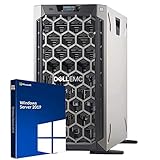
- 3.5 Inch Hot Plug Hard Drive PowerEdge T340 Tower Server Chassis
- Microsoft Windows Server 2019 Standard Operating System
- Processors: Intel Xeon E-2124 Quad-Core 3.3GHz 8MB CPU, Up To 4.3GHz Turbo
- Memory: 32GB (2 x 16GB) DDR4 PC4-21300 2666MHz Unbuffered Memory
- Hard Drive: 8TB (4 x 2TB) 7.2K RPM 6Gb/s SATA 3.5 Inch HDDs in RAID
A NAS may avoid some Windows licensing and administration costs when the need is limited to storage and backup, but it may still require paid backup, security, support, or cloud services. To compare alternatives fairly, include:
- Hardware and disks.
- Operating system, CALs, and application licenses.
- Backup service or software, including off-site storage.
- UPS, support, warranty, and installation.
- Electricity, cooling, and ongoing IT labor.
- Replacement parts, recovery planning, and eventual replacement.
Know when a NAS or server is the wrong choice
A NAS may not be enough
A NAS may be a poor fit if you need Active Directory as a core identity service, a vendor-certified Windows application, demanding SQL workloads, multiple production virtual machines, high-performance transactional processing, specialized PCIe hardware, GPU compute, or a platform specified by an auditor or regulator. Confirm the exact requirements with the application vendor and your IT provider.
A physical server may be unnecessary
Consider avoiding on-premises hardware if business applications are SaaS, files already live in Microsoft 365 or Google Workspace, the office has only a few users, or no one can patch and restore the equipment. A server is also a weak investment if the budget cannot cover a UPS and off-site backup. Compare hosted services with the full cost of hardware and administration, not just the purchase price.
Do these 3 things before closing this tab:
1Repair Windows errors before they cause bigger problems2Scan for outdated or missing drivers - takes under a minute3Clear out junk files and repair common Windows errorsBuild a backup and recovery plan
Storage redundancy helps keep a system running through some hardware failures; it does not make the data recoverable in every failure. A reliable plan needs independent backup copies and tested restoration. Avoid these common gaps:
- Counting RAID as a backup.
- Keeping the only backup on the same server or in the same location.
- Never testing a restore.
- Backing up a server but forgetting Microsoft 365 or other SaaS data.
- Relying on snapshots as the only defense against ransomware.
- Leaving backup credentials permanently exposed to ordinary administrator accounts.
- Ignoring UPS shutdown behavior or leaving recovery steps undocumented.
Before relying on a new system, update firmware, configure storage redundancy, create separate administrator accounts, apply least privilege, set appropriate patching, back up endpoints and servers, keep at least one offline or immutable copy, and test recovery. Configure UPS shutdown, document recovery procedures, monitor drive, temperature, capacity, and backup health, and review the setup annually.
Risks of buying used hardware
A cheap older server can become expensive if it arrives incomplete or fails outside support. Check warranty and firmware status, drive caddies, controller and battery condition, replacement-part availability, noise, idle power use, and whether the seller includes disks, operating system, rails, or support. Confirm how long the hardware and operating system will receive security updates compared with your planned replacement date.
Quick Recap
Product prices and availability are accurate as of the date/time indicated and are subject to change. Any price and availability information displayed on Amazon at the time of purchase will apply.
What’s actually slowing this PC down?
Pick the symptom - the matching free tool is one click away.




