Workers’ compensation form integration is state-specific: the required forms, filing channel, transaction rules, attachments, and service duties can differ by jurisdiction, filer, and claim event. Treat each state agency’s current instructions as the source of truth. An accepted EDI transaction may meet a reporting requirement without replacing a separate signed form, claimant copy, or required attachment.
How do I integrate workers’ comp forms with our claims system?
Build a separate filing workflow for every state, filer role, form, and transaction type. Start with the agency’s current implementation guide, form instructions, technical specifications, edit matrix, and change log. Do not assume a portal, API, XML file, EDI transaction, approved partner, or paper option works for every form in that state.


As an Amazon Associate I earn from qualifying purchases.
- Inventory obligations. List the jurisdictions, filing entities, claim events, forms, recipients, deadlines, claimant-copy duties, signatures, and service requirements your workflow handles.
- Choose the official channel. Confirm the channel and technical specification for each form or transaction on the relevant agency page. Record any approved-partner requirement, required test or certification, attachment rules, and permitted fallback.
- Map and validate data. Map source-system fields to the jurisdiction’s required elements and conditional edits. Validate claim identifiers, names, addresses, dates, and other required data before sending; retain the provenance and form or schema version used.
- Enforce sequencing and document rules. Check that the claim record exists before attaching documents, and validate required signatures, narrative reports, and file formats for the specific filing.
- Reconcile acknowledgments. Track each transmission as accepted, rejected, pending, or duplicate. Retain the agency response, transaction identifier, timestamp, and correction or retransmission history.
- Complete non-transaction duties. Separately verify claimant copies, proof of service, required attachments, and any forms not covered by the transaction.
- Test and monitor changes. Use an agency-approved test process where required. Assign an owner to monitor effective dates and update notices, then regression-test changes before production.
For example, Alabama’s First Report EDI process requires a trading partner agreement packet and successful testing before the Division accepts EDI First Reports; connection credentials alone are not sufficient. Confirm current onboarding and test requirements with the Alabama Department of Labor.
Do workers’ comp filing rules vary by state?
Yes. The examples below are state-specific, not a nationwide workflow. They show why an integration should store rules by jurisdiction and filing scenario rather than apply one generic “workers’ comp form” process.
#1 Best Overall
| State and scope | Channel or transaction detail | Important integration check |
|---|---|---|
| New York: eForms | The Board lists eCase, API, and XML for particular forms; available methods and technical requirements are form-specific. | Check the individual form page. Do not infer that a method listed for one form applies to others. |
| New York: eClaims | The Board maintains EDI R3.1 requirement tables, an implementation guide, transaction reports, and change logs. | Use the current table and change log, and treat the stated 90 percent acceptance rate as a target for trading partners—not an achieved rate. |
| Pennsylvania: claim forms and EDI | WCAIS supports online claim-document submission; accepted EDI transactions satisfy Bureau reporting only for specified scenarios. | Check whether the named form still must be filed separately and whether claimant delivery, service, signature, or deadline rules apply. |
| California: electronic documents | Under 8 CCR § 10206.5, electronic documents are filed using the appropriate e-form or XML file. | Required attachments must accompany the e-form in an allowed format; embedded data is restricted for documents other than e-forms and required attachments. |
| Alabama: First Report EDI | Trading partner agreement materials and successful testing are required before First Report EDI acceptance. | Confirm registration, test completion, transaction scope, and acknowledgment handling with the state. |
For New York, the Workers’ Compensation Board’s eForms overview describes its process as including data validation, additional fields for more specific information, receipt of required information, and automatic case-file updates after successful submission. Those features describe the Board’s eForms process; they do not establish that every form supports every channel.
The Board’s eClaims page says requirement tables posted January 9, 2026 were updated June 1, 2026, with changes summarized in log items 410–456 and alignment to January 1, 2027 changes. Check the current New York eClaims materials before building against a particular table or effective date.
In Pennsylvania, the WCAIS is the state claims-management system for online document submission and processing. Its role is specific to Pennsylvania; it is not a general product recommendation or a substitute for checking each form’s instructions.
Recommended Free Tools
Does EDI replace the paper form?
Not automatically. Whether EDI replaces a separate form or filing depends on the state, the form, and the scenario. An accepted data transaction can satisfy a reporting duty in a defined case while leaving separate submission, signature, claimant-copy, or service obligations in place.
Pennsylvania: confirm the form and scenario
Pennsylvania says an initial First Report of Injury (FROI) establishes the claim in WCAIS. A form received before the initial FROI cannot be attached because the claim record does not yet exist. The Department also identifies agreement and settlement forms that must still be submitted to the Bureau even when EDI reporting occurs. In other specified scenarios, an accepted EDI transaction satisfies Bureau reporting, but a copy of the submitted information still must be provided to the claimant as required by law, regulation, or policy.
The Pennsylvania Department of Labor & Industry’s WC Claim Forms instructions describe different filing routes, including uploading through a claim’s Actions tab, using system-generated forms for certain items, submitting accepted EDI transactions for specified forms, or mailing hard copy. Apply only the route and duties stated for the form and scenario at hand.
Rank #4

- CMS-1500 health insurance claim form
- Printed in OCR red ink for scanning
- Approved by CMS, NUCC and OMB
- 2-part continuous
- Made in the USA
New York: electronic medical bills are a distinct mandate
New York requires workers’ compensation health care providers, regardless of practice size or patient population, to submit CMS-1500 bills electronically through a Board-approved electronic submission partner as of August 1, 2025. The Board says a CMS-1500 must include a detailed narrative report to be valid. Paper CMS-1500 forms submitted after that effective date will not be acted on or enforced for payment, and payers can deny them. These requirements concern New York medical billing, not workers’ compensation filings nationwide. See the Board’s CMS-1500 electronic submission guidance and Subject Number 046-1715.
How do I keep up with form updates?
Maintain a versioned rule set that connects each form or transaction to the agency specification and its effective date. Monitor dated edit matrices, element requirements, form instructions, and change logs; preserve the version used for each submission. A prior announcement can describe an expected mandate without proving the rule currently in force, so confirm the operative entry before implementation.
Best Value
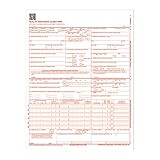
- CMS-1500 health insurance claim form
- Printed in OCR red ink for scanning
- Approved by CMS, NUCC and OMB
- Laser compatible
- Made in the USA
- New York eForms: RFA-1LC XML documentation was updated and posted March 16, 2026; the page said the “Claimant withdraws appeal” request reason was to be added effective March 20, 2026. The Board’s news archive also listed an RFA-2 electronic-submission mandate announcement in December 2025. A September 12, 2024 notice had anticipated a late-2025 mandate for carriers, Board-approved self-insured employers, and TPAs, but an older notice is not proof of the current operative rule. Verify the current RFA-2 entry on the eForms page.
- New York eClaims: Compare the current EDI R3.1 requirements with the applicable change-log entries and effective dates before changing mappings or validation rules. The Board’s 90 percent figure is a target acceptance rate for trading partners, not reported performance.
- Other states: Keep an effective-date calendar and an assigned update owner. Confirm current instructions directly with the state agency before deploying a form, schema, or partner change.
Why was my workers’ compensation filing rejected?
Start by separating a technical rejection from an incomplete legal filing. A transaction can be technically accepted while a related attachment, signature, claimant copy, or service requirement remains unmet. Use the agency acknowledgment and case-file status to identify what failed, then correct only the affected submission or obligation.
- Claim record or sequence missing: In Pennsylvania, an attachment submitted before the initial FROI cannot be attached to a claim that has not yet been created in WCAIS.
- Wrong form or schema revision: The state may have changed an element, event, form version, or conditional edit. Compare the transaction against the current dated specifications and change log.
- Required form still outstanding: EDI may not replace a named Pennsylvania agreement or settlement form. Check the state instruction for that form and scenario.
- Wrong channel or partner: For New York CMS-1500 billing, use a Board-approved electronic submission partner; paper bills submitted after August 1, 2025 are not acted on or enforced for payment.
- Missing or invalid attachment: California requires specified attachments to be submitted with the e-form in an allowed format. Under California Code of Regulations, Title 8, § 10206.5, listed attachment formats are PDF/A1-a, DOC, XLS, or TIFF, with PDF/A1-a preferred. Except for e-forms and required attachments, embedded data is not allowed in electronically filed documents; filers must take reasonable steps to prevent harmful computer code, including viruses.
- Data or execution defect: Check the state’s named instructions for accuracy of names, addresses, Social Security number, employer and insurance details, injury date, injury description, signatures, service confirmations, and deadlines where applicable.
After correction, retain the rejection, revised payload or form, resubmission timestamp, and final acknowledgment so the audit trail distinguishes the original attempt from the accepted filing.
What causes a workers’ comp EDI transaction to fail?
Common causes include missing required data, invalid values, an outdated schema, a sequence or claim-identifier problem, a channel or partner mismatch, and a failed test or onboarding requirement. Failures can also occur after technical acceptance if the integration does not track attachments, signatures, claimant copies, or service separately.
Use a pre-transmission validation layer for required and conditional fields, identifiers, version compatibility, and transaction order. After transmission, reconcile acknowledgments and case status rather than treating a successful connection or a sent message as proof of filing completion. For Alabama First Report EDI, include the state’s agreement packet and successful test process in the implementation plan; for Pennsylvania attachments, ensure the initiating FROI has established the WCAIS claim before submission.
Quick Recap
Product prices and availability are accurate as of the date/time indicated and are subject to change. Any price and availability information displayed on Amazon at the time of purchase will apply.




