The Airbus A380’s wiring problems helped drive a delivery delay of about two years, but the evidence does not support saying that a software bug alone caused the setback or a single, definitive multibillion-euro loss. Different CATIA versions and data-transfer difficulties exposed a wider integration failure involving complex wiring, tight installation space, design changes, customization and management across Airbus sites. Financial estimates refer to different effects and should not be added together.
Why the wiring problem surfaced during assembly
The difficulties became visible when major aircraft sections were joined and workers had to install electrical harnesses across them. According to a 2006 French Senate report, the A380’s wiring system was twice as complex as that of the largest Airbus built previously, the A340-600: it comprised 100,000 wires, 40,300 connectors and 530 kilometres of wiring. French Senate report
The harness had to fit through space constrained by the passenger-cabin design. That left little room to adjust the installation after the design was set. Frequent changes during flight-test prototype work also needed to be reflected in the engineering information used to build the aircraft; the Senate report says updates were not being incorporated quickly enough by the Hamburg engineering team.
This is more precise than the familiar shorthand that all the wires were simply a fixed amount too short. The accounts describe difficult or incompatible connections, data-transfer problems and harnesses that proved hard to install across fuselage sections. They do not establish that every wire shared one uniform length defect.
#1 Best Overall
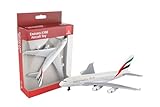
- In presentation window box
- Diecast metal with plastic parts
- Detailed exterior with authentic livery and markings
- Officially licensed product
- Fixed landing gear
What CATIA versions had to do with the delay
Airbus engineering teams in Germany and Spain used CATIA V4, while teams in France and Britain used CATIA V5, according to IEEE Spectrum. Reporting described data loss as files moved between systems and difficulty incorporating wiring-design changes into fuselage sections built in Germany. When a design crosses software versions, sites and manufacturing stages, the risk is not just whether a drawing opens: teams must preserve detailed geometry and keep revisions aligned with the aircraft’s overall design.
The version mismatch therefore mattered, but it is not shown to have been a solitary software failure. The wiring was unusually extensive, installation space was restricted, design changes were frequent, and airline-specific interiors added variation. Aluminum conductors were another practical complication because they are less flexible than copper. IEEE Spectrum reported that Airbus sources said aluminum had been intended from the outset, countering claims that a mid-program switch from copper triggered the problem. IEEE Spectrum account
Rank #2

- Officially licensed by the airline
- Die cast metal with plastic parts
- Makes a great souvenir or gift
Why this was an integration failure, not just a Hamburg failure
The French Senate cautioned against assigning responsibility solely to Hamburg. Its analysis also pointed to insufficient anticipation of the industrial learning curve and late, incomplete recognition of how difficult the problem had become. A separate Senate report records Noël Forgeard’s account that Hamburg teams did not continually check drawing compatibility with the overall Toulouse design interface, and that the defect was detected later in Toulouse. It also identifies shortcomings in management and the control chain. French Senate report on the A380 program
Taken together, these accounts suggest that the software discrepancy exposed and amplified a broader weakness: design data, revisions and manufacturing requirements were not being integrated reliably across sites. IEEE Spectrum quoted aerospace analyst Nick Cunningham calling the episode “an execution failure” linked to “their lack of integration in engineering.” That is an analyst’s assessment, not an official finding.
Quick wins for a faster PC:
Scan for outdated or missing drivers - takes under a minuteDriver Scan →Repair Windows errors before they cause bigger problemsFix Now →Fix the driver behind crashes, sound loss and screen glitchesFind Drivers →Rank #3

- Product Dimensions>- This Airbus A380 aircraft model kit is carefully crafted in 1/300 scale based on a real Airbus aircraft. It measures 7.48×7.95×2.64 inches and weighs 0.44 pounds, showing off the beautiful shape of the Airbus A380. There are removable undercarriage widgets on the belly, making it suitable for collection or decoration on a shelf, table or display case.
- Material and coating>-90% of the entire aviation model is made of high-quality zinc alloy metal die-casting, which is strong and durable and will not rust. Its surface is carefully painted with bright colors and shiny luster. We offer you a variety of paint jobs to accurately replicate real Airbus aircraft. No matter which aviation livery you choose, you can admire the exquisite details of this A380 model aircraft.
- Packing List>-This aircraft model kit contains an all-metal aircraft model, an aircraft model display stand and landing gear parts. If you are someone interested in aviation, this 1:300 scale Airbus A380 metal die-cast model will be a good choice. It showcases one of the great engineering achievements of the Airbus A380 and allows you to recall the history of this aircraft.
- Commemorative Collections & Gifts>- The Diecast Metal airplane model is not only a treasured work of art, but also a perfect gift for aviation enthusiasts. It allows you and your friends and family to share and reminisce the story and history of this airplane, giving you a taste of the charm and legend of A380 airplanes. It can also stimulate your interest and exploration of aviation knowledge and technology.
- Worry-free purchase>-We insist on strict production requirements to control the quality of this airplane model aircraft product to ensure that every customer is satisfied with a high-quality product. If the aircraft model you receive has any defects, please feel free to contact us and we will solve it for you within 24 hours. Thank you for your trust in our products!
What the reported billions measure—and what they do not
Several large figures are associated with the delay, but they describe different financial effects, come from different sources and should not be treated as one software-attributable bill.
| Reported figure | What it represents | Attribution and qualification |
|---|---|---|
| Nearly two years; $6.1 billion | Overall delay and estimated development-cost impact | Douglas K. Howarth’s 2025 analysis in the Journal of Cost Analysis and Parametrics describes the version mismatch as causing a nearly two-year delay and estimates $6.1 billion in then-year development-cost dollars. This is a later analytical estimate, not an official Airbus figure isolating the software’s share; the paper also discusses caveats in comparing this delay with other aircraft programs. Howarth, 2025 |
| Two years; about €3 billion | Delivery-schedule delay and estimated customer penalties | Airmic’s 2011 risk case study describes a two-year schedule delay and estimates customer penalties in the region of €3 billion. The penalty estimate is not a software-only cost. Airmic case study, 2011 |
| 26%; €5.5 billion | Share-price fall and resulting market-capitalization reduction | Airmic reports that the delay announcement was followed by a 26% share-price fall, reducing market capitalization by €5.5 billion. This is a stock-market effect, not a development-cost or customer-penalty figure. Airmic case study, 2011 |
These numbers cannot be summed into a single total “caused by the software.” The sources do not quantify what fraction of the program’s delay or cost was exclusively due to CATIA incompatibility, and they do not establish an authoritative euro total for that share. In particular, the $6.1 billion development-cost estimate is denominated in US dollars, while the roughly €3 billion estimate concerns customer penalties.
Rank #4

- Compact 1/400 Scale Diecast Metal Airplane Model for Display: Measuring 14.50 cm in length, this diecast metal airplane model offers a compact yet detailed presence. Its 1/400 scale makes it an ideal choice for mini desktop decor, bookshelf accents, or as a space-efficient addition to any airplane collectible collection.
- Solid Diecast Alloy Construction for Durability: Crafted from high-quality diecast metal, this Airbus A380 model delivers a satisfying weight and robust feel. Unlike fragile plastic alternatives, the metal construction ensures lasting durability, making it suitable for both display and gentle handling.
- Realistic Spray-Painted Finish for Authentic Appearance: This a380 model plane features a detailed spray-painted livery, carefully applied to replicate the distinctive FedEx markings. Unlike models that rely on stickers, the painted finish provides a smooth, seamless surface without edges or bubbles, resulting in a cleaner and more realistic presentation.
- Includes Clear Display Stand for Versatile Showing: Comes with a transparent plastic display stand, allowing you to showcase this compatible for fedex airplane model in an elegant in-flight pose. The stand keeps the model stable while adding a dynamic touch to desks, shelves, or display cabinets.
- Thoughtful Gift for Aviation Fans and Families: Whether chosen as a birthday gift for an aviation enthusiast or a surprise for someone who appreciates aircraft, this model appeals to a wide range of ages. Its sturdy build and realistic details make it a welcoming addition to any home, sparking interest in aviation for both young and adult admirers.
Why the distinction matters to readers
For a finance-minded reader, the A380 episode is a reminder that a technical failure can produce several distinct kinds of economic impact: development spending, contractual penalties and changes in market value. Those measures answer different questions. Market capitalization can move sharply when investors reassess risk, while a penalty estimate concerns payments to customers and a development-cost estimate concerns resources spent on the program. None should be presented as interchangeable or attributed wholly to one software discrepancy without evidence.
Quick Recap
Product prices and availability are accurate as of the date/time indicated and are subject to change. Any price and availability information displayed on Amazon at the time of purchase will apply.




