On July 11, 2024, reporting based on IDC’s market estimates said U.S. Apple Vision Pro sales could fall about 75% in the then-current quarter. That was a forecast—not an Apple-reported result—and it described a post-launch slowdown, not a prediction for today. The central issue was whether a $3,499 headset with an emerging software ecosystem and a demanding form factor could attract buyers beyond the early adopters who drove launch interest.
What did the 75% forecast actually mean?
The figure appeared in reporting on July 11, 2024, which attributed the estimate to IDC. It concerned expected U.S. sales in the quarter being discussed at that time, after the headset’s February 2 U.S. launch. It is not a current-quarter forecast, and it should not be presented as a confirmed 75% decline in Apple’s reported results. 9to5Mac’s July 11, 2024 report summarized the forecast; Bloomberg Law’s report on IDC’s estimates also said IDC expected no post-launch U.S. quarter to reach 100,000 units and projected fewer than 500,000 sales in the product’s first year.
As an Amazon Associate I earn from qualifying purchases.
Those are third-party estimates, not Apple disclosures. Apple’s public filings report broad categories such as “Wearables, Home and Accessories,” rather than a separate Vision Pro unit-sales line. Its 2026 Form 10-Q therefore cannot confirm the specific unit forecast. The reports do not establish a precise, independently verified unit count or a complete basis for the percentage calculation, so “75%” is best understood as IDC’s forecast, not a measured result. A large percentage decline from a launch-inflated comparison period also does not, by itself, reveal the absolute number of units involved.
Why launch demand was likely to fade
A launch brings forward the most motivated buyers
Vision Pro became available in the United States on February 2, 2024, following Apple’s announcement of the launch date and a $3,499 starting price for the 256GB model. Apple promoted in-store demonstrations, and the first audience naturally included people most willing to try a new category: Apple enthusiasts, developers, technology reviewers, affluent early adopters, and organizations exploring spatial-computing uses. Apple’s launch announcement set out the U.S. date and price.
#1 Best Overall

- CARDBOARD MONKENAUT — Get our best Gorilla Tag bundle yet with this Amazon exclusive deal. Purchase Meta Quest 3 to get exclusive items, including the Gorilla Space Program Suit and Helmet, plus 2,000 SHINY ROCKS.
- NEARLY 30% LEAP IN RESOLUTION — Experience every thrill in breathtaking detail with sharp graphics and stunning 4K+ Infinite Display.
- NO WIRES, MORE FUN — Break free from cords. Game, play and explore in immersive worlds — untethered and without limits.
- 2X GRAPHICAL PROCESSING POWER — Enjoy lightning-fast load times and next-gen graphics for smooth gaming powered by the Snapdragon XR2 Gen 2 processor.
- EXPERIENCE VIRTUAL REALITY — Blend virtual objects with your physical space and experience two worlds at once in your VR headset.
That early audience is not a reliable measure of a lasting sales pace. A launch can concentrate purchases from people who have been waiting for a product or want to experience it first. Once those buyers have had their chance, continued growth requires a much broader pool of people who see a compelling reason to own it. IDC’s forecast suggested that this transition was not happening quickly in the United States.
U.S. timing matters
The United States was Vision Pro’s first major market, so it had the earliest launch surge and the earliest chance for that demand to normalize. Subsequent availability in other countries could change worldwide sales or geographic mix, but it would not show that U.S. demand remained strong. The 75% estimate was explicitly about the U.S. market, not a global sales measure.
Why the $3,499 price was a major obstacle
At $3,499 before any needed prescription inserts or optional accessories, Vision Pro asked buyers to make a substantial commitment to a personal device. The price placed it in the territory of a high-end computer or premium home-entertainment purchase, while its use was concentrated in one wearer’s experience. That makes the purchase harder to justify for a household than a shared television or console, and it raises the bar for a product that many people were still learning how to use.
Some buyers also face a higher effective cost: Apple listed ZEISS Optical Inserts at $99 for readers and $149 for prescription inserts. Its October 2025 announcement listed a $199 Travel Case and a $99 Dual Knit Band. Apple’s M5 refresh announcement gives those accessory prices and confirms the U.S. starting price remained $3,499. These add-ons are not necessary for every owner, but they matter to buyers who need vision correction or want particular fit and travel options.
Rank #2

- Your purchase of this item includes a new Meta Quest Pro 256 GB VR headset and a 12-month subscription to Optima Academy Online (OAO) field trips.
- Optima Academy Online (OAO) harnesses the power of virtual reality to make previously impossible learning opportunities just a few clicks away. Our VR Field Trips provide powerful ways of engaging users on a whole new level while providing learning experiences. With our VR Field Trips, we deliver users directly into an immersive educational experience that engages them like never before. We offer a one-month subscription to our VR Field Trips. During your subscription, you can spend as much time in our uniquely created Metaverse environments as you like. Each environment has its own theme, learning experiences, and adventures.
- High resolution mixed reality passthrough uses full-color sensors to let you see and engage with the physical world around you, even as you connect, work and play in virtual spaces.
- Share your true emotions and reactions with real time natural avatar expressions. Meta Avatars translate your natural facial expressions into VR so you can bring your true personality to meetings and gatherings with friends.
- Meta Quest Touch Pro Controllers translate instinctive hand gestures and detailed finger actions directly into VR with self-tracking cameras and precision controls. Multi-point, advanced haptics make virtual interactions feel entirely real
Price is not proof that the headset lacks value. A professional who uses it often for a valuable workflow may judge the economics differently from a casual consumer. But the higher the price, the more frequent and distinctive the use needs to be. A memorable demonstration alone cannot carry that decision.
Why a compelling demo did not guarantee everyday use
The promise was broad, but the daily task was less obvious
Apple described Vision Pro as a “spatial computer,” not simply a gaming headset. That framing opened up uses such as floating work windows, immersive entertainment, viewing spatial photos and videos, and interacting with digital objects in a room. It also invited buyers to compare the device with computers, tablets, monitors, televisions, and other headsets. For many consumers, the practical question was not whether the experience could impress in a demo, but what they would do with it often enough to justify owning it.
Immersive video, virtual displays, and 3D photography can be attractive features without being indispensable daily needs. A buyer might enjoy an Apple Store demonstration yet decide that watching a film or working on a screen is already convenient enough without wearing a headset. Demo appeal and ownership utility are different tests.
The Tool Desk
Outbyte Driver Updater FREEScan for outdated or missing drivers - takes under a minuteDriver Scan →Outbyte PC Repair FREERepair Windows errors before they cause bigger problemsFix Now →Weight, fit, battery, and social context affect repeat use
Vision Pro is a substantial headset compared with ordinary glasses, and its external battery adds a separate piece of hardware to manage. Reviewers and later industry coverage repeatedly raised weight, facial pressure, and comfort as concerns; how strongly they affect an individual depends on fit and personal tolerance. The sealed, face-worn design can also feel isolating, making spontaneous or all-day use less natural than reaching for a phone or laptop. These are recurring adoption barriers, not evidence that every owner finds the headset uncomfortable.
Rank #3
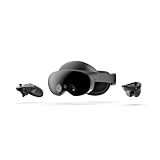
- Meta Quest Pro unlocks new perspectives in work, creativity, and collaboration.
- Multitask with ease with multiple resizable screens so you can organize tasks, work on new ideas or message with your friends.
- World class counter balanced ergonomics and our sleekest design let you wear the headset for longer in premium comfort.
- High resolution mixed reality passthrough uses full-color sensors to let you see and engage with the physical world around you, even as you connect, work and play in virtual spaces.
- Share your true emotions and reactions with real time natural avatar expressions. Meta Avatars translate your natural facial expressions into VR so you can bring your true personality to meetings and gatherings with friends.
Eye-and-hand interaction is central to the experience, but the usefulness of any interaction method depends on the task, environment, and application. People seeking lightweight everyday augmented-reality glasses or controller-driven gaming may find the headset’s basic form factor a poor match for their goals.
Why software and content mattered as much as hardware
A premium platform needs software that gives people a reason to return. At launch, Apple highlighted more than one million compatible iPhone and iPad apps, alongside experiences designed specifically for spatial computing. Apple’s launch-store announcement made that distinction. Compatibility creates breadth, but an existing app running in a window is not the same as a native spatial app designed to make use of the headset’s environment and input model.
That gap creates a familiar platform problem: developers have less incentive to build costly, specialized software for a small premium audience, while buyers have less reason to join a platform without a deep selection of must-have experiences. A large compatible-app count does not by itself answer whether users have enough high-quality spatial applications or recurring content to sustain regular use.
Apple continued to promote immersive programming, including sports content in 2026. Its announcement for Spectrum Front Row is evidence that Apple was still adding experiences, not evidence that sales recovered. Content releases can improve the platform’s appeal, but their commercial effect depends on whether customers use them repeatedly and whether they help justify the hardware purchase.
Rank #4

- CARDBOARD MONKENAUT — Get our best Gorilla Tag bundle yet with this Amazon exclusive deal. Purchase Meta Quest 3S to get exclusive items, including the Gorilla Space Program Suit and Helmet, plus 2,000 SHINY ROCKS.
- NO WIRES, MORE FUN — Break free from cords. Game, play and explore immersive worlds — untethered and without limits.
- 2X GRAPHICAL PROCESSING POWER — Enjoy lightning-fast load times and next-gen graphics for smooth gaming powered by the Snapdragon XR2 Gen 2 processor.
- EXPERIENCE VIRTUAL REALITY — Take gaming to a new level and blend virtual objects with your physical space to experience two worlds at once in your VR headset.
- 2+ HOURS OF BATTERY LIFE — Charge less, play longer and stay in the action with an improved battery that keeps up. *Based on the graphic performance of the Qualcomm Snapdragon XR2 Gen 2 platform vs the Meta Quest 2 platform.
Could professional or enterprise use offset weak consumer demand?
Low consumer sales would not automatically mean Vision Pro had no strategic or commercial value. A specialized headset could be useful in industrial design, architecture and engineering, training, medical education, visualization, video production, or other workflows where seeing and manipulating 3D material has practical value. A small number of devices can matter to an organization if they help with a specific task.
Enterprise adoption, however, does not necessarily produce consumer-scale unit volumes. Organizations may need custom applications, device management, training, support, and a demonstrated productivity benefit. Procurement also tends to move on a different timetable from individual purchases. Enterprise traction could therefore be meaningful while leaving the broad consumer-sales question unresolved.
- Developers and Apple power users may value early access to a new computing platform.
- Professionals may justify the cost if the headset improves a recurring, high-value workflow.
- Travelers and immersive-video enthusiasts may value private entertainment, but that benefit is personal and may not be enough for every buyer.
- Gaming-focused buyers may prefer a platform with a lower entry cost and a gaming-first library.
- Casual consumers need a clear, repeatable use case to overcome price, comfort, and social-friction concerns.
What Apple changed—and what it did not
In October 2025, Apple introduced an M5-based Vision Pro with improved performance, display rendering, and battery life, along with a Dual Knit Band. Apple kept the U.S. starting price at $3,499. The update addressed parts of the performance and fit proposition, but it did not make the headset substantially cheaper or replace its face-worn form factor. Apple’s announcement describes the refresh.
Quick wins for a faster PC:
Fix the driver behind crashes, sound loss and screen glitchesFind Drivers →Clear out junk files and repair common Windows errorsFree Scan →That makes the M5 model an incremental response to the original adoption problem rather than proof that it was solved. A faster chip and revised band may matter to owners and particular use cases; they do not automatically create a broader audience. Apple was still promoting Vision Pro content in 2026, but it does not publish a separate unit-sales figure in its filings, so precise current U.S. sales claims need attribution to outside analysts or reporting.
Best Value

- Ultimate Comfort: Experience superior comfort with the new ANNAPRO A2 comfort head strap. Enjoy pressure-free wear for extended periods, with stable, no-wobble support, and experience unparalleled comfort and an immersive experience like never before
- Pressure-Free Facial Comfort: The ANNAPRO A2 head strap, designed specifically for Apple Vision Pro, features a new design that fits the head more comfortably, effectively reducing 60%-90% of the pressure on the cheekbones and around the eyes
- Customizable Fit: Offers 4 different thicknesses of comfortable cushion (5/12/18/25mm) to perfectly fit various head shapes. The upgraded breathable ice silk cushion are soft and skin-friendly, greatly enhancing wearing comfort. Tip: If you encounter issues with eye tracking being too far or too close, select the most suitable cushion and then recalibrate the eye tracking to ensure accuracy
- Damage-Free Quick Installation: Easily install A2 head strap without harming Vision Pro’s original accessories. Simply align and push the strap into place after removing the official head strap
- Enhanced Versatility: Combining Vision Pro with our head strap allows for the removal of the light seal or light seal cushion, bringing the lenses closer to your eyes for a wider field of view and improved comfort and breathability
What would make a future Vision headset easier to adopt?
A lower price would reduce the risk of trying the platform and could expand its potential audience. More owners could in turn give developers stronger reasons to invest, while a more comfortable and lighter design could make sessions easier to repeat. Neither change alone guarantees success: a less expensive device still needs useful software and a clear purpose, while a lighter headset still has to justify its cost.
- Lower total cost: a materially cheaper entry point would broaden the set of buyers who can consider it.
- More convenient hardware: reduced weight, improved fit, and practical battery arrangements would lower everyday friction.
- Must-have recurring software: native applications and content people return to are more valuable than novelty experiences tried once.
- A sharper audience and use case: consumers and organizations need to understand what the headset does better than existing devices.
- Developer and enterprise support: a larger installed base, deployment tools, and measurable workflow benefits could reinforce adoption.
Industry reporting and analyst commentary have discussed possible changes to Apple’s future Vision-product plans, but those reports are not official product announcements. For example, MacRumors’ June 2026 report attributes roadmap claims to analyst Ming-Chi Kuo. Such claims should be treated as attributed reporting rather than confirmed Apple strategy.
What the 75% forecast does—and does not—tell us
The forecast captured a real business challenge: after the first wave of launch buyers, Vision Pro needed a much larger audience to sustain momentum, yet its price, physical demands, limited everyday use cases, and still-developing native software ecosystem made that transition difficult. It did not establish Apple’s exact sales, prove the product category was permanently doomed, or rule out value in professional and enterprise settings. It was a dated, third-party estimate of near-term U.S. demand—and a warning that technological novelty by itself does not create a mass-market product.
Quick Recap
Product prices and availability are accurate as of the date/time indicated and are subject to change. Any price and availability information displayed on Amazon at the time of purchase will apply.




