Free tools Windows power users keep installed
One-click scans. No signup required.
Your gaming PC uses more electricity under load because demanding games make its processor and graphics card do more work than they do while idle. How much that extra use costs depends on your PC’s measured power, how long you play, what else you include in the measurement, and your electricity rate—not on a universal gaming-PC wattage figure.
Why does my gaming PC use more electricity under load?
Games can push the CPU and graphics processor into higher-performance activity. That raises power use compared with idle or routine desktop tasks. The European Commission Joint Research Centre reports that high-speed graphics and CPU activity, such as gaming, can notably increase consumption at full load. It also finds that common office use, including browsing and video streaming, tends to have active consumption comparable to short idle periods. These are qualitative findings, not a current benchmark for a particular gaming PC. European Commission Joint Research Centre report
“Load” is not a fixed level: the game, resolution, graphics settings, frame-rate cap, and activity happening in the background all affect the work the system performs. A paused game left running can also keep a computer from entering sleep mode, according to ENERGY STAR’s computer guidance.
How much electricity does gaming add?
There is no representative gaming-versus-idle wattage range or annual kWh figure established here for modern gaming PCs. A number without a defined computer, game, settings, test method, and play schedule can mislead. For your own system, compare measured average wall power in representative idle and gaming sessions, then account for the hours spent in each state.
Recommended Free Tools
#1 Best Overall

- 80 PLUS GOLD CERTIFIED
- 10-year limited warranty, guaranteeing long term reliable operation
- Fully modular design
- ATX 3.1 & PCIE 5.1
Keep the measurement boundary consistent. A PC-only measurement cannot be fairly compared with one that includes the monitor and peripherals. Also, do not treat a power supply’s rated capacity or a component’s TDP as your computer’s measured wall consumption; those specifications answer different questions.
How to measure and estimate your own cost
- Plug a true-power electricity meter into the AC outlet and connect the PC through it. Measure a representative idle period and a representative gaming session. The EPA’s archived test procedure describes AC-source measurement with a true-power meter; it does not validate any particular consumer meter. EPA Version 4.0 test procedure
- Use the same measurement boundary for both sessions: PC alone, or PC plus monitor and accessories. Note the game, resolution, graphics settings, frame-rate cap, and session length so the comparison has context.
- Convert average power into energy: average watts ÷ 1,000 × hours = kWh. If your meter displays cumulative energy directly, use the kWh reading for the period measured.
- Multiply the kWh by the applicable price per kWh on your electricity bill to estimate the cost. Taxes, tariffs, and time-of-use rates can change the amount you pay.
For example, if a hypothetical PC averages 300 W during a two-hour session, that session uses 0.6 kWh: 300 ÷ 1,000 × 2. At a hypothetical rate of $0.20 per kWh, the energy would cost $0.12. These assumed figures illustrate the calculation; they are not typical-system measurements or a price estimate for your area.
Rank #2

- 80 PLUS GOLD CERTIFIED
- 10-year limited warranty, guaranteeing long term reliable operation
- Fully modular design
- ATX 3.1 & PCIE 5.1
Why play time and sleep settings matter
A high draw for a few hours has a different effect from leaving a game running for much longer. Estimate use across your actual schedule: add the kWh from gaming, idle, and any other measured states over the same period. A game left open in the background may prevent sleep even when paused, so close it or use sleep settings when you are finished.
ENERGY STAR recommends power management for inactivity and says certified computers are expected to operate efficiently in Off, Sleep, and Idle modes. Its computer page lists a specification effective date of October 2025. Separately, the U.S. Department of Energy’s Federal Energy Management Program says leaving power-saving mode enabled can reduce computer energy use by up to 27% annually. That broad guidance is not a gaming-PC-specific prediction or a guaranteed saving for an individual household. DOE FEMP power-management guidance
Do these 3 things before closing this tab:
1Clear out junk files and repair common Windows errors2Fix the driver behind crashes, sound loss and screen glitches3Repair Windows errors before they cause bigger problemsQuick Recap
Best Value

- 80 PLUS GOLD CERTIFIED: Delivering gold-level performance with 92% efficiency, ensuring effective power transmission to your components.
- Fully Modular Design: Unique dragon-pattern fully modular cables cut redundant wiring to tidy your chassis, improve airflow and optimize system heat dissipation. With dimensions of 150×150×86mm (5.91×5.91×3.39in), the PSU fits most mainstream ATX cases.
- Support ATX 3.1 & PCIe 5.1: Compliant with the ATX 3.1 standard to fuel high-performance PC components with stability, efficiency, and power spike resistance. Meanwhile, supporting PCIe 5.1 platform withstands 2x transient power excursions from the GPU.
- Dual-Colour 16-Pin Cable: The Dual-color dragon-pattern 12V-2x6 PCI-E 5.1 cable for modern high-end graphics cards. With yellow connector can easily show you whether the cable has been plugged in properly.
- RGB Silent Fan & RGB Lighting Model: This 140mm low-noise fan comes with a silent mode, it outperforms standard 120mm fans in terms of quietness, heat dissipation capability and durability. What's more, the psu features ARGB lighting model, allowing you to adjust the lights style according to your needs.
Rank #4

- Fully Modular PSU: Reliable and efficient, low-noise power supply with fully modular cabling, so you only have to connect the cables your system build needs.
- Intel ATX 3.1 Certified: Compliant with the ATX 3.1 power standard, supporting PCIe 5.1 platform withstands 2x transient power excursions from the GPU.
- Keeps Quiet: A 120mm rifle bearing fan with a specially calculated fan curve keeps fan noise down, even when operating at full load.
- 105°C-Rated Capacitors: Delivers steady, reliable power and dependable electrical performance.
- Modern Standby Compatible: Extremely fast wake-from-sleep times and better low-load efficiency.
Rank #3
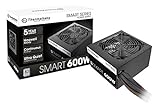
- Delivers 600W Continuous output at plus 40℃. Compliance with Intel ATX 12V 2. 31 and EPS 12V 2. 92 standards
- 80 PLUS Certified – 80% efficiency under typical load. Power good signal is 100-500 millisecond
- Supports (2) PCI-E 6 plus 2pin Connectors. Active (PFC) Power Factor Correction, MTBF: 100, 000 hours
- Industry Grade Protections: (OPP) Over Power Protection, (OVP) Over Voltage Protection, (SCP) Short Circuit Protection
- Hold up time is 16 millisecond minimum within 60 percent load. Input frequency range 50 - 60 in Hz
Product prices and availability are accurate as of the date/time indicated and are subject to change. Any price and availability information displayed on Amazon at the time of purchase will apply.




