Airlines keep flying the Boeing 737 MAX because aviation regulators lifted the grounding after requiring design changes, revised pilot training, and maintenance work on the aircraft. That lifting was a regulator’s return-to-service decision under stated conditions. It does not mean the crashes that caused the grounding stopped mattering, and it does not explain why any individual airline chose to keep or order the aircraft. Official statements and Boeing’s filings document the regulatory path, a separate 2024 quality failure, and the company’s current production and certification activity. Individual carrier motives are not established in those sources.
What went wrong in the two fatal crashes
Two accidents about five months apart involved the 737 MAX 8, which carries the official designation 737-8. Lion Air Flight 610 crashed in October 2018, killing 189 people. Ethiopian Airlines Flight 302 crashed in March 2019, killing 157. The combined toll was 346, according to the U.S. Department of Transportation Office of Inspector General report of April 26, 2023.
The European Union Aviation Safety Agency (EASA) reports that accident investigation bodies identified MCAS, the Maneuvering Characteristics Augmentation System, as a key contributor. MCAS is a flight-control function that could push the nose down. In its return-to-service report of January 27, 2021, EASA also describes weaknesses in Boeing’s safety assessment process, including:
- failure to identify the risk of relying on a single angle-of-attack data source;
- weaknesses in development assurance;
- assumptions about how flight crews would react when the system activated.
What regulators required before the MAX flew again
The FAA and EASA each reached their own return-to-service decision for their jurisdictions. Their requirements overlapped in substance but were not identical.
Do these 3 things before closing this tab:
1Repair Windows errors before they cause bigger problems2Fix the driver behind crashes, sound loss and screen glitches3Clear out junk files and repair common Windows errors#1 Best Overall

- Purpose & Use – Perfect for collectors, aviation enthusiasts, or as a display piece, this snap-fit model assembles quickly without glue and includes a sturdy display stand
- Perfect Size – At 1/200 scale, the model measures approximately 13 inches long with a 12 ½-inch wingspan—large enough to impress while fitting neatly on shelves or desks
- Quality Materials – Made from durable solid injection-molded plastic for long-lasting quality, smooth finishes, and detailed realism
- Brand Excellence – From SkyMarks by Daron, a trusted leader in collectible aircraft models, delivering officially licensed replicas that celebrate modern aviation design and engineering
FAA: a 20-month review and an airworthiness directive
- After the accidents, the FAA grounded the MAX and completed a review that took 20 months.
- On November 18, 2020, the FAA rescinded the grounding order and issued an airworthiness directive requiring design changes to the aircraft. The FAA’s statement of that date sets out the sequence.
- The FAA specified pilot-training requirements. Each U.S. airline’s revised training program needed FAA approval.
- Aircraft that had been parked during the grounding needed maintenance before they could return to service.
EASA: an independent review and, in some cases, operating limitations
EASA conducted its own independent review and required operational and training updates. In some cases it added operational limitations. Its airworthiness directive 2021-0039 mandated the approved changes and actions. EASA’s January 27, 2021 report said:
“The operation of the 737 MAX is indeed already considered safe with the approved changes and actions mandated in the EASA Airworthiness Directive 2021-0039.”
The same report lists post-return actions intended to improve safety over the longer term, so the return to service was not the end of the review.
Rank #2

- Purpose & Use – Perfect for collectors, aviation enthusiasts, or as a display piece, this snap-fit model assembles quickly without glue and includes a sturdy display stand
- Perfect Size – At 1/200 scale, the model measures approximately 13 inches long with a 12 ½-inch wingspan—large enough to impress while fitting neatly on shelves or desks
- Quality Materials – Made from durable solid injection-molded plastic for long-lasting quality, smooth finishes, and detailed realism
- Brand Excellence – From SkyMarks by Daron, a trusted leader in collectible aircraft models, delivering officially licensed replicas that celebrate modern aviation design and engineering
A return-to-service decision is a judgment that the aircraft may operate under specified conditions. It does not establish that the earlier design and assessment failures were disproven, and it does not remove the need for continuing oversight of Boeing’s manufacturing system.
The January 2024 door-plug event was a separate quality failure
On January 5, 2024, a door plug on an Alaska Airlines 737-9 MAX (Flight 1282) separated in flight. This was a manufacturing and quality problem, not an MCAS problem, and the regulatory response was different.
The FAA’s immediate response grounded 171 affected 737-9 MAX aircraft. Its actions, described in its January 24, 2024 announcement and January 2024 updates, included:
Rank #3
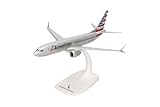
- 𝐄𝐀𝐒𝐘 𝐀𝐒𝐒𝐄𝐌𝐁𝐋𝐘: Herpa SnapFit airplane models click together in just a few steps — no glue or tools required. A simple way to start collecting detailed models.
- 𝐂𝐎𝐋𝐋𝐄𝐂𝐓𝐎𝐑'𝐒 𝐈𝐓𝐄𝐌: Herpa models are a perfect addition to any collection — discover model cars, trucks with trailers, fire engines, emergency vehicles and airplanes .
- 𝐑𝐄𝐀𝐋𝐈𝐒𝐓𝐈𝐂 𝐃𝐄𝐓𝐀𝐈𝐋: High-quality plastic planes with finely captured details — authentic airline liveries such as Lufthansa, Delta, KLM and American Airlines, on aircraft by Boeing, Airbus and Embraer.
- 𝐏𝐑𝐄𝐂𝐈𝐎𝐔𝐒 𝐆𝐈𝐅𝐓: The precise, true-to-scale design delights both collectors and businesses alike. With their realistic detailing, Herpa models make an excellent choice for birthday presents or corporate gifts. Suitable for ages 14 and up.
- 𝐈𝐍𝐅𝐎 & 𝐒𝐂𝐎𝐏𝐄 𝐎𝐅 𝐃𝐄𝐋𝐈𝐕𝐄𝐑𝐘: The model airplane has been scaled down to 1:200. It is suitable as a gift, decoration or refined detail for a miniature world, diorama or model train.
- an inspection and maintenance process that had to be completed before affected aircraft returned to service, including checking fasteners and door-plug components and correcting any abnormalities found;
- an investigation of Boeing’s production practices;
- increased FAA oversight of production;
- a decision not to authorize expanded MAX production at that time, with the stated aim of improving quality control.
FAA Administrator Mike Whitaker said: “The Jan. 5 Boeing 737-9 MAX incident must never happen again.” A January 2024 FAA update added: “The safety of the flying public, not speed, will determine the timeline for returning these aircraft to service.”
Certification and production status as of October 8, 2026
Several 2026 decisions changed the MAX’s regulatory and production picture. Some entries are regulator decisions and others are company forecasts, so the table labels each one.
The Tool Desk
Outbyte PC Repair FREEClear out junk files and repair common Windows errorsFree Scan →Outbyte Driver Updater FREEScan for outdated or missing drivers - takes under a minuteDriver Scan →| Item | Status as reported | Source and date |
|---|---|---|
| Production-end airworthiness certificates | The FAA said Boeing could resume issuing these certificates for all 737 MAX airplanes effective July 20, 2026. The announcement also covered the 787. FAA inspections, audits, and monitoring continue, including observation of safety management and safety culture. | FAA, July 17, 2026 |
| 737 MAX-7 certification | The FAA announced certification after required updates to flight-control software, flightcrew alerting, and the engine anti-ice system. | FAA, August 3, 2026 |
| 737 MAX-10 certification and first delivery | Boeing said certification was still anticipated in 2026, with first delivery expected in 2027. This is a company forecast, not a regulatory date. | Boeing second-quarter 2026 results |
| Production rate | The FAA and Boeing agreed to a rate of 42 airplanes per month in October 2025. Further increases are subject to FAA concurrence. | Boeing 2025 Form 10-K |
| Commercial Airplanes backlog | Above 6,200 airplanes. | Boeing second-quarter 2026 results |
The July 2026 change concerns who may issue certain end-of-production airworthiness certificates under FAA oversight. It does not end that oversight. The production rate and backlog show planned output and customer commitments at the company level. They do not explain any single airline’s decision.
Rank #4
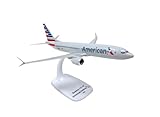
- Official American Airlines Livery: Showcases the current American (13-Cur) colors, complete with authentic logos and detailed design that mimics the real Boeing 737 MAX 8’s official look.
- 1:200 Scale Detailing: Scaled for accuracy, measuring approximately 7.75 inches in length and 7.25 inches in wingspan, displaying the precise proportions of the original aircraft.
- Molded Plastic Construction: Made from premium molded plastic for lasting durability and a smooth, glossy finish ideal for collectors and aviation displays.
- Snap-Together Assembly: Components snap easily into place for quick setup; includes a custom display stand with an engraved plaque for professional presentation.
- Perfect for Collectors and Gifts: Designed for airline enthusiasts, model collectors, and professionals, it’s suitable for home, office, or as a unique gift.
Why airlines keep the aircraft: what the evidence supports
The documented sequence is straightforward. A regulator authorizes return to service under conditions, the operator completes the required work, and the aircraft enters service. Boeing’s backlog and production plans show that customers hold orders in the commercial system. That sequence explains why an airline can lawfully operate the aircraft. It does not explain why a given carrier bought or kept it.
Carrier-specific reasons are not supported by the sources cited here. Commonly discussed hypotheses include fleet commonality with existing 737 operations, fuel efficiency, delivery timing, and the cost of replacing aircraft. These are reasonable questions to test, but they should be treated as hypotheses unless a carrier states them itself. Useful places to check include:
- the airline’s annual report, fleet plan, or order-book disclosures;
- Boeing’s customer announcements that name the carrier;
- for airlines listed in the United States, the filings they make with the SEC.
How to read future news about the MAX
The three kinds of past issues need separate tests. Design and control-system failures are judged through airworthiness directives, required changes, and training approvals, as in the 2020–2021 return to service. Manufacturing and quality failures are judged through inspections, production oversight, and decisions on production rates, as in 2024. Production and certification questions are judged through dated regulator announcements and company forecasts.
Quick wins for a faster PC:
Repair Windows errors before they cause bigger problemsFix Now →Fix the driver behind crashes, sound loss and screen glitchesFind Drivers →Clear out junk files and repair common Windows errorsFree Scan →For travelers, the regulatory record supports one narrow conclusion: the FAA and EASA each judged the aircraft able to operate after the corrective work. It does not speak to any particular flight, and the agency statements do not compare the MAX with competing aircraft families. A comparative safety ranking would need separate data.
For readers following Boeing as a company, its Form 10-K and quarterly releases are the primary documents for production, backlog, and certification timing. Treat their forward-looking statements as company expectations, not regulatory commitments.
Quick Recap
Product prices and availability are accurate as of the date/time indicated and are subject to change. Any price and availability information displayed on Amazon at the time of purchase will apply.




