Quick wins for a faster PC:
Scan for outdated or missing drivers - takes under a minuteDriver Scan →Repair Windows errors before they cause bigger problemsFix Now →Fix the driver behind crashes, sound loss and screen glitchesFind Drivers →AI data centers use electricity to run computing equipment and the systems that keep it operating. GPU clusters perform the AI computation, but a facility’s power demand also includes storage, networking, cooling and other infrastructure. There is no single representative power figure for a GPU cluster: demand varies with its equipment, workload, utilization and facility design.
What a data center’s electricity runs
A data center is not just a room full of GPUs. The International Energy Agency (IEA) defines data centers as facilities housing servers, storage systems, networking equipment and associated components arranged in racks. Their electricity meters reflect both the computing equipment and the supporting systems that keep it available.
Servers, storage and networking
Servers do the computing. Storage systems hold data, and networking equipment moves information between servers and to users. In the IEA’s 2025 analysis, servers account for an average of about 60% of electricity demand in modern data centers. That is an average, not a fixed share: the figure varies substantially by data-center type. The rest includes cooling and other infrastructure.
Cooling and facility systems
Computing equipment produces heat, so data centers need cooling and related systems to operate reliably. Those systems use electricity too. A server-only power figure therefore does not represent the entire facility’s electricity demand, and the server share cannot be applied as a universal conversion factor for every site.
The Tool Desk
Outbyte PC Repair FREEClear out junk files and repair common Windows errorsFree Scan →Outbyte Driver Updater FREEFix the driver behind crashes, sound loss and screen glitchesFind Drivers →#1 Best Overall
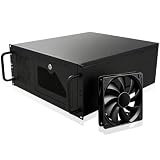
- Server Cabinet Case:The 4u server cabinet case adopts a combined internal architecture.With 7 x PCI slot, providing additional storage space for hardware, networks, servers, or audio/video accessories.
- Lockable design: The 4u rack case comes with a key lock for better security and helps prevent damage, tampering, or theft. The front door foam filter is designed to minimize the dust inflow and prolong the service life.
- High Compatibility: Our 4U computer cabinet is universally mountable in any standard front mount server rack or cabinet, Motherboard Compatibility: 12 x 9.6 ATX/M-ATX/Mini-ITX (smaller than 305mm*245mm/12*9.6inch)
What GPU clusters do with the power
A GPU cluster is a group of interconnected servers equipped with accelerators. It performs AI computing, including model training and deployment. Because the servers communicate and exchange data as they work, the cluster depends on networking as well as computation; the wider facility also supplies storage, cooling and other support.
The available figures do not establish a universal split of cluster electricity among training, inference, data movement, communication, cooling or idle capacity. Nor do they establish one typical GPU-cluster load or a reliable energy-per-query figure. Those values depend on the particular hardware, workload, utilization and facility design. Treating a single task or GPU’s power draw as the total cost of operating an AI data center would leave out important parts of the system.
Rank #2
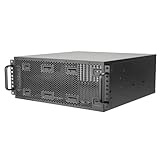
- Supports up to SSI-EEB motherboards
- Supports 360mm radiators and 2x 80mm fans.
- Supports hard drive mounting on expansion card retainer
- 8 PCI expansion slots
- Includes one USB Type-C interface
How much electricity data centers use
Global totals describe all data centers, not AI alone. The IEA estimated that data centers used 415 terawatt-hours (TWh) of electricity worldwide in 2024, about 1.5% of global electricity use. Its 2025 base case projects global data-center electricity use at around 945 TWh in 2030. These are an estimate and a forecast, respectively—not a measured total for AI facilities or a guarantee of future consumption.
AI is changing the server mix and the expected pace of growth. In the IEA’s 2025 base case, electricity use by accelerated servers—mainly driven by AI adoption—is projected to grow 30% per year from 2024 through 2030. Conventional server electricity use is projected to grow 9% per year over the same period. These rates apply to the IEA’s global server categories and forecast assumptions, not to every data center or GPU cluster.
Rank #3

- Includes 3×120mm fans (pre-installed) or supports 360mm liquid cooling radiators (pre-installed fans must be removed)."
- M/B size: ATX/MicroATX/Mini-ITX
- Drive Bays: 2*3.5 (internal)+1*2.5 (internal) Storage: suggest use of M.2/NVMe and PCIe based storage on M/B
- 8 slots PCI/PCIE expansion: Support max length=320mm with fans only / max length=305mm with AIO only
- PSU: SFX or SFX-L
U.S. estimates are a separate forecast
For the United States, the U.S. Department of Energy and Lawrence Berkeley National Laboratory’s 2025 update, published in 2026, gives a reference-case estimate of 649 TWh of data-center electricity use in 2030, equivalent to 11.8% of projected U.S. electricity use. Its scenarios put data centers’ share at 9.5% to 15.3%. The range reflects uncertainty; it is not a confidence interval for one specific facility.
LBNL built its estimates using a bottom-up model that considers planned equipment shipments, per-device electricity use, cooling-system simulations, and data-center types and locations. The estimate is therefore a modeled national outlook, not a direct reading of future consumption. It also should not be confused with the IEA’s global total: the figures cover different geographies and analyses.
Rank #4

- max 8+4 x3.5 or 6+4 x3.5+2x2.5 drive bay
- ATX 12x9.6 / Micro-ATX 9.6x9.6 / Mini-ITX 6.7x6.7 (When using an ATX motherboard, part of it will be positioned under the PSU, limiting access to some components. The PSU will occupy two PCI slot spaces.)
- 2 x120mm + 1 x 80mm fan infront+2 x 60mm fan at rear pre-installed
- Material: Front Bezel+ handel Aluminum; Main Chassis- Zinc-Coated Steel
- 2 x front access USB 3.0 (compatible with USB2.0)
Why a modest global share can matter locally
Even if data centers account for a relatively modest share of total global electricity, their demand is geographically concentrated. A rapid increase in load can put pressure on the grid serving a particular area, especially when facility construction and connection needs advance faster than energy-system planning and infrastructure expansion. National or global percentages can therefore understate the significance of a project for its local grid.
Forecasts also depend on how quickly AI is adopted, how efficient future hardware becomes, and whether equipment, power and infrastructure can be supplied on time. The IEA’s 2030 figure is a base-case projection with alternative scenarios, not a certain outcome.
Free tools Windows power users keep installed
One-click scans. No signup required.
Where the electricity comes from
The IEA’s 2025 base case projects global electricity generation serving data centers rising from 460 TWh in 2024 to above 1,000 TWh in 2030. It expects renewables to meet nearly half of the increase in data-center electricity demand through 2030. Natural gas, coal and nuclear also contribute in the analysis, with nuclear playing a growing role later in the period.
These are global generation projections, not a description of the electricity contract or physical grid mix at a particular data center. The supply serving an individual site depends on its location and power arrangements; a global projection cannot establish a specific facility’s energy source.
Quick Recap
How to read claims about AI power use
- Check the scope: Is the number for one server, a GPU cluster, an entire facility, U.S. data centers or all global data centers?
- Check the measure: Is it electricity used, electricity demand, or projected generation serving data centers? These are related but not interchangeable.
- Check the date and status: A past-year estimate is different from a future base-case projection or a scenario range.
- Check what is included: Server electricity does not automatically include cooling and other facility systems.
- Be cautious with universal task comparisons: Without matching assumptions about hardware, workload, utilization and facility design, a per-query or per-model figure cannot describe every AI service.
Product prices and availability are accurate as of the date/time indicated and are subject to change. Any price and availability information displayed on Amazon at the time of purchase will apply.




