A ball striking your car does not automatically make the person who hit it, or the venue where it happened, legally responsible. There is no nationwide rule for this situation. Who pays depends on where the incident happened, what conduct caused it, the law of your state, and the terms of your own insurance policy. In many cases, the quickest path to a repair is a claim under your own comprehensive coverage, with any claim against another party pursued separately.
Why a stray ball is not automatically someone else’s bill
Being hit by a ball is not, by itself, proof of legal fault. A claim against another person or a facility generally has to show that someone’s conduct, not just the ball’s flight, supplies a basis for responsibility under the law that applies where the damage occurred. Courts ask about the circumstances, the activity, and what the people involved knew and did to reduce risk.
Because the question is so fact-specific, it helps to separate the possible routes to payment before deciding where to start.
The four routes to paying for the damage
| Route | Who it involves | What decides it | Main limit |
|---|---|---|---|
| Your own comprehensive coverage | Your auto insurer | Whether your policy includes comprehensive coverage, the exclusions, and your deductible | Comprehensive coverage is not a finding of fault, and you pay the deductible |
| Claim against the person who hit the ball | The player or other individual | Whether the conduct was intentional or unusually careless under the law where it happened | A mishit alone does not establish liability; the claim may be disputed |
| Claim against the venue or facility | The course, park, or sports operator | Whether it knew of a recurring hazard, what precautions it took, and whether a state statute applies | Statutory protections differ by state and setting |
| Property-damage liability coverage of the person responsible | The at-fault person’s insurer | Whether that person is liable and whether their policy covers the loss | Coverage is not confirmed for a ball impact; not stated for any particular policy |
What decides whether someone is liable
Five questions drive most of the analysis. None of them answers the question alone, and each can change depending on your state.
#1 Best Overall

- When the product is working, the sensor emits ultrasonic waves. When encountering an obstacle, the ultrasonic waves are reflected. The sensor receives the reflected signal and transmits it to the control box. Through calculation, the control box obtains the distance between the vehicle and the obstacle, and reminds the driver to pay attention through the display and sound, etc., to avoid danger. It is a good helper for us to drive the car!
- 1: When reversing, activate the rear 4 sensors and the front 2 sensors to detect and alarm. During normal driving, when braking, the 4 sensors in front of the car are activated to assist the driver to safely pass through narrow passages. When you release the brake, the parking sensor will work for about 15 seconds before stopping.
- 2: The product alerts the driver through sound, numbers, and light bars at the same time.
- 3: Probe behind the car to prevent collision, probe in front of the car to prevent rubbing.
- 4: On the display, there are 8 light bars representing each sensor, allowing the driver to distinguish the orientation of obstacles.
- Conduct: Was the shot deliberate, reckless, or unusually careless, or was it an ordinary mishit during play?
- Location and expectation: Was the car where a stray ball could reasonably be expected, such as beside a fairway, or somewhere that was not connected to the activity?
- Prior incidents: Did the facility know of repeated ball strikes to property and fail to act?
- Precautions: What netting, warnings, or design choices were in place, and were they reasonable for the setting?
- Statutes: Does a state law specifically govern sports facilities, and does it reach property damage at all?
How the court decisions apply, and where they stop
Court decisions are useful for understanding the reasoning, but they are not a direct answer to a car-damage claim.
New York: a sports-injury case about participants
In Katleski v. Cazenovia Golf Club, decided by the New York Court of Appeals in 2025, a golfer was injured by another golfer’s mishit shot. The court treated that risk as inherent in playing golf in the circumstances presented and found no evidence that the course design unreasonably increased it. The court stated: “The rule that sports players do not assume risks that have been unreasonably enhanced is well settled in our case law.”
Rank #2

- [Auto Tow Bar Recognition]:58 KHz OE quality sensor with full detection coverage,ensures accurate detection,even with a tow-bar or rear protrusions installed,eliminating false alerts
- [Adjustable Alarm Volume]:Customise the alarm volume to your preference (low,medium,high),ensure that you have a clear understanding of the distance to nearby obstacles every time you reverse
- [Extended Detection Range]:The system can extend its detection range by 20 cm or 40 cm to accommodate rear protrusions,such as spare tyres,providing comprehensive coverage
- [Self Test Function for Faulty Sensors]:Identifies and alerts you to any sensor issues to prevent accidental collisions and keep you safe on the road
- [58KHz OE Standard Sensor]:At the heart of the PS-02 lies Promata 58KHz OE-quality ultrasonic sensor,providing superior coverage and accuracy compared to traditional 40KHz sensors.With its enhanced capabilities,this rear parking sensor kit ensures reliable detection of obstacles,even in the tightest spaces
That decision concerns a participant injured in the sport. It does not decide whether a player or a course is liable for damage to a car, and it should not be applied to a motorist or a vehicle owner who was not taking part in the activity. Its rule is also specific to New York.
Minnesota: repeated damage near a course
In Neegard v. Valley Golf Association, the Minnesota Court of Appeals concerned repeated golf-ball damage to a home. It found a genuine factual dispute about whether the repeated damage was abnormal given the home’s proximity to the course. The case shows that repetition and setting can matter. It is a different state and a different kind of property, so it does not set a rule for a parked car.
Rank #3

- 20 color options for probe sensors are available. The reverse distance display is adjustable with meter or inch unit selection, and the screen features 285-degree flip with easy button switching.
Illinois: a statute for a specific sport
Some states have sports-facility statutes. Illinois’s Baseball Facility Liability Act limits liability for ball- or bat-related injury in specified circumstances. Do not assume that a statute like this governs golf, applies in another state, or decides a vehicle-damage claim.
Insurance: what your own policy may cover
For most car owners, the practical starting point is their own policy. The National Association of Insurance Commissioners (NAIC) describes comprehensive coverage as paying for damage to your auto from causes other than collision, including broken glass. Its consumer guidance says: “Comprehensive coverage pays for damage to your auto from almost all other causes, including fire, severe weather, vandalism, floods and theft.” That is a general description. Whether a particular ball impact is covered depends on your policy’s wording, its exclusions, your deductible, and the insurer’s review of the claim.
Rank #4
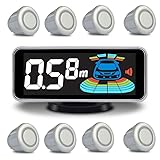
- When the product is working, the sensor emits ultrasonic waves. When encountering an obstacle, the ultrasonic waves are reflected. The sensor receives the reflected signal and transmits it to the control box. Through calculation, the control box obtains the distance between the vehicle and the obstacle, and reminds the driver to pay attention through the display and sound, etc., to avoid danger. It is a good helper for us to drive the car!
- 1: When reversing, activate the rear 4 sensors and the front 2 sensors to detect and alarm. During normal driving, when braking, the 4 sensors in front of the car are activated to assist the driver to safely pass through narrow passages. When you release the brake, the parking sensor will work for about 15 seconds before stopping.
- 2: The product alerts the driver through sound, numbers, and light bars at the same time.
- 3: Probe behind the car to prevent collision, probe in front of the car to prevent rubbing.
- 4: On the display, there are 8 light bars representing each sensor, allowing the driver to distinguish the orientation of obstacles.
Property-damage liability insurance works differently. The NAIC describes it as paying for damage an insured person causes to another person’s property, including through a negligent auto accident. It is relevant only if the person who hit the ball is shown to be responsible and has a policy that covers the loss. It does not establish that anyone is liable or insured for this incident.
If the damage is a chip in the windshield
A small chip caused by a ball may be a candidate for a repair rather than a full replacement, and some comprehensive policies treat glass damage differently from other losses. A large crack, or a windshield that is structurally compromised, generally needs professional replacement. Do not assume a do-it-yourself kit is suitable for anything beyond a small chip.
Best Value

- [Automatic Front Bull-Bar Recognition]:Promata 58 KHz OE quality sensor with full detection coverage,ensures accurate detection,even with a bull-bar installed
- [Intelligent and Adjustable Alarm]:Customise the alarm volume to your preference (low, medium, high),no longer have to hear the shrill and constant alarm when vehicle is at standstill and stuck in traffic
- [Audio Mute Funtion]:When the vehicle is stopping or reversing,PS-01 will reduce the audio volume,let the driver can hear the parking sensor warning clearly,ensuring every parking experience is a seamless one
- [Self Test Function for Faulty Sensors]:Identifies and alerts you to any sensor issues to prevent accidental collisions and keep you safe on the road
- 58KHz OE Standard Sensor:At the heart of the PS-01 lies Promata 58KHz OE-quality ultrasonic sensor,providing superior coverage and accuracy compared to traditional 40KHz sensors.With its enhanced capabilities,this front parking sensor system ensures reliable detection of obstacles,even in the tightest spaces
What to do after the impact
- Photograph the damage, the car’s position, and the surrounding area before moving the vehicle or starting repairs.
- Write down the date, time, and place, and how the ball struck the car, if you know.
- Collect witness names and phone numbers. Ask for the player’s or the facility’s contact details where that is appropriate.
- Contact your auto insurer promptly. Ask whether the loss falls under comprehensive coverage, what your deductible is, and what documentation the insurer needs.
- Keep repair estimates, receipts, and all written communication with insurers, the player, or the facility.
- If another party disputes responsibility or the damage is significant, consult a local attorney or a consumer assistance resource familiar with your state’s law.
Common mistakes that weaken a claim
- Assuming the golfer, the course, or the car owner automatically pays. Liability has to be established under the law where the damage happened.
- Repairing the car or discarding the ball before photographs and witness details are recorded.
- Treating a general insurance description as confirmation that a particular claim is covered.
- Applying a sports-injury ruling to a parked car without checking that the facts and state law match.
When the amount at stake is small, many people choose to file under their own comprehensive coverage rather than pursue a dispute, but that decision depends on the deductible, the repair estimate, and whether a claim could affect your premium under your insurer’s rules.
Quick Recap
“
Product prices and availability are accurate as of the date/time indicated and are subject to change. Any price and availability information displayed on Amazon at the time of purchase will apply.




