What’s actually slowing this PC down?
Pick the symptom - the matching free tool is one click away.
On most U.S. personal checks, the account number is the group of numbers along the bottom, usually between the nine-digit routing number and the check number. The routing number normally appears first; the check number commonly appears in the upper-right corner and is repeated in the bottom line.
This is the standard layout, not a rule for every check. Business checks, cashier’s checks, computer-generated checks, and some nonstandard designs can arrange the numbers differently. If the order is unclear, verify the account and transaction-specific routing number through your bank’s app, website, statement, or customer service before submitting it.
As an Amazon Associate I earn from qualifying purchases.
How to find the account number on a personal check
- Turn the check face-up.
- Look at the machine-readable line of numbers near the bottom edge. This is the MICR line.
- Find the first group, which is normally a nine-digit routing number.
- On a standard personal check, the next group is usually the account number.
- Look at the small number printed in the upper-right corner. If the final group on the bottom line matches it, that final group is the check number—not the account number.
The usual pattern is:
Bottom of check: [routing number] [account number] [check number]
For example, this is a fictional illustration only:
123456789       001234567890       1042
 routing          account           check
The Federal Reserve describes the MICR line as information printed near the bottom of a check that may include the routing number, account number, check number, check amount, and other processing information. The American Bankers Association explains the common routing-number, account-number, and check-number arrangement.
#1 Best Overall

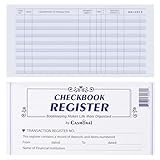
- Compact and Sturdy: These checkbook registers offer clear pages with 17 lines each, making it easy to track account withdrawals; The bold layout and spacious rows and columns (0.32 in wide) provide a comfortable writing experience
- Simplify financial management: The Casmonal account books help you effortlessly remember automatic deductions, dodge overdraft risks, and gain insight into your spending patterns, making financial tracking simple and clear
- Financial instruments: These transaction Registers simplifie your financial monitoring, helping you easily manage your balance, precisely budget, and work towards your financial goals; It's a convenient tool for achieving financial success
- Personal and Small Business Finances: The check register simplifies tracking of payments and deposits, equipped with columns for item numbers, transactions, and balances, making it an ideal tool for managing both personal and small business finances
- Small and Portable: These compact 6x3 inches checkbooks are perfect for on-the-go financial tracking and feature a stylish calendar from 2026 to 2028, guiding you through a better financial journey
Fast answer: On a typical personal check, use the middle bottom group as the account number—but confirm it with your bank if the check does not clearly follow this pattern.
Account number vs. routing number vs. check number
| Number | Usual location | What it identifies | What to know |
|---|---|---|---|
| Routing number | Usually the first group on the bottom; normally nine digits | The bank or credit union | A bank may use different routing numbers for paper checks, ACH payments, domestic wires, regions, or account types. |
| Account number | Usually the group after the routing number on a personal check | Your specific checking account | Its length and formatting vary by financial institution. It is not necessarily the same as the number shown on your debit card. |
| Check number | Usually in the upper-right corner and repeated in the MICR line | The individual paper check | It is a serial number for that check, not the bank account number. |
The routing number identifies the financial institution, while the account number identifies the account at that institution. Under the ABA system, a routing number is nine digits. There is no universal account-number length: institutions use different lengths and formats, and some forms permit an account-number field of up to 17 characters. Do not select a number merely because it has a particular number of digits.
Do not confuse the account number with other numbers
- Upper-right number: Usually the check number. Do not enter it when a form asks for your account number.
- Debit-card number: Identifies the card, not necessarily the checking or savings account connected to it.
- Routing number: Identifies the institution, not your individual account.
- Fractional routing number: Some checks also show a fractional form of the routing number near the upper-right area. It is still a routing identifier, not the account number. The Federal Reserve explains the fractional routing-number format.
What if the number is not the middle group?
The middle-group shortcut applies mainly to standard U.S. personal checks. Do not rely on position alone when the check looks unfamiliar.
Other exceptions include:
- Nonstandard personal-check designs: Some checks place the account number before the routing number or use a different order. Discover warns that some checks show the account number first.
- Cashier’s checks: These are drawn on the issuing bank’s funds and may not show your personal checking-account number.
- Government and payroll checks: The printed information may belong to the government agency, employer, or issuing payment account—not to your own receiving account.
- Computer-generated and online bill-pay checks: The account information may belong to the payer, issuing bank, or payment processor.
- Foreign checks: Checks from outside the United States can use different layouts and banking identifiers. The U.S. ABA routing-number and MICR explanation may not apply. International payments may instead require identifiers such as a SWIFT/BIC code. The U.S. Bank overview of ABA routing numbers describes their U.S. scope.
The safest rule is: when a form asks for your account number, use your bank’s own account details—not an unfamiliar check’s number simply because of where it appears.
If the check belongs to someone else
The account number printed on a check someone else wrote is generally the writer’s account number, not yours. It identifies the account from which the check is drawn. If you are depositing that check, you need the account number for your own receiving checking or savings account.
Find your receiving account number in your own bank app, online banking, statement, or official direct-deposit form. Do not copy the account or routing number from the check you received.
Rank #2
- Compact and Sturdy: These checkbook registers offer clear pages with 17 lines each, making it easy to track account withdrawals; The bold layout and spacious rows and columns (0.32 in wide) provide a comfortable writing experience
- Simplify financial management: The Casmonal account books help you effortlessly remember automatic deductions, dodge overdraft risks, and gain insight into your spending patterns, making financial tracking simple and clear
- Financial instruments: These transaction Registers simplifie your financial monitoring, helping you easily manage your balance, precisely budget, and work towards your financial goals; It's a convenient tool for achieving financial success
- Personal and Small Business Finances: The check register simplifies tracking of payments and deposits, equipped with columns for item numbers, transactions, and balances, making it an ideal tool for managing both personal and small business finances
- Small and Portable: These compact 6x3 inches checkbooks are perfect for on-the-go financial tracking and feature a stylish calendar from 2026 to 2028, guiding you through a better financial journey
How to find your account number without a check
A check is not required. Use these sources, preferably in this order:
Recommended Free Tools
- Mobile banking or online banking: Open the relevant account and look for “Account details,” “Account & routing number,” “View details,” or similar wording.
- Bank statement: Look near the account heading. Statements often mask all but the last four digits, so a statement may confirm only part of the number.
- Bank or credit-union customer service: Ask for the account number and the routing number for the specific transaction. Expect identity verification.
- Official direct-deposit form: Some banks can generate a prefilled form containing the correct account and routing information.
Bank menus change. The following are examples of paths reported as checked on August 10, 2026, not permanent instructions:
- Chase mobile app: Sign in → select the account tile → Show details.
- Chase website: Sign in → select the account name → Account & routing number.
- Capital One website: Sign in → select the account → View details.
- Capital One mobile app: Select the account → Account Details → View All.
- U.S. Bank mobile app: Select the account → Manage → Account & routing number.
- Wells Fargo Online: Select the account; the full account number is accessed from the account name and the four digits displayed beneath it.
For a savings account, there may be no personal checks to inspect. Use the account’s online details or ask the bank instead of trying to infer the number from a debit card or masked last-four display. See Capital One’s account and routing-number instructions and Chase’s account and routing-number guidance for examples.
Can you use the number on a check for direct deposit or automatic payments?
Usually, a personal check provides the routing and account information needed to identify a checking account for direct deposit or an ACH payment. But reading the check is only the first step. Verify the information with your financial institution before submitting it.
Use this verification checklist
- Correct account: Confirm that the account number belongs to the account that should receive the deposit or pay the automatic bill.
- Correct account type: Select checking or savings exactly as required by the form.
- Correct routing number: Confirm that it is the routing number for ACH or direct deposit—not merely the number used for paper checks or domestic wires.
- Correct institution: Make sure the account is still open and held at the institution named on the form.
- Correct formatting: Follow the receiving organization’s instructions about spaces, dashes, leading zeroes, and other characters.
- Correct name: Some government or payroll programs require the account holder’s name to meet specific requirements.
Routing numbers can be transaction-specific. A bank may publish separate numbers for paper checks, ACH transfers, domestic wires, different states, or different account types. Bank of America explains that routing numbers can vary by transaction; Wells Fargo also notes that routing numbers can differ by account or wire type.
Do these 3 things before closing this tab:
1Scan for outdated or missing drivers - takes under a minute2Clear out junk files and repair common Windows errors3Fix the driver behind crashes, sound loss and screen glitchesDo not assume that the routing number on a deposit slip is the right one for direct deposit. The IRS warns that a deposit-slip routing number can differ from the routing number printed on checks and advises taxpayers to verify the information with their financial institution. Social Security guidance similarly says to obtain the routing and depositor account numbers from the financial institution and not rely on a deposit-slip number without verification. See the IRS direct-deposit instructions and Social Security guidance.
Rank #3

- 12 Easy Read Register Checkbook Transaction Registers: Balance your check account withdrawals with this checkbook register featuring 16 lines per pages. This thicker body paper is small enough to carry in your pocket or wallet. Column headings are bold easy to read.
- Made in the USA. Each register has 444 lines. Lines are gray in color. Standard checkbook registers having Item No. Date, Description of Transaction, Payment Debit, Deposit Credit and Balance Column.
- High-quality ink print is easy on the eyes and a great booklet for easy insertion into your checkbook.
- Calendars on Back: Check register has up-to date 2025-2026-2027 calendars printed on the back.
- Checkbook Measures: Checkbook register measures 6x3 inches.
For a wire transfer, do not simply reuse the routing number from a check. Ask the bank for the institution’s domestic-wire instructions. For an international payment, ask whether a SWIFT/BIC or another identifier is required.
Incorrect direct-deposit information can cause a payment to be rejected, delayed, or sent to the wrong account. For an IRS refund, the agency specifically advises taxpayers to verify account and routing information with their financial institution before submitting it. See the IRS direct-deposit refund guidance.
How to use a voided check safely
An employer, payroll provider, lender, or payment company may ask for a voided check to set up direct deposit or an electronic payment. To prepare one:
Free tools Windows power users keep installed
One-click scans. No signup required.
- Write VOID clearly across the front of the check.
- Do not cover the routing and account numbers unless the recipient specifically tells you to do so. The information is needed for legitimate account setup.
- Submit the image or check only through a verified employer, bank, payroll, or payment-provider channel.
- Keep a record of where you sent it and why.
Is it safe to share an account number printed on a check?
Use caution. An unredacted check can expose the account holder’s name, address, signature, routing number, and account number. The FDIC identifies this combination of information as potentially useful in payment fraud. Account and routing information does not automatically give someone unrestricted access to an account, but it can provide the means to attempt certain withdrawals, including a demand draft or similar payment supposedly authorized by the account holder. The Consumer Financial Protection Bureau explains this risk.
Practical precautions:
- Do not post an unredacted check photo on social media, a public forum, or a marketplace listing.
- Confirm the recipient independently before sending a check image.
- Use a secure bank, payroll, employer, or payment-provider portal rather than an unverified email address.
- Do not share a full check image when the recipient needs only selected information.
- Monitor the account for unfamiliar ACH debits, checks, or other transactions.
- Contact the bank immediately if a checkbook, check image, or account information was exposed.
Report suspicious activity promptly. Available protections and the bank’s procedures can depend on the type of transaction and how quickly you notify the bank; they are not identical for every unauthorized payment. The CFPB provides guidance on monitoring and reporting suspicious bank-account activity.
Rank #4

- Keep Your Finances Organized: A very simple and efficient check register, it suitable for personal and commercial use. You can record checks, deposits, withdrawals and any budget notes you want to achieve your financial goals.
- Holds a Lot of Entries:2834 entries in total /26 entries each page. So many pages and this will last a long time. You can keep it instead of the individual check registers. More room to make notes on an entry. Each line is big enough to read what is written.
- Thick Pages and doesn’t Bleed Through: 100gsm paper, no bleed through. 180°lay flat so it’s easy to write in. With a pen loop, bookmarker and pocket for storing receipts and checks.
- Perfect Size for Carrying: Register book Size 5.8in x 8.3 in, perfect size for keeping track of multiple accounts. Enough to take with you in your purse and write down transactions through out the day.
- Ideal Gift Options: Great for keeping banking activity. A great present for Children, parents, colleagues, friends. during various holidays, birthdays and anniversaries, such as Christmas, Thanksgiving, Mother's Day.
What to do when the number is hard to read
Do not guess at a smudged digit or assume that a group is the account number because it is the longest or shortest. Stop and use this recovery process:
The Tool Desk
Outbyte PC Repair FREERepair Windows errors before they cause bigger problemsFix Now →Outbyte Driver Updater FREEFix the driver behind crashes, sound loss and screen glitchesFind Drivers →- Compare the check with an official source: Check your bank app, online account details, or a recent statement.
- Use the check number as a cross-check: Compare the upper-right check number with the bottom groups. If it does not match any expected check-number group, the layout may be different.
- Ask the bank to verify both numbers: Request the account number and the routing number for the intended payment type.
- Confirm checking or savings: A correct number paired with the wrong account type can still cause a rejected payment.
- Ask about special formatting: Find out whether spaces, hyphens, leading zeroes, or symbols should be included or omitted.
- Check the account status: A recently changed, merged, or closed account may no longer accept deposits or debits.
- If you already submitted incorrect information: Contact both the receiving organization and your bank immediately.
Common mistakes to avoid
| Mistake | Why it fails | Better approach |
|---|---|---|
| Entering the small number in the upper-right corner | That is usually the individual check number. | Use the account group from the bottom line, then verify it. |
| Using the debit-card number | A card number is a separate identifier. | Use the account details shown by the bank. |
| Assuming the second group is always the account number | Business and nonstandard checks can use other layouts. | Confirm the layout with the bank. |
| Using the routing number from someone else’s check | It identifies the other person’s institution and may not apply to your account or transaction. | Use the routing number displayed for your own account and payment type. |
| Using a deposit-slip routing number without checking | It may differ from the check or ACH routing number. | Ask the bank which routing number the form requires. |
| Inferring the full account number from the last four digits in an app | Many apps intentionally mask most of the number. | Open the full account-details view or contact the bank. |
| Removing spaces or hyphens arbitrarily | The receiving system may require a particular format. | Follow the receiving form’s instructions. |
| Copying information from a check received from someone else | That is generally the payer’s account, not yours. | Use your own receiving account information. |
Frequently Asked Questions
Is the account number always the middle group on a check?
No. The middle group is the usual account-number location on a standard U.S. personal check. Business checks may include an auxiliary on-us field, and some nonstandard checks place the account number elsewhere. Verify an unfamiliar layout with the issuing bank.
Is the check number the same as the account number?
No. The check number identifies one individual paper check. It is commonly printed in the upper-right corner and repeated in the bottom MICR line. The account number identifies the checking account.
Is the routing number the same for ACH, checks, and wire transfers?
Not necessarily. A financial institution may use different routing numbers for paper checks, ACH or direct deposit, domestic wires, regions, or account types. Use the number supplied by the bank for the specific transaction.
Can I find my account number without a check?
Yes. Look in your bank’s mobile app or website under Account details or Account & routing number. You can also check a statement, request an official direct-deposit form, or call the bank after identity verification. A statement or app may show only the last four digits.
Where is the account number on a business check?
It may not be a simple middle group. Business checks can include an auxiliary on-us field to the left of the routing number and may combine account and check-serial information. Ask the issuing bank rather than relying on the personal-check pattern.
Best Value
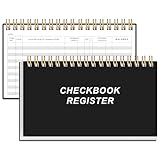
- MANAGE EASILY - This checkbook registers will help you track and manage your personal finances, savings, debts, and bills for your bank account. Use the account track notebook to keep your budget in balance, and develop good bookkeeping habits to meet your financial goals.
- UNIQUE DESIGN - This check registers total 65 sheets/130 pages contains: offer clear pages with 17 lines each, making it easy to track account withdrawals; The bold layout and spacious rows and columns (0.32 in wide) provide a comfortable writing experience, an annual overview (calendar from 2025-2026), yearly goals page, 8 pages (lined) for notes, lists, goals, etc, that helping you easily manage your balance, precisely budget, and work towards your financial goals; It's a convenient tool for achieving financial success
- A6 SIZE/POCKET SIZE - The transaction registers size of 3.75" x 6.75". Check registers for personal checkbook. Just the perfectly size to fit in your wallet, purse or laptop case. Without taking up your space and always helping you keep track of your finances.
- SUPERIOR QUALITY - This transaction registers with 100gsm thick paper to reduce ink leakage, erase fraying and shade issues. Sturdy and flexible PP cover to protect the inner pages well. Strong metal and lay-flat twin-wire binding, Planner with inner pocket to store loose items, like tickets, cards etc and elastic closure to protect your finance planner.
- THE PERFECT GIFT - Use check register book for your personal or business finances, give it to your friends, colleagues as a gift for Birthday| Easter|Children's Day|Halloween|Thanksgiving|Christmas|Back to school and New Year's Day.
What if my check does not show an account number clearly?
Do not guess. Compare it with your bank’s official account details and ask the bank to verify the account number and the routing number for the intended payment type. Smudging, masking, unusual formatting, or a nonstandard check design can make the bottom line difficult to interpret.
Is a debit-card number the same as a bank account number?
No. The debit-card number identifies the card. It is separate from the checking or savings account number, even though the card may be linked to that account.
What account number should I use when depositing someone else’s check?
Use the account number for your own receiving account. The account number printed on the other person’s check generally belongs to the writer and identifies the account from which the check is drawn.
Windows Errors? Fix Them Before They Spread
Repair common Windows errors and clear accumulated junk for a smoother, more stable PC - no reinstall needed.Free scan · no reinstallCrashes, No Sound, or Screen Glitches?
Random freezes, missing sound and display glitches usually trace back to one bad driver. Find and replace yours safely.Free scan · under a minuteCan I safely send a picture of a voided check?
Send it only to a verified employer, bank, payroll provider, or payment company through a secure channel. Do not post an unredacted image publicly. A check can expose your name, address, signature, routing number, and account number; monitor the account and contact the bank promptly if the image is exposed.
The Bottom Line
For a standard U.S. personal check, the account number is usually the middle group on the bottom MICR line: after the nine-digit routing number and before the check number. Treat that as a starting point, not proof. Confirm the account, account type, and transaction-specific routing number through your bank before using the information for direct deposit, ACH payments, automatic payments, tax refunds, or wires.
Quick Recap
Product prices and availability are accurate as of the date/time indicated and are subject to change. Any price and availability information displayed on Amazon at the time of purchase will apply.




