Quick wins for a faster PC:
Clear out junk files and repair common Windows errorsFree Scan →Fix the driver behind crashes, sound loss and screen glitchesFind Drivers →Illinois produced more pumpkins than any other U.S. state in 2025. The USDA Economic Research Service (ERS) puts its crop at about 533 million pounds—slightly more than the next four states combined. But that ranking describes state production, not the origin of every pumpkin at a farm stand or every can in a pantry. Fresh and ornamental pumpkins are grown across the country, while Illinois’s lead is closely tied to pumpkins raised for processing.
Which state grows the most pumpkins?
Illinois held the top spot in the latest USDA ERS figures, which cover the 2025 crop and were updated September 29, 2026. U.S. production totaled 1.47 billion pounds. Illinois produced about 533 million pounds—more than California, Indiana, Michigan and Pennsylvania combined.
The state ranking below compares reported 2025 production. Harvested acreage is included to show the scale of each crop; acreage is not a measure of yield or of how many individual pumpkins a state grows.
| State | 2025 pumpkin production | 2025 harvested acres |
|---|---|---|
| Illinois | About 533 million pounds | 14,800 |
| California | About 162 million pounds | Not stated in the cited 2025 ERS figures |
| Indiana | About 135 million pounds | Not stated in the cited 2025 ERS figures |
| Michigan | About 115 million pounds | Not stated in the cited 2025 ERS figures |
| Pennsylvania | About 105 million pounds | Not stated in the cited 2025 ERS figures |
ERS reports that the four states after Illinois each harvested between 4,900 and 7,700 acres in 2025; it does not attach a state-by-state acreage figure to that range in the cited summary. Total U.S. pumpkin acreage was 68,100 acres that year. USDA ERS pumpkin statistics (2025 crop; updated September 29, 2026).
What’s actually slowing this PC down?
Pick the symptom - the matching free tool is one click away.
#1 Best Overall

- Contents: This mixture of seeds includes more than 7 varieties of Pumpkins. A blend of Jack O' Lantern, Blue Jarrahdale, Atlantic Giant, Fairytale, Small Sugar, Jack Be Little, Cumshaw Green Striped, Connecticut Fields, Cinderella, Howden & more!
- Harvest: The different varieties of pumpkins grown from this seed mixture will be ready for harvesting from 90 days to 125 days. Placing straw underneath the fruits as they mature can prevent rot.
- Note: Take note that larger seeds grow larger varieties of Pumpkins and smaller grow medium to miniature sized pumpkins. Smaller seeds produce shorter harvesting dates and vice versa.
- Quality: All seeds packaged by Seed Needs are intended for the current and the following growing seasons. All seeds are stored in a temperature controlled facility that is free of significant amounts of moisture.
- Quantity: Seed Needs offers generous quantities. You can share with friends and family, or you can save the extra seeds until the following season, if properly stored.
Why does Illinois lead?
The key is that “pumpkin” covers different markets. Fresh and ornamental varieties are sold for decoration and direct consumption. Processing pumpkins are grown for products such as canned puree, pie filling, soup and prepared foods. Illinois’s production advantage is particularly associated with the processing side of the business.
Illinois grows a large share for processing
In 2022 Census of Agriculture data summarized by ERS, nearly 70 percent of Illinois pumpkin acreage was devoted to processing. The comparable shares were roughly 3 percent in Pennsylvania and less than 1 percent in Indiana and California. Processing production tends to be concentrated near canning facilities, which helps explain why a state can dominate national production totals without supplying every local pumpkin market.
Rank #2

- FOUR HEIRLOOM VARIETIES – Small Sugar, Jack O’ Lantern, Fairytale & Casper pumpkins for sweet pies, carving traditions, and fall decorating
- COOKING & STORAGE – Bake pies, roast seeds, or can pumpkin puree; dependable harvests for family meals and long-term food storage
- CARVING & hOLIDAY FUN – Grow classic orange Jack O’ Lanterns and ghost white Caspers for halloween, autumn décor, and seasonal traditions
- GROW ANYWHERE – Reliable germination in garden beds, raised planters, or containers; suitable for spring planting or fall gardening projects
- FAMILY OWNED USA SMALL BUSINESS – heirloom non-GMO seeds from Survival Garden Seeds, a trusted American brand; always open-pollinated, untreated, and quality tested for garden success
ERS’s 2020 discussion of Illinois and processing plants offers historical context for that relationship, but the acreage shares above come from the 2022 Census data summarized on the current ERS page. USDA ERS pumpkin statistics; USDA ERS historical Illinois processing analysis.
Production totals are not a climate verdict
ERS describes pumpkin production as geographically widespread, with crop conditions varying by region. The available figures support the importance of Illinois’s processing mix and proximity to processing facilities; they do not establish one simple climate explanation for the state’s lead.
Rank #3

- Fruit Size: Varied seed blend produces pumpkins ranging widely from two to twenty pounds in diverse, whimsical proportions.
- Appearance: Eclectic combination of bright orange, white, and bicolored rinds in smooth, warty, round, or flattened forms.
- Best Uses: Ideal for diverse doorstep displays, colorful carving selections, festive autumn decor, and school gardens.
- Growing Tips: Plant in fertile mounds with full sun, watering evenly to support diverse growth rates across mixed plants.
- Quality - All Primrose seeds packaged by Seed Needs are intended for the current and the following growing seasons. All seeds are stored in a temperature controlled facility that is free of significant amounts of moisture.
Does every pumpkin come from Illinois?
No. The USDA reports that fresh-market pumpkins were grown in all 50 states in the 2022 Census of Agriculture. More than 15,000 U.S. farms produced fresh-market pumpkins that year, whereas processing production was more concentrated. Of the nation’s 959 processing-pumpkin farms, nearly 15 percent were in Illinois.
That spread is why an Illinois production crown should not be read as a claim about the origin of every jack-o’-lantern or grocery-store pumpkin. National and state totals describe aggregate production, not the supply chain for an individual item. The figures also cannot establish where a particular can of pumpkin puree was grown or processed. Check product labeling or ask the seller if you need an item-specific origin. USDA ERS, 2022 Census findings for fresh and ornamental pumpkins.
Rank #4

- Name: Big Max Pumpkin | Type: Heirloom
- Size at Maturity: 100+ Pounds | Days to Maturity: 110 Days
- Light Requirement: Full Sun | Planting Time: Warm Season
- Sowing Method: Direct Sow
- Planting Depth: 1-1 1/2" | Plant Spacing: 48"
What the numbers say about pumpkins Americans consume
ERS estimates average U.S. pumpkin availability at about 6 pounds per person per year for 2022–2025, measured on a fresh farm-weight basis. Its 2025 figure is 5.2 pounds per person. Availability is an agricultural supply measure, not a direct estimate of how much pumpkin each person actually eats; it should not be confused with a tally of whole pumpkins purchased for decoration.
The same ERS series puts Illinois’s average production at about 37,000 pounds per acre over 2022–2025. In 2025, the average Illinois grower price was $48 per 1,000 pounds, reflecting the state’s processing-heavy mix. That farm-level price is not a retail price for a pumpkin or canned product. USDA ERS pumpkin statistics.
Recommended Free Tools
Best Value
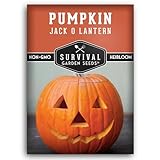
- HALLOWEEN CLASSIC – Reliable jack o'lantern pumpkin that grows 18–24 pound fruits, perfect for carving spooky faces or festive fall porch displays
- TASTY & VERSATILE – Smooth orange pumpkins that can be roasted, baked, or pureed for pies, soups, and other comforting fall recipes
- GROW WITH CONFIDENCE – Easy to cultivate in full sun with regular watering, producing uniform pumpkins ready in about 100 days
- PLANT NOW OR STORE – Seeds stay viable for multiple seasons when stored properly, so you can grow pumpkins this year or in the future
- FAMILY OWNED USA SMALL BUSINESS – Heirloom non-GMO seeds from Survival Garden Seeds, a trusted American brand; always open-pollinated, untreated, and quality tested for garden success
How to read other Illinois pumpkin figures
USDA’s National Agricultural Statistics Service (NASS) reported 14,400 harvested pumpkin acres and 4,536,000 hundredweight of production for Illinois in 2024. Those are 2024 figures in hundredweight, while the ERS national comparison above uses rounded pounds for the 2025 crop. They are useful as a separate year-and-source check, not as interchangeable entries in the same-year ranking. USDA NASS 2024 Illinois State Agriculture Overview.
Quick Recap
Product prices and availability are accurate as of the date/time indicated and are subject to change. Any price and availability information displayed on Amazon at the time of purchase will apply.




