Do these 3 things before closing this tab:
1Scan for outdated or missing drivers - takes under a minute2Clear out junk files and repair common Windows errors3Fix the driver behind crashes, sound loss and screen glitchesA pharmacy benefit manager (PBM) is a company a health plan or plan sponsor hires to administer some or all of its prescription drug benefit. PBMs can process prescription claims, negotiate drug-price concessions, set up pharmacy networks, and administer coverage rules. Their choices can affect a plan’s spending, a pharmacy’s reimbursement, and what a patient pays—but those amounts are not the same, and PBM contracts vary.
What a PBM does
A PBM sits between a health plan and the pharmacies and manufacturers involved in providing prescription drugs. It is not itself the insurer, drug manufacturer, or dispensing pharmacy. Depending on its contract, a PBM may handle several parts of a plan’s prescription benefit:
- Claims processing: When a pharmacy submits a prescription claim, the PBM checks it against the plan’s coverage and payment rules.
- Formulary administration: A formulary is the plan’s list of covered medicines and related conditions. PBMs may help develop or administer it.
- Pharmacy networks: PBMs can contract with pharmacies and help determine which pharmacies are in a plan’s network.
- Price negotiations: PBMs may negotiate rebates and other concessions from drug manufacturers.
- Pharmacy payment arrangements: A PBM may contract with pharmacies and determine claim reimbursement under its agreement with the plan.
These responsibilities are not identical across PBMs or contracts. The Government Accountability Office (GAO) describes PBMs as providing services to health plans and plan sponsors, while the Centers for Medicare & Medicaid Services (CMS) identifies reporting categories that include rebates, pharmacy channels, generic dispensing, and spread pricing. GAO’s 2024 report, its 2019 report, and CMS’s drug-data guidance describe these roles and arrangements.
How a prescription benefit flows through a PBM
- A health plan or plan sponsor hires a PBM to manage specified parts of its prescription benefit.
- A patient presents a prescription at a pharmacy. The pharmacy submits a claim to the PBM.
- The PBM applies the plan’s coverage and network rules and returns the claim decision and payment information.
- The pharmacy dispenses the medicine and receives payment under its contract. The patient pays any applicable cost sharing at the point of sale.
- Manufacturer rebates or other concessions may be negotiated and reported later, changing the plan’s net cost after the prescription has been dispensed.
This is a simplified sequence, not a universal accounting flow. Contracts, payment timing, and the route by which money moves differ across plans and products.
#1 Best Overall

- AM/PM COMPARTMENTS: Plan doses for morning and evening with separate AM/PM compartments
- LARGE CAPACITY: Each compartment can hold 12 aspirin sized tablets
- CONTOURED BOTTOMS: Planner compartments have contoured bottoms so retrieving your medication out of the planner is simple
- CLEAR LIDS: Clear planner lids keep your medication visable to help prevent missed doses
- HEALTHY LIVING: Amazon Basic Care products make living healthier simply easier
Why drug spending, pharmacy payment, and your cost can differ
Several figures are often described as “the price” of a prescription, but they measure different things. The amount charged or paid at the pharmacy counter is not necessarily the plan’s final net cost after later concessions. Pharmacy reimbursement is also a separate contract amount, and a patient’s cost sharing depends on the plan’s rules.
- Gross spending is measured before rebates and other price concessions are deducted.
- Net plan spending reflects the effect of applicable concessions, subject to how they are accounted for and passed through under the arrangement.
- Pharmacy reimbursement is what the pharmacy receives under its contract for a claim; it should not be confused with the manufacturer’s price or the patient’s payment.
- Patient out-of-pocket cost is the amount the patient owes under the plan at the point of sale. A later rebate does not automatically mean the patient paid less at the counter.
For historical context, GAO reported that rebates and other price concessions in Medicare Part D reached $29 billion in 2016—20% of gross expenditures that year. Gross Part D expenditures were $145.1 billion and net expenditures were $116.1 billion. These are GAO figures for Medicare Part D in 2016, not current estimates for all drugs or insurance markets. GAO’s analysis explains why gross and net spending should not be treated as interchangeable.
Rank #2

- AWARD-WINNING DESIGN: Recipient of the Arthritis Foundation Ease-of-Use Commendation for its effortless, push-button opening—perfect for individuals with arthritis or limited dexterity, making medication management easier and pain-free
- PHARMACIST DESIGNED: Features four silicone “feet” that firmly grip the counter, keeping the planner stable and secure. This thoughtful design allows for easy one-handed opening, making medication management simpler and more convenient
- EXTRA LARGE PILL STORAGE COMPARTMENTS: Each oversized AM/PM section holds up to 35 Aspirin—perfect for organizing large supplements, fish oil, vitamins, and daily medications. Ideal pill organizer for arthritis hands, seniors, and travel use
- CONTOURED SCOOP BOTTOM: The specially designed curved base lets you easily remove pills using just your fingertips, eliminating the need for digging or tipping, making medication access quick and hassle-free
- BUILT TO LAST: Crafted with high-quality BPA-Free materials, this durable design is made to endure repeated use over time without wear, ensuring long-term reliability and consistent performance for your daily medication needs
How rebates and spread pricing work
Rebates and other concessions
A manufacturer may provide a rebate or another price concession after a drug is dispensed. The concession can lower a health plan’s net cost, but it does not, by itself, establish what the patient paid at the pharmacy or how much the dispensing pharmacy received. The effect on patients depends on the plan’s cost-sharing rules and the PBM’s contract with its client.
Spread pricing
CMS defines reported spread pricing as the aggregate difference between what a qualified health plan pays a PBM and what the PBM pays retail and mail-order pharmacies. This describes a possible payment arrangement; its inclusion in reporting rules does not mean every PBM contract uses spread pricing. CMS’s definition and reporting guidance concern qualified health plans and should not be generalized into a claim about every insurance arrangement.
Windows Errors? Fix Them Before They Spread
Repair common Windows errors and clear accumulated junk for a smoother, more stable PC - no reinstall needed.Free scan · no reinstallCrashes, No Sound, or Screen Glitches?
Random freezes, missing sound and display glitches usually trace back to one bad driver. Find and replace yours safely.Free scan · under a minuteRank #3

- Spring Assisted Open Design. We use the latest design on this weekly pill organizer to achieve one-handed operation with the little rubber strips for the smart "lid spring open" feature. The lids are all beautifully colored and marked clearly with the date, everything is clear at a glance so you may find it easy to choose the pills you need. It's quite nice for easy daily dispensing and big enough to hold 8 fish oils or 12 large vitamins for each dose (size of each compartment: 1.3"x1.18"x0.82")
- Say Goodbye to Dumpage Pills. No worries about unwanted dumpage of pills found by pets and kids for your slightest unintentional or incidental touch on the medicine organizer. The push button stays closed once locked and securely snap shut keeping pills safe. It's small and perfectly suitable for travel and is ideal for storing small jewelry or items such as earrings, beads, nail art tips, ect.
- Premium Screen Printing. To avoid screen-printing fonts and icons falling off from the surface of the pill box, we use high-end screen printing ink and strictly do the Ink Adhesion Test with 3M Tapes before shipment. Thus, no need to be frustrated with the missing fonts of "Tuesday" or icons of "PM", and worry about mistakenly taking the wrong tablets.
- BPA-Free Material. This pill case is pretty safe because of being made of food grade materials. You would be worry-free with the BPA-free pill boxes and organizer when storing multiple pill regimes inside. With the transparent plastic lid, it's quite easy to distinguish the pills in each dose without opening the lids.
- What You Receive: 1 x AUVON iMedassist Pill Holder, our 12-month warranty, and friendly customer service.
How formularies and pharmacy networks affect patients
A formulary can determine whether a medicine is covered, what coverage conditions apply, and what alternatives a plan recognizes. A network determines which pharmacies can fill prescriptions under the plan’s preferred terms. Together, these choices can influence a patient’s access to a medicine or pharmacy and the cost sharing that applies.
The Federal Trade Commission (FTC) said in its 2024 interim staff report that leading PBMs have significant influence over formulary and pharmacy-network decisions. That is the FTC’s assessment, not a claim that every PBM makes every coverage decision independently of its plan client. The FTC report release also found that nearly 80% of approximately 6.6 billion U.S. prescriptions in 2023 were processed by the three largest PBMs. The figure refers to U.S. prescription volume in 2023, not the share of all drug spending or all patients.
Rank #4

- Carry More but Portable - Overall 8''x 5''x 1.4'' and 4.8" x 1.2" x 1'' for each compartment, pill box 3 times a day is with enough storage for your medicine and very portable while traveling. You can also take each day separate pill case out instead of the whole pill box 7 day for your daily life
- Pill Organizer 3 Times a Day - From morning to evening, our weekly pill organizer 3 times a day considering any moment you take medicine. You can organize your pills and vitamin only once a week with our medicine organizer 3 times a day
- Excellent Printing Pill Holder - Bold letter marks on the daily pill box organizer will remind you what to take by the day. The printing of the pill organizer weekly has passed the critical 3M adhesives & tapes test, and won't rub off after over 5000 times of use
- Easy Open 7 Day Pill Organiser - With easy open design, the elderly or patients can also open the pill cases organizers 7 day
- Double Protection Design - Premium solid ABS outer container and high-quality weekly pill organizer provide double protection for your pills. Don't need to worry about pills spilling in your bag or suitcase anymore, pill organizer 3 times a day closes tightly all the time
What government reports say—and what the figures cover
Agency findings help describe PBM practices, but each figure has a defined scope. The FTC’s interim reports, in particular, analyze specified data and should not be read as a complete accounting of every PBM contract or the entire market.
- Specialty generic drugs: The FTC’s 2025 interim staff report estimated more than $7.3 billion in dispensing revenue above estimated acquisition costs at affiliated pharmacies during 2017–2022. The analysis covered 51 specialty generic drugs, or 882 National Drug Codes, for members of commercial and Medicare Part D plans managed by the three largest PBMs for which the FTC had relevant data. It used the National Average Drug Acquisition Cost (NADAC) as its acquisition-cost measure. This is not an estimate of all PBM revenue.
- Separate spread-pricing estimate: In that same defined specialty-generic analysis and period, the FTC estimated $1.4 billion in separate spread-pricing income. This is a distinct measure; it should not be added to the $7.3 billion as though both represented the same kind of markup.
- Patient cost concerns: The FTC’s 2024 release said nearly 30% of Americans surveyed reported rationing or skipping doses because of high medicine costs. The release does not provide enough survey-method detail to treat this as a current estimate for the U.S. population.
The FTC Chair characterized the 2025 staff report by saying that the three major PBMs “hiked costs for a wide range of lifesaving drugs, including medications to treat heart disease and cancer.” That is the Chair’s description of an interim staff report, not a court finding. The underlying FTC findings and their scope are set out in the FTC’s 2025 release.
Best Value
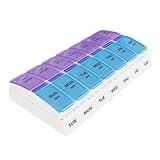
- 7-DAY PILL ORGANIZER: Organize your weekly doses with ease using the AM/PM compartments of this 7-day pill organizer. Perfect for daily medication management, it ensures you never miss a dose, simplifying your medication schedule
- PILL CAPACITY: Each compartment holds up to 25 pills (aspirin-sized), offering ample space for vitamins, supplements, and prescription medications. Ideal for managing multiple medications, ensuring accurate daily dosing for optimal health
- BUILT TO LAST: Constructed with durable materials, this high-quality pill organizer is designed for repeated use. It resists wear and tear, ensuring long-lasting performance for years of dependable medication management
- EASY TO USE: Featuring easy-to-press push buttons, this pill organizer allows effortless opening and quick access to your medication. Perfect for individuals with limited dexterity or arthritis, simplifying medication management with ease
- HEALTHY LIVING: Ezy Dose products help make healthy living simple and convenient. This pill organizer promotes proper medication adherence, encouraging a healthier lifestyle by making it easier to stay on track with your daily regimen
How PBMs are overseen
Federal reporting
Federal law requires PBMs and qualified health plan issuers to report specified prescription-benefit information to CMS. Categories include the shares of prescriptions filled through retail and mail-order channels, generic dispensing, rebates and other concessions, and spread pricing. CMS says it may share the collected information only with GAO, the Congressional Budget Office, and states for Exchange purposes, so it cannot make that collected data public. As a result, the public does not have a complete ledger of the reported qualified-health-plan PBM data. CMS explains the reporting and data-sharing limits.
State laws
States regulate PBM arrangements in different ways, including through licensing or registration, reporting, rules about rebates and spreads, pharmacy-network protections, and patient-access provisions. GAO’s 2024 review of five selected states—Arkansas, California, Louisiana, Maine, and New York—found that all five had enacted laws addressing drug pricing and pharmacy payments, while four had enacted a PBM duty-of-care or related requirement. Those results describe the five states GAO selected, not a complete count of state laws or a current legal guide for every state. GAO’s report details the selected-state review.
FTC matters
FTC enforcement developments can change. As of the FTC case page’s July 14, 2026 update, the agency reported a settlement agreement with Caremark and Zinc Health Services and an earlier February 2026 settlement with Express Scripts entities. The page described commitments involving transparency, patient out-of-pocket costs, and community pharmacies, while listing the administrative matter as pending. These are agency-reported settlement commitments, not a final resolution of every issue in the administrative proceeding. For the current status and terms, consult the FTC case page.
What to compare when choosing or reviewing a health plan
A plan’s PBM may be invisible to a member, but the plan’s benefit design and pharmacy arrangements are not. When comparing plans or asking an employer or insurer about its PBM arrangement, useful questions include:
Free tools Windows power users keep installed
One-click scans. No signup required.
- What is the plan’s total net cost after rebates, fees, and other concessions, and how is that figure calculated?
- Do rebates affect a member’s point-of-sale cost, or are they accounted for only after the claim?
- How are pharmacy reimbursements determined, and does the contract include spread pricing?
- What drugs are on the formulary, what exceptions are available, and what covered alternatives exist?
- Which local, mail-order, or independent pharmacies are in the network, and what access limits apply?
- What reporting, audit rights, and safeguards address conflicts of interest?
These questions do not identify a universally best PBM model. A plan sponsor may value negotiated concessions that lower its net spending, while patients and pharmacies may focus on point-of-sale costs, access, and reimbursement. Those outcomes depend on the contract and plan design, so one measure alone cannot establish whether an arrangement benefits every party.
Quick Recap
Product prices and availability are accurate as of the date/time indicated and are subject to change. Any price and availability information displayed on Amazon at the time of purchase will apply.




