The Tool Desk
Outbyte Driver Updater FREEFix the driver behind crashes, sound loss and screen glitchesFind Drivers →Outbyte PC Repair FREEClear out junk files and repair common Windows errorsFree Scan →There is no single federal form that covers everything you need to pay employees. At a minimum, organize records for employee identity and tax withholding, hours and wages, payroll taxes, and year-end wage statements. The exact requirements depend on worker coverage and classification, tax circumstances, and where each employee works; state and local rules may add forms, pay-statement details, reports, or longer retention periods.
What documents and records do you need?
For U.S. employers, payroll compliance is a set of related records rather than one master document. Some are forms employees complete; others are time, wage, tax-payment, and filing records that the employer maintains. The federal checklist below is a baseline, not a complete state-by-state list.
- Hiring and withholding: a completed Form W-4 and the employee details needed to identify the worker and maintain payroll records.
- Time and pay: accurate hours, pay basis and rates, overtime and other earnings, additions and deductions, pay-period totals, pay dates, and the period covered.
- Employment taxes: records supporting wage and tip payments, withholding, deposits, filed returns, benefits, reimbursements, and any credits claimed.
- Year-end reporting: applicable Forms W-2 and W-3, plus copies and filing records.
What to collect and maintain when an employee starts
Form W-4
Obtain the employee’s completed Form W-4 to determine federal income-tax withholding and retain it for at least four years. The IRS explains the retention period in Topic no. 753, Form W-4. If an employee does not provide a valid W-4, do not guess at the withholding treatment; consult the current Form W-4 and Publication 15 instructions.
Employee identity and employment details
Maintain the employee’s name, address, Social Security number, occupation, and employment dates as applicable to payroll and employment-tax records. These records contain sensitive personal information, so limit access to people who need it for their work and store it securely.
#1 Best Overall

- Preprinted folder keeps all pertinent personnel records organized and contained in one place.
- Folder complies with the Americans with Disabilities Act (ADA) requirements and EEO-1 information.
- Can be color-coded using standard color-coding systems such as ACCS A-Z labels.
- Complete payroll, personnel, employment, accident and termination record is on the outside of the file.
Form I-9 is mentioned among forms that may be held in payroll files in the IRS’s Publication 4268 (Rev. 8-2022). That publication alone does not establish the current I-9 process or its retention and storage rules. Consult current USCIS guidance for those requirements rather than treating an IRS payroll checklist as a complete I-9 guide.
What time and wage records are required?
For workers covered by the Fair Labor Standards Act (FLSA), the Department of Labor (DOL) requires records of identifying information, hours, and wages, but does not prescribe a particular record format. Its Fact Sheet #21 says, “Any timekeeping plan is acceptable as long as it is complete and accurate.” A spreadsheet, time clock, or other method may work if it captures the required information; buying a particular device is not a federal requirement.
Rank #2

- Keep your deposit slips, receipts, checks, vouchers, and tickets neatly organized with this practical desk organizer.
- Made from black textured molded plastic, this deposit ticket holder is built to last and resists wear, making it ideal for high-use office or bank environments.
- Measuring 10W x 4D x 6H, this holder fits easily on counters, desks, or workstations without taking up excessive space.
- Slots and compartments provide quick and convenient access to tickets and forms, streamlining deposit and record-keeping processes for bank tellers, office staff, or retail employees.
Record these details for covered, nonexempt workers
- Employee’s full name, address, Social Security number, sex and occupation, and birth date if the employee is younger than 19.
- The time and day of the week when the workweek begins.
- Hours worked each day and total hours worked each workweek.
- The basis of pay, such as hourly, weekly, or piece rate, and the regular hourly rate.
- Straight-time earnings and overtime earnings.
- Additions to and deductions from wages.
- Total wages paid each pay period, the payment date, and the pay period covered.
The DOL permits employers with fixed schedules to record the schedule and note when an employee follows it. Record actual departures from that schedule, so the time and wage records reflect hours actually worked rather than simply the planned schedule.
What employment-tax records should you keep?
The IRS generally says to keep employment-tax records for at least four years. Its Employment tax recordkeeping guidance lists records that support what the employer paid, withheld, deposited, reported, and claimed, including:
Recommended Free Tools
Rank #3

- Adams Columnar Analysis Pads are adaptable ledgers perfect for accounting or other numeric data; 4-column ledger has fill-in headers, numbered columns & rows & 50 double-sided 3-hole punched sheets
- Columnar sheets are printed on green tinted non-glare paper to help prevent eye strain; heavy-duty 75 gsm bond is acid free and archival safe for recordkeeping
- Shaded double columns keep your data straight and your decimals aligned; 4-column record books are ideal for recording expenses and other transactions for your home, business or side gig
- Each ledger sheet has numbered rows and columns to eliminate the need for hand numbering; increases your accuracy and saves time
- Quality columnars at a stock-up price; Adams columnar pads are sturdy and have a 3 hole punch to fit a standard binder; securely stores your accounting books for tax season
- The employer identification number (EIN).
- Amounts and dates of wage, annuity, and pension payments; reported and allocated tips; and the fair market value of wages paid in kind.
- Employee identity and occupation, employment dates, and W-4 withholding certificates.
- Tax deposit dates and amounts, with EFTPS acknowledgment numbers.
- Copies of filed returns and their confirmation numbers.
- Records supporting fringe benefits, reimbursements, and credits claimed.
The IRS identifies a special six-year retention period for certain qualified sick and family leave wage records and employee-retention-credit records on that recordkeeping page. Apply the period relevant to the particular record and credit rather than assuming the general four-year period covers every tax item.
Which year-end forms and copies belong in the file?
Employers required to file Forms W-2 must handle the required wage statements and transmittal. The IRS’s General Instructions for Forms W-2 and W-3 (2026) explain the filing conditions and describe Form W-3 as the transmittal for Form W-2 Copy A. Keep copies of W-2 Copy A and W-3 for at least four years under those instructions. A payroll provider does not remove the employer’s responsibility to ensure required wage statements are filed and furnished correctly and on time.
Rank #4
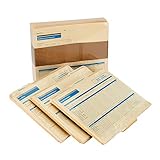
- HR & Employee Management: Sort and simplify staff details and documents with ComplyRight employee record organizer; This employee record 3-folder set helps manage important data efficiently; Store documents safely and in full compliance with the federal and state laws; Keep the whole paperwork in proper order
- Convenient & Confidential Employee File Folder: ComplyRight Organizer Folder Set records Hiring and Employment history, Payroll and Tax Information, and Benefits and Insurance details; It makes record filing easy and accessible; It collects general information as well as crucial data, all at once place
- Recordkeeping Folders for Documents: This easy-to-use personnel records organizer has three separate folders that fit into the outer jacket neatly; The jacket has an imprint for recording status, general information, and service date; This organizer set fits in any standard filing cabinet for secure storage
- Packaging/Dimensions: This employee information filing folder comes in a pack of 25 and measures 9-1/2" x 12" x 1-1/4"
- ComplyRight Employee Management Folders: ComplyRight strives to free businesses from the burden of tracking and complying with the complex web of federal, state, and local employment laws by providing convenient filing solutions like these folders
How long should you retain payroll records?
Retention periods differ because federal payroll records fall under different rules. These periods are not a single universal deletion date.
| Record category | Federal retention period | Source |
|---|---|---|
| FLSA payroll records | At least three years | DOL Fact Sheet #21 |
| Records used to calculate wages, including time cards, piecework tickets, wage-rate tables, schedules, and records of additions to or deductions from wages | At least two years | DOL Fact Sheet #21 |
| Employment-tax records | Generally at least four years; certain specified credit-related records have a six-year period | IRS Employment tax recordkeeping |
| Form W-4 | At least four years | IRS Topic no. 753 |
| W-2 Copy A and W-3 copies | At least four years under the 2026 instructions | IRS General Instructions for Forms W-2 and W-3 (2026) |
Keep each record for the longest period that applies under federal, state, local, contractual, or litigation-hold requirements. State and local rules may require longer retention, and which rules apply depends on where the employee works.
Windows Errors? Fix Them Before They Spread
Repair common Windows errors and clear accumulated junk for a smoother, more stable PC - no reinstall needed.Free scan · no reinstallOutdated Drivers Are Slowing You Down
One free scan finds every outdated or missing driver and matches the right update for your exact hardware.Free scan · exact hardware matchBest Value

- Sold as 1/Each.
- Contains 3 folders: Hiring/Employment History, Payroll/Tax and Benefits/Insurance. Confidential information is easily concealed inside each folder.
- Back side of organizer jacket explains what records you must keep and for how long.
- Organizer: 9.5" x 11.875" x 1.75".
- Package of 25 sets (each set includes organizer and 6 tabbed folders).
How should you choose a timekeeping or payroll process?
Federal guidance allows different timekeeping methods as long as records are complete and accurate. Whether you use manual records, a spreadsheet, a time clock, or payroll software, assess whether the process can:
- Capture daily hours and weekly totals, including actual departures from fixed schedules.
- Support regular-rate, straight-time, and overtime calculations.
- Track additions to and deductions from wages.
- Export records and preserve an audit trail.
- Control access securely and apply appropriate retention periods.
- Support tax deposits and filings, and accommodate the state and local rules for each work location.
A time clock or payroll service can be useful, but neither is a substitute for checking that the required records and filings are complete.
What federal guidance does not settle
Without each employee’s work location and details about the employer and worker, a federal checklist cannot identify every applicable obligation. State and local rules may add new-hire reports, pay statements, other forms, or longer record-retention requirements. Check the rules for every jurisdiction where employees work before relying on this as a complete checklist.
Quick Recap
Product prices and availability are accurate as of the date/time indicated and are subject to change. Any price and availability information displayed on Amazon at the time of purchase will apply.
Do these 3 things before closing this tab:
1Fix the driver behind crashes, sound loss and screen glitches2Clear out junk files and repair common Windows errors3Scan for outdated or missing drivers - takes under a minute



