Do these 3 things before closing this tab:
1Clear out junk files and repair common Windows errors2Fix the driver behind crashes, sound loss and screen glitches3Repair Windows errors before they cause bigger problemsA credit card cash advance fee is the charge your card issuer applies when you take credit as cash or its equivalent, such as an ATM withdrawal. It is separate from interest, and it is only one part of what a cash advance costs. The amount, the calculation method, and any cap are set in your own card’s fee disclosure and cardholder agreement.
How the fee is defined
Under Regulation Z, the federal rule that implements the Truth in Lending Act, a “cash advance fee” is “any fee imposed for an extension of credit in the form of cash or its equivalent” (Consumer Financial Protection Bureau, Regulation Z, § 1026.60(b)(8)). The definition describes the purpose of the charge: it is the issuer’s price for letting you borrow against your credit line in a form you can spend like cash.
The fee is a disclosed charge in its own right. It appears in the fee table that accompanies your account terms, separately from the purchase APR, the cash advance APR, and any penalty or late fees.
What counts as a cash advance
The most common case is an ATM withdrawal made with a credit card. Beyond that, the rule reaches any transaction the issuer treats as cash or its equivalent. The Consumer Financial Protection Bureau’s market report notes that card agreements may set different fee percentages and minimums for different types of advances, including ATM transactions and cash equivalents such as casino chips (Consumer Financial Protection Bureau, The Consumer Credit Card Market, 2019).
#1 Best Overall
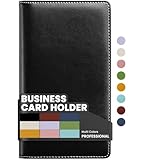
- Large capacity business card storage: This book-style business card organizer can hold up to 240 business cards, two cards back-to-back in each pouch. It is very compact & professional. Enough capacity for your different cards: business cards, credit card, social security, gift cards, insurance cards, name cards, personal IDs, mini photos, and more
- Sturdy & Long-lasting card book: Name card holder is made from high-quality pu leather cover and PVC pocket sheets. Long-lasting and sturdy
- Easy to find & read: Card holder book transparent slots are good for reading and finding information on the business card
- Compact size business card folder: The slim profile and lightweight design make carrying a breeze – Carry it in your hand, pocket or handbag when on the go. Dimension: 7.7"x 4.5" x 0.7"
Issuers do not all classify transactions the same way. Before you assume a particular purchase is a purchase rather than a cash advance, check how your agreement defines cash advances and cash equivalents. Transactions such as wire transfers, money orders, or gambling chips are where classifications most often differ.
How the fee is calculated
Card agreements use one of three structures. The fee may be a flat dollar amount, a percentage of the advance, or a percentage with a minimum or a maximum. The CFPB’s official interpretation of Regulation Z uses this example: an issuer charges “a cash advance fee of $5 or 3 percent of the cash advance transaction amount, whichever is greater, but the fee will not exceed $100.” That is an illustration of how a fee can be disclosed, not a market average or the price on any card.
Flat fee
A flat fee is the same regardless of the amount withdrawn. A $40 flat fee costs $40 whether you take out $100 or $1,000. The effective cost is therefore highest, as a percentage, on small advances.
Rank #2

- SHIPMENT CONTAINS: 25-pack of protective plastic business card holder sleeves for 3-ring binders, transparent design for easy viewing
- HIGH CAPACITY STORAGE: Displays 20 business cards per page with 10 on each side, can hold up to 500 business cards total across all sleeves
- DURABLE CLEAR MATERIAL: Made of durable clear plastic for see-through transparency and everyday strength as a business card organizer
- BINDER READY DESIGN: Comes pre-punched for handy storage in a 3-ring binder, great for office and home organization
- QUICK CARD ACCESS: Easy to check and locate cards quickly, standard 8.5 x 11 inch dimensions fit most binders
Percentage fee
A percentage fee scales with the amount. At an illustrative 3% rate, a $500 advance carries a $15 fee and a $2,000 advance carries a $60 fee. Check whether your agreement applies the percentage to the amount withdrawn only or to the amount withdrawn plus any ATM operator charge, since the wording determines the base.
Free tools Windows power users keep installed
One-click scans. No signup required.
“Greater of” formula with a cap
The formula in the CFPB example works in three steps:
- Calculate the percentage amount on the advance.
- Compare it with the flat minimum.
- Apply the cap if one exists.
Using the example’s terms ($5 or 3%, whichever is greater, capped at $100), the results are as follows.
Rank #3
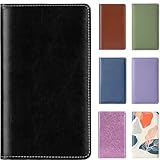
- Premium Material: Handheld business card holder using high-end PU leather, it is compact and easy to carry. Dimensions: 7.87"x 4.5" x 0.79"
- Large Capacity: Up to 300 business cards can be stored(two cards back-to-back in each pocket). The organized business card work also went smoothly
- Multiple Color Options: Idea gift for oneself, family, and friends. Mild dirt and water leakage can be quickly wiped off. Not completely waterproof
- Quick Access: Because it is a refreshing and sturdy PVC pocket, business cards are not stuck together and can be easily picked up and placed
- Soft Cover and Multiple Pockets: Professional Soft Cover Name Card Credit Cards organizer for Men/Women. The inner pocket can store small items such as notebooks
| Cash advance | 3% of advance | Greater of $5 or 3% | Fee after $100 cap |
|---|---|---|---|
| $100 | $3.00 | $5.00 | $5.00 |
| $500 | $15.00 | $15.00 | $15.00 |
| $3,000 | $90.00 | $90.00 | $90.00 |
| $5,000 | $150.00 | $150.00 | $100.00 |
The table is arithmetic applied to the illustrative terms above. Your card may use a different rate, minimum, or cap.
Why the fee is not the whole cost
The upfront fee is only one of the costs of a cash advance. The CFPB’s 2019 report states that cash advances “typically have two cost components: upfront fees and interest.” Interest is the second component, and it works differently from purchase interest. Cash advance APRs are generally higher than purchase APRs, and cash advances usually do not receive the grace period that may apply to purchases. Interest therefore typically starts accruing from the day the advance is taken, even if you normally pay your statement balance in full. This describes typical terms; your agreement controls.
Recommended Free Tools
The table below separates the charges that can apply to a single cash withdrawal.
Rank #4

- Advanced PU Material: This handheld business card holder is crafted from high-end PU leather with reinforced stitching, featuring a compact structure for easy storage and portability
- High-Capacity Design: The business card organizer can accommodate up to 300 cards, with a total of 50 double-sided pages (3 slots per page), enabling you to browse and locate contacts with ease
- Zipper Closure Design: Unlike other credit card organizer, this one adopts a zipper-sealed closure, ensuring tight protection to prevent your cards from getting lost
- Wide Applicability: It can be used for storing business cards, credit cards, gift cards, insurance cards, game cards, star cards, photos, and more
- High-Quality PVC Inner Pages: Made of PVC material with a thickness of 11c, the inner pages are durable and scratch-resistant. The transparent design offers optimal clarity for convenient viewing
| Charge | Imposed by | How it is typically set | Where to find your terms |
|---|---|---|---|
| Cash advance fee | Card issuer | Flat amount, percentage, or percentage with minimum and/or maximum | Fee table in your account terms |
| Cash advance interest | Card issuer | Cash advance APR, usually accruing from the transaction date with no grace period | Cash advance APR disclosure |
| ATM operator fee | Owner of the ATM | Set by the operator; not determined by your card agreement | Shown by the ATM operator, if charged |
| Foreign transaction charge | Card issuer, if it applies one | Varies by card | Your agreement’s foreign transaction terms |
Charges from the ATM operator
An ATM operator can charge you separately for a withdrawal, whatever your issuer charges. Regulation Z treats a charge imposed by the card issuer for ATM use to obtain a credit card cash advance as a finance charge. The cash advance fee disclosure rule, however, does not require the issuer to include a charge that another institution imposes for using its ATM. Keep the two charges separate when you estimate the cost of a withdrawal.
Independent reader supportYour contribution helps us test, update, and keep practical guides available for everyone.Historical fee figures
The CFPB has published aggregate figures on cash advance fees, drawn from Y-14+ data supplied by large card issuers. These measure fees as a share of total cash advance volume. They are not the fee on a particular card and not a current consumer rate.
| CFPB report (year published) | Period measured | Cash advance fees as a share of cash advance volume |
|---|---|---|
| The Consumer Credit Card Market (2019) | 2018 | 5.3% |
| Subsequent CFPB report (2021) | 2019 and 2020 | 5.0% |
The 2021 report states that its fee-to-volume figure was corrected from the 2019 report due to a technical error, so the two tables should not be compared as a trend without that caveat. Both figures describe the market years they cover; neither tells you what your own card charges today.
Best Value

- Durable Material: Hard PP shell with advanced three layers thicken treatment, this business card book is more durable than others in the market, and it will recover to original shape even after hard bending
- Premium Interior Slots: The interior slots are made of clear PVC material, you can easily find the card you need. The slot of business card book is semicircle open design, you can insert or get the cards with less effort
- Loose-leaf Design: Any pages can be removed from the ring binder and rearranged by varied category habit. Loose-leaf design allows you to adjust the pages based on your needs for easy using this business card holder book
- 600 Cards Capacity: Name card holder book is great for you to keep all your name cards in order. Thirty pages and ten cards can be inserted on each sides, 600 cards capacity
- Multi-purpose: Business card organizer can not only hold name cards, your credit cards, membership cards, shopper cards, gift cards, ID cards and personal cards can be protected well
How to check your own cash advance cost
- Find the fee table in your current cardholder agreement or your issuer’s online account documents, and identify the fee structure: flat, percentage, or percentage with minimum or maximum.
- Note the cash advance APR and confirm whether interest starts on the transaction date.
- Check how your issuer defines a cash advance and whether the transaction you plan falls within that definition.
- Ask the ATM operator for its fee before you confirm the withdrawal, and note whether it is charged in addition to the issuer’s fee.
- Add the issuer fee, the ATM operator fee if any, and the first month’s estimated interest to get the true cost of the advance.
If the answer differs from what you expected, the agreement controls, so use the figures printed there rather than a general description.
The Bottom Line
A cash advance fee is a disclosed issuer charge that sits on top of a higher cash advance APR, which typically accrues from the day you withdraw. Compare the fee formula, cap, APR, and any ATM operator charge before you withdraw.
Quick Recap
Product prices and availability are accurate as of the date/time indicated and are subject to change. Any price and availability information displayed on Amazon at the time of purchase will apply.




