A checkbook is a booklet of paper checks tied to a checking account. Each check is a written instruction to your bank to pay a specific person or business a specific amount from that account. Most checkbooks also come with a check register, a small ledger where you record each check, deposit, and withdrawal so you can track your balance between bank statements.
What a checkbook contains
A standard checkbook is a set of pre-printed checks, usually bound with a stub or register section. The printed checks typically carry your name and address, the bank’s name, and the account and routing numbers printed along the bottom edge. Each check has blanks for the date, the payee (the person or business being paid), the amount in numbers and in words, a memo line, and your signature.
The checkbook itself does not hold money. It is simply the paper instrument that directs the bank to pay out of the account it is linked to. Owning checks does not open an account or add funds to one.
The check register: the personal record
The register is the part of the checkbook that tracks your money. For each transaction you enter the date, a description, the amount, and the new running balance. Registers were designed for checks, but they are used for any activity that changes the account, including:
Quick wins for a faster PC:
Fix the driver behind crashes, sound loss and screen glitchesFind Drivers →Repair Windows errors before they cause bigger problemsFix Now →#1 Best Overall

- Compact and Sturdy: These checkbook registers offer clear pages with 17 lines each, making it easy to track account withdrawals; The bold layout and spacious rows and columns (0.32 in wide) provide a comfortable writing experience
- Simplify financial management: The Casmonal account books help you effortlessly remember automatic deductions, dodge overdraft risks, and gain insight into your spending patterns, making financial tracking simple and clear
- Financial instruments: These transaction Registers simplifie your financial monitoring, helping you easily manage your balance, precisely budget, and work towards your financial goals; It's a convenient tool for achieving financial success
- Personal and Small Business Finances: The check register simplifies tracking of payments and deposits, equipped with columns for item numbers, transactions, and balances, making it an ideal tool for managing both personal and small business finances
- Small and Portable: These compact 6x3 inches checkbooks are perfect for on-the-go financial tracking and feature a stylish calendar from 2026 to 2028, guiding you through a better financial journey
- Checks you write, whether or not they have been cashed yet
- Deposits, including paychecks and transfers in
- Debit card purchases
- ATM withdrawals
- Bank fees and interest
- Automatic and electronic payments, such as bill pay or recurring transfers
The register is your own version of the account history. The bank’s statement is the bank’s version, and the two will not always match on any given day.
How a check moves from your hand to your account
- You write the check. Fill in the date, payee, amount in numbers and words, and sign it. Writing the check does not move money yet.
- You record it. Enter the check number, payee, and amount in the register and subtract it from the running balance.
- The payee deposits it. The payee’s bank receives the check and begins processing it.
- The check clears. Funds are removed from your account, and the item appears on your next statement or in your online transaction history.
Steps 3 and 4 can take time, and the gap between them is where most confusion starts. Until a check clears, your register shows less money than the bank will eventually show as spent, and the bank’s posted balance may still include money you have already committed.
Rank #2

- 12 Easy Read Register Checkbook Transaction Registers: Balance your check account withdrawals with this checkbook register featuring 16 lines per pages. This thicker body paper is small enough to carry in your pocket or wallet. Column headings are bold easy to read.
- Made in the USA. Each register has 444 lines. Lines are gray in color. Standard checkbook registers having Item No. Date, Description of Transaction, Payment Debit, Deposit Credit and Balance Column.
- High-quality ink print is easy on the eyes and a great booklet for easy insertion into your checkbook.
- Calendars on Back: Check register has up-to date 2025-2026-2027 calendars printed on the back.
- Checkbook Measures: Checkbook register measures 6x3 inches.
Checkbook balance versus bank balance
Your register balance is your calculated figure based on what you have recorded. The bank’s posted balance reflects transactions the bank has processed. The available balance is the amount you can currently spend, which can be lower than the posted balance because of holds on deposits or pending items.
The Office of the Comptroller of the Currency (OCC) cautions that checks can clear more quickly through electronic processing and that deposited funds may not be available on the schedule you expect. Before writing a check, confirm that the available funds cover it. Exact clearing and availability times depend on your bank and account type, so check your bank’s funds-availability policy rather than relying on a general rule.
Do these 3 things before closing this tab:
1Fix the driver behind crashes, sound loss and screen glitches2Clear out junk files and repair common Windows errors3Scan for outdated or missing drivers - takes under a minuteRank #3
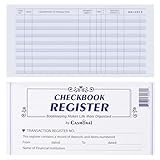
- Compact and Sturdy: These checkbook registers offer clear pages with 17 lines each, making it easy to track account withdrawals; The bold layout and spacious rows and columns (0.32 in wide) provide a comfortable writing experience
- Simplify financial management: The Casmonal account books help you effortlessly remember automatic deductions, dodge overdraft risks, and gain insight into your spending patterns, making financial tracking simple and clear
- Financial instruments: These transaction Registers simplifie your financial monitoring, helping you easily manage your balance, precisely budget, and work towards your financial goals; It's a convenient tool for achieving financial success
- Personal and Small Business Finances: The check register simplifies tracking of payments and deposits, equipped with columns for item numbers, transactions, and balances, making it an ideal tool for managing both personal and small business finances
- Small and Portable: These compact 6x3 inches checkbooks are perfect for on-the-go financial tracking and feature a stylish calendar from 2026 to 2028, guiding you through a better financial journey
Balancing a checkbook
Balancing, also called reconciling, means comparing your register with your bank statement and explaining any differences. The usual process is:
- Start with the ending balance on the statement.
- Subtract any checks or payments in your register that do not yet appear on the statement (outstanding items).
- Add any deposits in your register that do not yet appear on the statement.
- Compare the result with your register’s ending balance.
- If they differ, look for items that appear on one record but not the other: a missed fee, an unrecorded debit purchase, a transposed amount, or a check you wrote and forgot to enter.
Reconciling monthly, when the statement arrives, keeps errors small and easy to trace. Waiting several months makes it much harder to find where the figures diverged.
Rank #4

- 24 Easy Read Checkbook Registers for Personal Checkbook
- Standard checkbook register measuring 3" x 6".
- The white and blue background makes recording clearer and less prone to eye fatigue.
Paper checks and electronic processing
Paper checks are no longer processed only as paper. The Federal Reserve’s Check 21 law, which became effective on October 28, 2004, was designed to let banks handle more checks electronically. Under Check 21, a bank can create a substitute check, an image-based copy that carries the same legal effect as the original, when a paper check is needed. The Federal Reserve states that “Check 21 is a federal law that is designed to enable banks to handle more checks electronically, which should make check processing faster and more efficient” (Board of Governors of the Federal Reserve System, Check 21 FAQ).
A merchant may also convert a paper check into an electronic funds transfer, including through the ACH network. The merchant should tell you that this may happen. On your statement, the transaction may appear as an electronic debit rather than as a conventional check. Your register should record the amount and date either way, because the bank’s record will show it.
Best Value
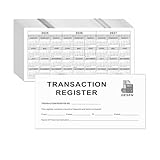
- Compact and Sturdy: These checkbook registers offer clear pages with 14 lines each, making it easy to track account withdrawals; The bold layout and spacious rows and columns (0.55" width) provide a comfortable writing experience.
- Small and Portable: These compact 6" x 3" checkbooks are perfect for on-the-go financial tracking and feature a stylish calendar from 2026 to 2028, guiding you through a better financial journey.
- Premium Material: This checkbook register uses high-quality cardboard, which is designed to prevent feathering and seepage. White Paper is ink-proof and thick enough to avoid ink bleeding through, offering you a smooth writing experience.
- Simplify financial management: The check register simplifies tracking of payments and deposits, equipped with columns for item numbers, transactions, and balances, making financial tracking simple and clear.
- A Thoughtful and Practical Gift: The checkbook registers is not only an ideal choice for yourself but also a perfect present. Great for enterprises, public institutions, individual business owners or individual users. It's a convenient tool for achieving financial success.
These rules describe U.S. practice. Checkbook terminology and check-handling practices differ in other countries.
Independent reader supportYour contribution helps us test, update, and keep practical guides available for everyone.Choosing how to keep your record
A paper register is optional. Bank guidance recognizes both paper and digital methods; neither is universally best. The useful comparison is how each method fits the way you bank.
| Method | Strengths | Limitations | Best fit |
|---|---|---|---|
| Paper register (from the checkbook) | Comes with checks; works without power, internet, or a device; no setup | Easy to forget to update; does not total or categorize spending; limited space for card and electronic activity | Someone who writes checks regularly and wants a simple paper trail |
| Separate notebook | Flexible layout; can record offline; no cost beyond the notebook | No automatic calculations; manual math is error-prone | Someone who wants more space or a custom format |
| Spreadsheet | Calculates balances automatically; can sort and total by category; can be backed up | Requires entering each item by hand; needs a device to update | Someone comfortable with basic formulas who wants a monthly summary |
| Financial app | Can import transactions; tracks cards and electronic payments; shows balances on the go | Depends on connectivity and the app’s accuracy; may not link to every bank; may involve fees | Someone with many card and electronic transactions who wants automated tracking |
Whichever method you choose, one habit matters more than the format: record each item when it happens, not when you remember it.
Quick Recap
Common mistakes to avoid
- Spending from the bank balance alone. A posted balance can exclude checks still in transit or include deposits that are not yet available.
- Leaving out debit and automatic payments. These reduce your balance just as checks do, and they are the most common reason a register drifts from the statement.
- Entering a check without the check number. Numbers make it easier to match items during reconciliation.
- Assuming a check is always a check. A merchant may have processed it electronically, so match by amount and date as well as by number.
Product prices and availability are accurate as of the date/time indicated and are subject to change. Any price and availability information displayed on Amazon at the time of purchase will apply.
Recommended Free Tools




