A cashless society is one where people and organizations rely mainly on electronic payments—such as cards, bank transfers and e-money—instead of banknotes and coins. It describes a shift in how people pay, not a point at which cash has necessarily vanished. Digital payments are growing, but cash remains in use, and the pace and shape of the change differ by country.
What is a cashless society?
“Cashless society” describes an economy in which electronic methods are the main way people pay, rather than cash. It does not mean every person has stopped using bills and coins, or that every business has stopped accepting them. The term is best understood as a degree of reliance on digital payments, not a uniform endpoint.
There is no single global percentage that says how cashless the world is. Payment count, total payment value, cash withdrawals and the amount of cash in circulation measure different things, so they cannot be combined into one simple score. The Bank for International Settlements’ 2025 commentary on 2023 payment data and 2026 commentary on 2024 data describe rising cashless payments across jurisdictions, alongside cash that remains part of payment systems and people’s lives.
How does a cashless society work?
A cashless payment is an electronic instruction to transfer value. A customer may start it with a payment card, a bank or payment app, or another digital interface. The payment can then use a card transaction, an account-to-account transfer or e-money. The method and infrastructure behind the payment vary by provider and country.
Quick wins for a faster PC:
Scan for outdated or missing drivers - takes under a minuteDriver Scan →Clear out junk files and repair common Windows errorsFree Scan →Fix the driver behind crashes, sound loss and screen glitchesFind Drivers →#1 Best Overall
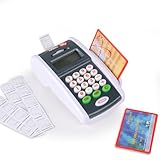
- Payment Terminal Playset: Look like a real payment terminal toy with light and sounds, including two credit cards and 2 receipts. Required 3 AAA batteries (Not Included). Satisfying children’s role-playing desires, providing endless fun for kids.
- Play Like Real POS Terminal: The POS terminal toy features a real calculation function. Kids can calculate the shop items and put figures into the payment machine, input the pin numbers, then, put the fake credit card into the slot and swipe the credit cards, next, put receipt paper into the printing slot, print out the receipt and finish the payment.
- Interactive Game Toy: Parents and kids can play pretend play interactive game together. Play the role of customer or cashier in the shop or supermarket. Training children’s imagination and communication skills, helping children to understand real life and enjoy the fun of pretend play.
- Quality and Safety: Made of eco-friendly and high-grated ABS plastics, like real function card reader machine. Provide a good and happy experience of shopping payment experience in pretend play game.
- Great Toy for Pretend Play: The card reader machine toy is a good addition for play store pretend play or coffee shop game. Great gift choice for kid's birthday, baby shower, Christmas and New Year.Great toy for boys and girls. Suitable for kids aged 3 and up, great toys for children who like the pretend play game. Encouraging kids to develop with their imagination and improving their communication social skills.
“Mobile payment” describes how someone accesses or initiates a payment, not the underlying payment rail. A phone may be used to access a card, bank transfer or e-money service. For example, Brazil’s central bank reported that mobile phones were the most-used access channel for non-cash payment transactions in 2024; that finding describes Brazil’s system and should not be assumed to apply elsewhere. The central bank’s 2024 payment-system information also identifies Pix and cards as the most-used payment instruments in Brazil.
Digital does not automatically mean instant, free, private or a direct transfer from payer to recipient. Speed, fees, data handling and settlement depend on the specific payment method, provider and local rules.
What do current payment trends show?
Global trends vary by region and measure
BIS CPMI’s 2025 commentary, based on 2023 Red Book statistics, described rising cashless payments—particularly credit transfers and e-money in emerging market and developing economies—and generally stabilized demand for cash withdrawals. Its 2026 commentary, based on 2024 statistics, found different regional drivers: credit transfers led cashless payment growth in emerging and developing economies, while card payments drove much of the growth in advanced economies. It also reported declining cash withdrawals while cash in circulation had largely stabilized. These trends show growth in electronic payments, not a common timetable for cash to disappear.
Rank #2

- 【Touchscreen Cash Register kit】Single Screen: 15.6-inch multi-touch screen, 8-inch LED customer display. Dual Screens: 15.6-inch main screen, 15.6-inch secondary screen. 1366 x 768 high resolution.The kit categories include: cash drawer, wired barcode scanner and electronic communication scale accessories for you to choose from.
- 【High Performance Configuration】The POS System with i5 dual-core CPU, 8GB RAM + 128GB SSD, dual-band Wi-Fi, speakers, Windows support, multiple languages, and compatibility with various cash register software (not included), providing a smooth checkout experience
- 【Built-in 58mm Printer】The All-in-One Pos Terminal Machine Built-in 58mm large gear thermal printeris easily removable, and prints quickly and clearly. The screen rotates at multiple angles to accommodate various working postures. It's secure and stable, and can be used even without an internet connection
- 【Multi-function Ports】This point-of-sale cash register features multifunctional ports: 6 USB ports, 1 DC-IN port, 1 LAN port, 1 CGA port, 1 COM port and 2 Audio ports. Easily connect to peripherals such as receipt printers, barcode scanners, cash registers, and payment devices
- 【Wide Applications】This POS Cash Register can be used in various scenarios such as convenience stores, shopping malls, supermarkets, clothing and shoe stores, restaurants, and cafes (this product only includes hardware and does not include POS software).
United States: cash remains part of consumer payments
The Federal Reserve’s 2025 Diary of Consumer Payment Choice found that cash accounted for 14% of U.S. consumer payments by number in 2024. Credit cards accounted for 35% and debit cards 30%. The same survey reported an average of 11 mobile-phone payments per month per U.S. consumer in 2024. These are U.S. survey measures, not global estimates. The Federal Reserve also found that households earning under $25,000 and adults aged 55 and older relied more on cash than other groups, and that more than 90% of consumers intended to use cash in the future as a payment method or store of value. Read the Federal Reserve’s 2025 release.
Recommended Free Tools
Euro area: preference and use are not the same measure
The European Central Bank’s 2024 SPACE study found that cash remained the most frequently used payment method in euro-area shops, although its use had declined. Digital payments continued to increase at a slower pace, with cards the most popular digital method. In the study, 55% of euro-area consumers preferred cards and other cashless payments in shops, 22% preferred cash and 23% had no clear preference. Those figures measure stated preference, not the share of actual transactions. The ECB’s 2024 SPACE study findings provide the regional context.
What are the pros of a cashless society?
Convenience and speed
Electronic payments can make in-person purchases and transfers more convenient, and they can support faster transfers where the relevant system allows it. The BIS identifies speed and convenience among the forces behind cashless payment growth. Actual processing time and availability depend on the payment method and local infrastructure.
Rank #3

- Accepts all payment types: NFC/CTLS, mobile wallets, EMV and magstripe
- Supports a variety of third-party apps through Verifone’s Merchant Marketplace
- Optional features, such as dual-band WiFi and Bluetooth 4.2 BLE
- Supports Verifone’s estate management solution for remote device management, value-added services, updates and diagnostics
Remote commerce and payments
Cards, transfers and e-money can pay for many purchases where handing over banknotes is impractical, including remote transactions. BIS guidance on financial inclusion discusses the role of safe, efficient electronic retail payment services in commerce and government-to-person payments. The BIS report on fintech and financial inclusion explains both the potential and the limits of digital services.
Potential access to transaction services
Mobile money and other financial technology can help people access transaction accounts and payment services. That opportunity is not a guarantee that everyone will be included: the BIS cautions that fintech is not a panacea and that its risks need to be managed.
Free tools Windows power users keep installed
One-click scans. No signup required.
What are the cons and risks?
Exclusion when digital access is missing
A digital-only environment can make it harder to pay for people who lack an account, reliable connectivity, a suitable device, an accessible interface or the skills to use it. BIS guidance identifies older people, people with disabilities, undocumented migrants, people experiencing poverty or homelessness, and residents of rural or remote areas as groups that may be at risk when access to or acceptance of cash is limited. These are structural risks; individuals’ circumstances differ. The BIS guidance on payment-system access and financial inclusion discusses these concerns.
Rank #4

- This new payment terminal holster is a perfect solution to hold your Clover Flex 3 POS terminal. Made of attractive gray textured and durable material with cushioning which protects the terminal from environmental impact including bumps and scratches and ensures the safety of the device if dropped.
- Includes plastic screen shield to protect device from damage including spills, dust, dirt and bacteria, and allows for repeated wipedowns. Case wraps around the device at the top to prevent device from slipping out.
- When device is in the carrying case, the chip (EMV) card slot can still be used.
- Includes detachable strap which can go over the shoulder or across the body and a hand strap on the back so you can use it either way. It offers flexibility in usage! Clover Flex 3 / Flex 4 POS not included.
Privacy and data use
Digital payments create transaction data that providers may handle under applicable legal and regulatory frameworks. Privacy depends on the instrument, provider and jurisdiction; it is not accurate to assume every digital payment is tracked in the same way. BIS analysis identifies consent, liability for misuse of data, and the balance between privacy and financial integrity as policy questions. The BIS analysis of fintech and inclusion covers these issues.
Scams and fraud
Digital systems can expose consumers to scams and other forms of fraud. A 2026 BIS Financial Stability Institute brief describes a global surge in scams and fraud alongside the benefits of digital innovation. That does not mean cash is risk-free, or that one digital method is always less secure than another. Authentication, dispute handling and liability depend on the specific service and the rules where it operates. The BIS brief on scams and fraud examines the issue.
Outages and dependence on infrastructure
Electronic payments can be disrupted by problems with electricity, communications networks, devices or service providers. A Reserve Bank of Australia official speaking at the BIS described how outages can materially affect businesses and individuals as reliance on electronic systems increases. Cash can provide a payment option independent of those digital systems when it is available and accepted. The BIS account of the remarks on payment outages addresses this resilience concern.
Best Value

- Revolutionize customer experience with this wall-mounted self-service machine tailored for printing and card swiping maximizing efficiency in any retail space
- Streamline transactions effortlessly using a crystal-clear 11.6 inch touch screen allowing quick access to printing and code scanning s integration
- Enhance your service capabilities with an all-in-one solution combining cashless features optimizing checkout speed won’t increase staff overhead
- Minimize wait times as customers swipe thiѕ cashier delight bringing convenience indulgences with high-tech scanning reducing operational costs seamlessly
- Upgrade to a sleek modern design to elevate ambiance create self-reliant stalls with this illuminated seamless efficiency preferred by consumers everywhere
How to compare cash and digital payment options
Rather than treating “cashless” as one payment method, compare the actual options available to you. Their strengths and limitations depend on where you live, who accepts them and the rules that apply.
- Access and acceptance: Check who can use the method and where it is accepted. Digital options may require an account, device, connectivity or accessible interface; cash depends on its continued availability and acceptance.
- Speed and convenience: Consider how quickly a payment can be initiated and completed, and whether it works for remote purchases. Do not assume every electronic payment is instant.
- Cost: Fees for consumers or merchants vary by method, provider and country. There is no universal cost ranking established here.
- Privacy and data handling: Consider what transaction data the method creates, who handles it and what protections or rules apply.
- Fraud protection and recourse: Look at authentication, dispute procedures and liability for the particular method. “Cashless” is not the same as “secure.”
- Resilience: Consider whether the method remains available if a device, power supply, network or provider is down, and whether a usable alternative remains.
Is cash disappearing?
Cash use is declining in some measures and places, but it has not disappeared. The BIS’s 2026 commentary reported that withdrawals were declining while cash in circulation had largely stabilized; the Federal Reserve’s 2025 U.S. survey and the ECB’s 2024 euro-area study also document ongoing cash use. The direction and pace of change depend on the country and the measure being considered, so claims that the world is becoming uniformly cashless go beyond what these figures establish.
As BIS CPMI put it in its 2026 commentary on 2024 data, “it is impossible to imagine a world without cash, as it still plays a prominent role in people’s lives.”
Quick Recap
Product prices and availability are accurate as of the date/time indicated and are subject to change. Any price and availability information displayed on Amazon at the time of purchase will apply.
The Tool Desk
Outbyte Driver Updater FREEFix the driver behind crashes, sound loss and screen glitchesFind Drivers →Outbyte PC Repair FREERepair Windows errors before they cause bigger problemsFix Now →



