Crashes, No Sound, or Screen Glitches?
Random freezes, missing sound and display glitches usually trace back to one bad driver. Find and replace yours safely.Free scan · under a minuteWindows Errors? Fix Them Before They Spread
Repair common Windows errors and clear accumulated junk for a smoother, more stable PC - no reinstall needed.Free scan · no reinstallThe three numbers on a fertilizer label show the product’s percentages of nitrogen, phosphate and potash, in that order. They tell you what is in the bag—not which blend your garden needs or how much to apply. Use a soil test and guidance for your specific plant and region to choose a blend, then calculate the amount from the nutrient target and follow the product directions.
What do the three fertilizer numbers mean?
A grade such as 5-10-5 lists the percentage by weight of three nutrients: nitrogen (N), phosphate (conventionally expressed as P₂O₅) and potash (conventionally expressed as K₂O). The shorthand N-P-K is common, but the second and third numbers are not normally stated as elemental phosphorus and potassium percentages. Oregon State University Extension’s label example explains that 10 pounds of 5-10-5 contains 0.5 pound nitrogen, 1 pound phosphate and 0.5 pound potash.
The grade tells you each nutrient’s concentration. A simplified ratio instead shows their relative proportions. Neither one, on its own, tells you the right application rate.
How do you calculate an NPK ratio?
Divide each number in the grade by the smallest number, reducing the values to their simplest proportion. For example, 18-6-6 becomes 3-1-1 because each value is divided by 6. Penn State Extension uses this method to explain fertilizer ratios.
#1 Best Overall

- Balanced All Purpose NPK Fertilizer – Complete NPK fertilizer designed to deliver essential nutrients for overall plant health and development.
- Supports Growth & Root Development – Helps promote strong roots, healthy foliage, and consistent plant growth across all stages.
- Ideal for All Plants – Versatile plant fertilizer suitable for flowers, vegetables, shrubs, and houseplants.
- Liquid Plant Fertilizer Formula – Fast-absorbing liquid plant food for efficient nutrient delivery and easy application.
- Made in USA
Keep the grade and ratio distinct when comparing products: an 18-6-6 and a 9-3-3 both have a 3-1-1 ratio, but the first has twice the nutrient concentration by weight. The ratio describes balance; the grade helps you determine how much product contains a given amount of a nutrient.
How do you choose the right blend?
Start with what the soil and intended plant need—not with a familiar “balanced” blend. A soil test interpreted for your region, together with crop-specific guidance, can identify which nutrients are needed and which are already sufficient. Soil-test methods and sufficiency ranges can differ by region, so use a local Extension service or a qualified lab using locally calibrated methods. Oregon State University Extension’s soil-test guide explains why interpretation depends on the methods used.
Rank #2
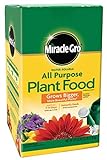
- FEEDS ALL PLANTS: Miracle-Gro Water Soluble All Purpose Plant Food is a plant fertilizer that feeds all outdoor, in-ground and indoor plants, including roses, flowers, houseplants, vegetables, and trees
- PROMOTES GROWTH: Use this all-purpose plant food outdoors and indoors to grow bigger, more beautiful plants (vs unfed plants); starts working instantly to promote quick, beautiful results
- NPK: 24-8-16 outdoor and indoor plant food contains Nitrogen (N), Phosphorus (P) and Potassium (K) which are key nutrients plants need to thrive
- APPLICATION: To use as plant food indoors, mix 1/2 tsp per gallon of water in a watering can; to feed outdoor plants, mix 1-1/2 tbsp per 1-1/2 gallon of water in any watering can or use with the Miracle-Gro Garden Feeder
- COVERAGE: One 3 lb. container of Miracle-Gro Water Soluble All Purpose Plant Food can be used as an outdoor and indoor plant food for houseplants, vegetables, flowers, trees, roses and more; feeds approximately 1,200 sq. ft. of garden area
Compare a product’s N, phosphate and potash values with the recommendation, and consider how much product would be needed to meet the relevant nutrient target. Also account for nutrient credits, such as nutrients already supplied by other amendments, and follow locally applicable rules.
Do not add nutrients the soil does not need
A higher number is not automatically an advantage. The University of Minnesota Extension illustrates this with a soil-test recommendation of 15-5-20: choosing 15-10-20 would add more phosphorus than recommended. In that example, 13-0-0 may be a closer choice than 15-10-20 because it is near the nitrogen target without adding phosphorus. This is an illustration, not a general prescription; the right choice depends on the crop, test results and local recommendations.
Rank #3

- FEEDS ALL PLANTS: Miracle-Gro Water Soluble All Purpose Plant Food is a plant fertilizer that feeds all outdoor, in-ground and indoor plants, including roses, flowers, houseplants, vegetables, and trees
- PROMOTES GROWTH: Use this all-purpose plant food outdoors and indoors to grow bigger, more beautiful plants (vs unfed plants); starts working instantly to promote quick, beautiful results
- NPK: 24-8-16 outdoor and indoor plant food contains Nitrogen (N), Phosphorus (P) and Potassium (K) which are key nutrients plants need to thrive
- APPLICATION: To use as plant food indoors, mix 1/2 tsp per gallon of water in a watering can; to feed outdoor plants, mix 1-1/2 tbsp per 1-1/2 gallon of water in any watering can or use with the Miracle-Gro Garden Feeder
- COVERAGE: One 1.5 lb. container of Miracle-Gro Water Soluble All Purpose Plant Food can be used as an outdoor and indoor plant food for houseplants, vegetables, flowers, trees, roses and more; feeds approximately 600 sq. ft. of garden area
The same principle applies when one nutrient is low but another is already abundant. For fruit and vegetable crops, University of Minnesota Extension gives 2-14-0 bone meal as an example of a source that may fit a phosphorus deficiency when potassium is already high, rather than 8-2-4, which supplies potassium too. See its crop-specific soil-test guidance for the context. A more complete blend is not necessarily a better match.
How much fertilizer should you apply?
Calculate product needed by dividing the target amount of a nutrient by that nutrient’s fraction in the fertilizer. Convert the label percentage to a decimal first: 12% nitrogen is 0.12. The arithmetic gives a product quantity, not a universal recommendation to fertilize at that rate; actual targets depend on plant, soil, location and timing.
Rank #4

- 🌿 Balanced 10-10-10 Granular Fertilizer for Outdoor & Indoor Plants: All-purpose plant food with 10% Nitrogen, 10% Phosphorus, and 10% Potassium. Perfect for outdoor vegetable gardens, fruit trees, evergreens, shrubs, lawns, and flowers. Also great for potted plants and indoor gardening. One solution for all your plant needs!
- ⏳ Slow-Release Formula for Continuous Outdoor Feeding: Provides up to 8 weeks of sustained nutrition with fewer applications. Ideal for outdoor lawns, vegetable gardens, fruit trees, and flowering plants. Apply twice per season for gardens and three times per year for trees and shrubs. Less work, more growth!
- 🌼 Promotes Strong Roots, Lush Growth, and Vibrant Outdoor Blooms: Phosphorus supports root health, Nitrogen fuels lush green leaves, and Potassium enhances plant resilience. Perfect for outdoor flowers, tomatoes, peppers, roses, evergreens, and shrubs. Enjoy thriving plants, colorful blooms, and abundant harvests!
- 🌱 Easy-to-Apply Granules for Even Outdoor Coverage: Fine granules spread evenly for maximum soil absorption in outdoor gardens, lawns, and landscapes. Ideal for pines, oaks, banana trees, fig trees, and ornamentals. Just spread, water, and watch your outdoor garden flourish!
- ⚡ Quick-Release Nitrogen for Immediate Outdoor Results: Instant nitrogen boost for rapid growth, combined with slow-release feeding for lasting results. Perfect for outdoor grass lawns, evergreen trees, flowering plants, and vegetables. See your outdoor garden thrive quickly and sustainably!
- Find the nutrient target in the applicable soil-test recommendation or crop guidance.
- Convert the relevant label percentage to a decimal.
- Divide the target nutrient mass by that decimal to get the product amount.
- Check the product directions and local guidance before applying; do not exceed label directions.
For example, Oregon State University Extension’s 2025 garden example uses a target of 3 pounds of nitrogen per 1,000 square feet. A product containing 12% nitrogen requires 3 ÷ 0.12 = 25 pounds of fertilizer per 1,000 square feet to supply that amount of nitrogen. With a 16% nitrogen product, the calculation is 3 ÷ 0.16 = 18.75 pounds, rounded in the source to 19 pounds. These figures demonstrate label arithmetic; they are not a recommendation for every garden.
Do not compare products on the first number alone. The same OSU guidance describes 12-11-2 as 12% nitrogen, 11% phosphate and 2% potash. Whether that combination fits depends on the nutrient needs, not simply the nitrogen concentration.
Best Value
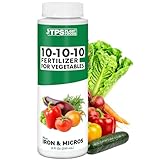
- Supports Roots, Foliage & Yield – Helps encourage strong roots, healthy leaves, and productive harvests.
- All-Purpose Feeding for Garden Crops – Provides balanced nutrients for a wide range of vegetables.
- Ideal for Garden Beds & Raised Planters – Suitable for backyard gardens, rows, and container vegetables.
- Made in USA
Does fertilizer source change the comparison?
Yes. In addition to NPK grade, consider nutrient availability and how the product behaves in soil. Oregon State University Extension notes practical differences between conventional and organic sources:
- Conventional fertilizers are often highly soluble, so nutrients may be readily available; liquid products can be easier to overapply, increasing the risk of plant burn.
- Organic sources may contain fewer nutrients per pound and may rely on soil microbes to convert nutrients into plant-available forms.
- Uncomposted manure or fresh cover crops can temporarily tie up soil nitrogen while microbes break down the material.
These are trade-offs, not a ranking of which type is inherently better. Use the product’s label and crop guidance to judge whether its nutrient content, release behavior and timing suit your situation.
Quick Recap
What else should you check before applying?
- Fit to the recommendation: Match the blend as closely as practical to the soil-test and crop recommendation instead of adding nutrients without a need.
- Application directions: Use the labeled rate and method; the nutrient calculation is not permission to exceed them.
- Local requirements: Rules may depend on location and land use. For example, Minnesota restricts lawn phosphorus in many circumstances, as described by University of Minnesota Extension; that state-specific context should not be treated as a nationwide rule.
- Soil-test context: Have results interpreted using methods and recommendations appropriate to your region and intended crop.
Product prices and availability are accurate as of the date/time indicated and are subject to change. Any price and availability information displayed on Amazon at the time of purchase will apply.




