The UK government confirmed up to £750 million for a new national supercomputer service at the University of Edinburgh in June 2025. The project is now moving into construction, with the government’s target for the service to come online in early 2027. That is an implementation update—not a new £750 million pledge in 2026.
There is also a separate, similarly sized AI-computing programme. Its host-site selection process was still open in July 2026, so its £750 million should not be added to, or confused with, the Edinburgh project.


What the Edinburgh funding pledge means
The June 2025 Spending Review confirmed up to £750 million for the UK’s next national supercomputing service, to be based at the Edinburgh Parallel Computing Centre (EPCC) at the University of Edinburgh. The government described it as an investment in a new national supercomputer; the university says UK Research and Innovation (UKRI) will own the system and the university will host it. The commitment is a funding ceiling, not evidence that £750 million has already been spent or that the final contract will equal that amount. The government’s announcement was made on 11 June 2025.
The word “recommits” needs a date attached: the confirmed commitment is from 2025. The newer developments are the publication of the UK Compute Roadmap, procurement and facilities work, and construction milestones—not a new August 2026 funding announcement.
#1 Best Overall

- [Personal AI Supercomputer]: Built for AI developers, researchers, data scientists, startup labs, and university labs, the ASUS Ascent GX10 is designed for local AI development, model testing, inferencing, RAG workflows, and agentic AI experimentation beyond a standard mini PC.
- [NVIDIA GB10 Grace Blackwell Superchip]: Powered by the NVIDIA GB10 Grace Blackwell Superchip with Blackwell GPU architecture and a 20-core Arm CPU, GX10 delivers up to 1 PetaFLOP of FP4 AI performance for generative AI prototyping and local model workflows.
- [128GB Unified Memory for Large AI Workloads]: 128GB LPDDR5x unified memory helps support demanding AI development and testing scenarios, including workflows for large language models, multimodal AI, local inference, fine-tuning experiments, and model evaluation.
- [2TB NVMe Storage for AI Projects]: The 2TB M.2 2242 NVMe SSD provides high-speed local storage for AI model libraries, datasets, Docker containers, checkpoints, development environments, and RAG or vector database workflows.
- [DGX OS and Advanced Connectivity]: DGX OS and the NVIDIA AI software stack help streamline CUDA, PyTorch, TensorFlow, TensorRT, NVIDIA NIM, and AI Blueprint workflows, while Wi-Fi 7, 10GbE, USB-C, HDMI, and NVIDIA ConnectX-7 support modern lab and desktop deployments.
Timeline: pledge, procurement and construction
- 11 June 2025: The government confirms up to £750 million for the Edinburgh national service. Government announcement.
- 7 October 2025: UKRI publishes a preliminary market-engagement notice for hardware procurement. It estimates a hardware contract at £275 million excluding VAT, or £330 million including VAT. The notice says the timetable is tentative and subject to government business-case approval. UKRI notice.
- 23 April 2026: The updated UK Compute Roadmap describes the Edinburgh service and targets it coming online in early 2027. UK Compute Roadmap.
- 25 May 2026: A Public Contracts Scotland notice gives this as the on-site start date for a facilities-preparation project at the university’s Advanced Computing Facility. It anticipates completion on 17 December 2027; this is a facilities-works timetable, not necessarily the computing service’s launch date. Construction notice.
- 25 June 2026: The University of Edinburgh announces a turf-cutting milestone for the supercomputer project. University announcement.
- 17 July–10 August 2026: The government’s separate AIRR programme invites eligible UK research organisations and consortia to express interest in hosting a heterogeneous AI supercomputer. Host-site expression of interest.
What will it replace, and why Edinburgh?
The new service is intended to replace ARCHER2, the UK’s current primary academic high-performance-computing system, which is hosted at Edinburgh by EPCC. ARCHER2 supports research workloads that require large-scale computing; its successor is part of a continuing national infrastructure, not a plan to put every UK computing resource on one machine. The University of Edinburgh’s ARCHER2 information describes the existing service, while a parliamentary answer identifies the new system as its intended replacement. Parliamentary answer.
Edinburgh already has EPCC’s national-supercomputing expertise, the Advanced Computing Facility and experience hosting ARCHER2. Those capabilities provide a practical base for the new service. The available official material does not establish that Edinburgh was the only technically suitable location. The roles are distinct: UKRI is identified as owner, the University of Edinburgh as host, and EPCC as the centre associated with technical and operational delivery.
What the system is for
A national supercomputer lets researchers run very large simulations and data-intensive calculations that would be impractical or too slow on ordinary servers. Government and university descriptions point to work including climate and extreme-weather modelling, aircraft and advanced engineering, drug discovery and biomedical research, scientific simulation, AI research, and public-sector and industrial research.
It is therefore both an AI-capable system and a traditional scientific supercomputer. The Compute Roadmap describes hardware intended for modelling, simulation and AI workloads. Calling it simply an “AI supercomputer” can obscure its broader research role; it is not described as a consumer chatbot or a general-purpose commercial cloud service. The roadmap projected performance that, at the time of publication, would have placed the system among the world’s top five supercomputers. That is a projection, not a final independently verified ranking.
What the £750 million covers—and what it does not
The up-to-£750 million figure refers to the Edinburgh service programme, not a single published hardware price. UKRI’s preliminary market-engagement notice estimates £275 million excluding VAT (£330 million including VAT) for hardware procurement, with estimated contract dates from 1 September 2026 to 31 August 2031 and a possible extension to 2033. The notice’s dates are tentative and subject to business-case approval. A hardware estimate is not the full programme budget: facilities, infrastructure, operations, services and other costs may also be involved.
The wider UK Compute Roadmap sets an ambition to invest up to £2 billion in a connected public compute ecosystem. It includes more than £1 billion to expand the AI Research Resource (AIRR) twentyfold by 2030, the Edinburgh service, cloud-compute procurement, National Supercomputing Centres, software, data stewardship, skills and international partnerships. The Edinburgh project is one element of that strategy, not the entirety of UK public investment in AI or computing.
Rank #4
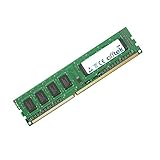
- Boost Your System’s Performance: Increase available memory for smoother multitasking, improved responsiveness and better performance when running memory-intensive applications.
- Matched Specifically to Your Machine: OFFTEK selects the correct memory configuration for the computer shown in this listing, removing the uncertainty from choosing a compatible upgrade.
- We Do the Technical Checking for You: There is no need to compare memory speeds, voltages, form factors or other technical details, as the upgrade has been matched to the machine’s supported requirements.
- Extend the Life of Your Computer: Increasing the available memory can help your existing machine remain productive for longer, offering a cost-effective alternative to replacing the complete system.
- Quick and Straightforward Upgrade: Memory is normally simple to install and requires no software installation; shut down and disconnect the machine before fitting and follow the manufacturer’s instructions.
A second £750 million programme is not the Edinburgh project
In July 2026, the Department for Science, Innovation and Technology opened a separate expression-of-interest process for an AIRR heterogeneous AI supercomputer. The published process sought potential UK hosts; it did not name Edinburgh or award funding. It was an expression of interest, not a competition or a commitment to fund a particular organisation.
| Programme | Purpose and status | Funding and schedule |
|---|---|---|
| Edinburgh national service | ARCHER2 successor at EPCC, University of Edinburgh; construction activity announced in 2026. | Up to £750 million; government roadmap target is online in early 2027. |
| AIRR heterogeneous AI supercomputer | Separate AI-focused system; July 2026 process sought eligible UK host expressions of interest, with host not confirmed in that notice. | Anticipated £750 million; initial capacity targeted for early 2028 and full service in financial year 2029–30. |
The AIRR proposal describes an established-vendor AI “spine”, specialised inference hardware, storage and networking, a software integration layer, and the possibility of a quantum-computing module. Its anticipated budget is broadly divided as follows:
Free tools Windows power users keep installed
One-click scans. No signup required.
| Proposed allocation | Amount | What the EOI says it covers |
|---|---|---|
| Advanced Market Commitment | £150 million | Novel inference hardware. |
| Specialised hardware | £250 million | Additional specialised hardware. |
| Established-vendor hardware and infrastructure | £350 million | Established-vendor hardware, data-centre and associated infrastructure costs; possible additional operational expenditure and quantum-module funding are also mentioned. |
The EOI says the AIRR system could require up to 10 MW in its first phase and 20–30 MW at full deployment. Those estimates apply to that separate system; they should not be attributed to the Edinburgh service.
What remains uncertain
- Final specification and performance: The university says the planned system will be around 50 times more powerful than ARCHER2. That is the university’s description of the planned system, not a final independent benchmark. University statement.
- Delivery date: Early 2027 is the roadmap target, not a guaranteed operational date. Facilities works can have a different completion schedule from system commissioning.
- Procurement and final cost: UKRI’s published hardware estimate is preliminary, and its notice makes the timetable conditional. It should not be treated as the full £750 million programme cost.
- Access arrangements: The service is intended for UK research and innovation communities, but the available sources do not establish final eligibility rules, allocation processes, charges or the extent of commercial access. It would be premature to promise unrestricted business use.
- Power, cooling and resilience: Large computing facilities require substantial power and cooling, as well as dependable operations. The Edinburgh sources cited here do not provide a final power or water-use figure for the service.
- Supply-chain dependence: UK sovereign compute means strengthening domestic capability and control of access; it does not establish that chips or every other component will be designed and manufactured in the UK. The government’s hardware plan discusses a mixed hardware landscape and the importance of domestic capability. UK AI Hardware Plan.
Earlier public discussion included a more ambitious or differently specified next-generation system and debate about exascale computing. The current official roadmap does not establish an exascale specification, and the available official sources do not document every earlier decision well enough to describe the history simply as a cancellation followed by reinstatement. “Next-generation national supercomputer” is more precise than calling the Edinburgh system exascale.
Quick Recap
Product prices and availability are accurate as of the date/time indicated and are subject to change. Any price and availability information displayed on Amazon at the time of purchase will apply.




