Recommended Free Tools
Tariffs reach board games through two channels: the duty charged on imported finished goods and components, and the timing risk that a rate changes between ordering a print run and its arrival in the United States. The clearest evidence on how this affected designers and publishers comes from April and May 2025, when rates and announcements were changing week to week. A July 2026 report adds one case of a company trying to produce a board game in the United States. None of these sources establishes a current tariff rate for board games. The duty on any shipment depends on its customs classification, its country of origin, and the date it enters the country.
How tariffs reach a board game
The importer of record normally pays the tariff. For many publishers, that is the company named on the customs entry, which is not always the designer and not always the factory that made the game. What the importer owes depends on how the goods are classified under the Harmonized Tariff Schedule of the United States (HTS). The USTR’s page on the U.S. Harmonized Tariff Schedule is the reference for those codes.


USTR’s guidance on Section 301 tariffs says product treatment is identified by the HTS subheading. Importers who do not know their code are advised to ask a supplier, a distributor, or a customs broker. U.S. Customs and Border Protection (CBP) interprets the HTS, issues binding rulings and advice, and administers the customs laws. In practice, two games that look alike on a store shelf can be classified differently, and the classification drives the duty.
The clearest public example is a 2025 CBP ruling, N353019, which classified one Monopoly game from China under HTSUS 9504.90.6000 and set the tariff treatment for that ruling’s date. It applies to that product and that date. It is not a general determination for every board game, component, or later import.
#1 Best Overall
What publishers said in April 2025
In a survey run April 9–11, 2025, while announced U.S. tariffs on China were in flux, Cardboard Edison asked board-game publishers how they would respond if high rates continued. It heard from 62 publishers. The analysis uses 61 of them, all of which manufactured in China some or all of the time. The figures below are self-reported answers to a hypothetical scenario, not measured outcomes in 2026.
| Measure | Figure | Scope and qualification |
|---|---|---|
| Publishers responding | 62 (61 included in analysis) | Survey run April 9–11, 2025; 61 manufactured in China some or all of the time |
| Game categories currently produced, average | 4.7 | Respondents’ own count at the time of the survey |
| Game categories they would produce under the stated scenario, average | 3.6 | Hypothetical continuation of the high tariffs announced at the time |
| Would print smaller games if tariffs continued | 41% | Self-reported response to the same hypothetical |
| Would make fewer board games | 23% more respondents said they would reduce board-game output | Same hypothetical; reported as a change in the number of respondents, not a measured drop in sales |
What respondents said they would change
The report found that publishers expected price increases and a shift toward smaller games with fewer costly components. It also said card games remained attractive because of lower manufacturing costs and higher margins, while dice-heavy and component-intensive designs looked less appealing. Smaller designs were described as more attractive to some cash-constrained publishers.
Advice the report gave designers
The report advised designers to understand a publisher’s interests before pitching a game. For a designer, that means checking whether a publisher’s production model and cash position can carry a component-heavy design before the design is built around it.
Why moving production to the United States is hard
Bringing production home is the obvious response to tariffs, and it is the one the sources treat with the most caution. The constraint is not only price. It is whether the specialist parts exist in the United States at all, and whether one manufacturer can coordinate them.
Crashes, No Sound, or Screen Glitches?
Random freezes, missing sound and display glitches usually trace back to one bad driver. Find and replace yours safely.Free scan · under a minuteWindows Errors? Fix Them Before They Spread
Repair common Windows errors and clear accumulated junk for a smoother, more stable PC - no reinstall needed.Free scan · no reinstallSpecialty components
An April 4, 2025 report by Ars Technica quoted Meredith Placko, CEO of Steve Jackson Games, on domestic capacity: “But the infrastructure to support full-scale boardgame production—specialty dice making, die-cutting, custom plastic and wood components—doesn’t meaningfully exist here yet.” The same report noted that printed content such as cards can be made in the United States, while bespoke parts are harder to source domestically and may be costly. That is reporting based on named industry experience in 2025, not a finding that no domestic supplier exists for any part.
One 2026 case: a US-made Monopoly special edition
In a July 12, 2026 report, Georgia Public Broadcasting described WS Game Company’s attempt to produce a special Monopoly edition in the United States. The company sourced board printing, a money tray, and custom metal tokens domestically. It could not find a U.S. supplier for its 10,000-dice order and used imported dice. The project took more than a year to assemble the different suppliers, and the company said manufacture cost at least twice what it would have cost in China.
Rank #3

Jonathan Silva, the company’s CEO, described the coordination problem this way: “When I place a purchase order in China, they have all those capabilities under one roof.” This is one company’s experience with one product. It is not a standard cost premium for every game.
Comparing the production options
The sources do not provide current comparable quotes across countries or factories, so the table below compares the axes a publisher should weigh and records what the cited reporting establishes for each.
What’s actually slowing this PC down?
Pick the symptom - the matching free tool is one click away.
| Decision axis | Made in China (as described in the sources) | Made in the US (WS Game Company case, 2026) |
|---|---|---|
| Component capability, especially custom dice, plastic, wood, and die-cut parts | Described by the WS Game Company CEO as having “all those capabilities under one roof” | Board printing, money tray, and custom metal tokens sourced domestically; no US supplier found for the 10,000-dice order, so dice were imported |
| Manufacturing cost | Lower manufacturing costs cited in the 2025 survey context for card games | At least twice the China cost, per the company (one product) |
| Lead time and coordination burden | Single purchase order to one manufacturer, per the WS Game Company CEO | More than a year to assemble the separate suppliers, per the company |
| Minimum order and capacity | Not stated in the cited reporting | Not stated in the cited reporting |
| Tariff treatment at the likely import date | Depends on classification, origin, and entry date; no rate stated for any specific product here | Imported components carry the treatment their own classification and origin dictate; the domestic portion is not dutiable as an import |
How tariff uncertainty reaches projects and royalties
Tariff decisions can change a project before a game reaches a store. The reported responses from 2025 fall into four groups:
Rank #4

- A Road trip for All Ages - In 10 Days in the USA, you will travel the country by jet, car, and on foot. Plan your trip from start to finish using destination and transportation tiles. With a little luck and clever planning, you just might outwit your fellow travelers.
- A Classic Game with a New Design – 10 Days in the USA was made by the creator of Ticket to Ride (Alan Moon)!
- Journey to 50 States in the USA – make connections with 50 state cards, 10 colored airplane cards, and 6 car cards
- Travel Connections: By Foot - Bordering state cards may be placed side-by-side; By Automobile - States may be connected by driving through a third state which borders them both (the car card is put between them); By Air - Two states of the same color may be connected by a same-color airplane placed between them
- Fun and Educational: Immerse yourself in an interactive exploration of U.S. geography. The game provides a hands-on way for players to enhance their understanding of different states and regions.
- Paused shipments and delayed crowdfunding. In an April 17, 2025 interview with WBUR’s Here & Now, Runaway Parade Games described pausing shipments and delaying a crowdfunding campaign while rates were changing.
- Production timing. Gwen Ruelle, co-owner of Runaway Parade Games, said: “Not being able to make a new plan because the goalpost is always shifting and production takes a long time — it takes between four and six months to make a product.” Four to six months is the company’s own estimate for making a product, and it is the reason a shifting rate is hard to plan around.
- Cancelled or paused production. The TTGDA and GAMA guide for designers and publishers, version 2 from May 2025, said some publishers had cancelled contracts or paused production. That is the trade associations’ assessment at the time, not a verified count of how many projects were affected.
- Royalty delays. The same guide said games held in China could delay designers’ royalties. A designer whose royalty is tied to sales of a game that is sitting in a port or a warehouse may wait for income that is already earned on paper.
The full guide, A Tariff Primer: Information for Designers and Publishers, is the best starting point for the contract and classification questions it covers.
Independent reader supportYour contribution helps us test, update, and keep practical guides available for everyone.What rate applies to a board game imported now
There is no general current rate that can be stated for board games from the 2025 reporting. The April 2025 coverage referred to a 145% figure for Chinese goods during the period of rapid announcements. That was a scenario at the time. It is not the rate for an entry made in October 2026.
Two 2026 USTR announcements describe a possible future mechanism rather than a current rate. In June 2026, USTR sought public comment on the scope and operation of a potential US-China Board of Trade mechanism. On September 27, 2026, USTR said recommendations for non-sensitive trade could benefit from more favorable tariff treatment in the future. Neither announcement establishes that a particular game has received an exemption, and neither states the entry rate for a board game today.
Free tools Windows power users keep installed
One-click scans. No signup required.
Best Value
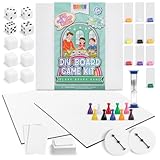
- Complete 146-Piece Kit: Create your own board game kit includes 2 blank boards, 108 blank playing cards, 10 tokens, 10 player boards with stands, 6 blank dice, 4 standard dice, timer, spinners, rule sheets, and more; great for 6 years and up
- 2 Customizable Game Boards: Design 2 unique games; set includes two 18 x 18-inch matte-finish DIY game board panels for you to build different games or test versions before creating your final design
- Portable and Organized: This customizable blank game board kit is designed for easy storage and portability, perfect for gaming at home or on the go. It includes a 9.5" x 9.5" x 1.5" box to keep all pieces organized
- Reusable Quality Materials: All board game pieces for board games are built to last longer than typical sets, allowing you to get creative, redesign your games, and enjoy them again and again
- Educational Fun: This family-friendly board game box is suitable for group activities, homeschooling, or family game nights that encourage critical thinking, problem-solving, and teamwork
To find the rate for a specific shipment:
- Identify the HTS subheading for the product as it will be imported. USTR’s Section 301 guidance says treatment is identified by that subheading.
- If you do not know the code, ask your supplier, distributor, or a licensed customs broker.
- Confirm the country of origin for each item you import.
- Check the entry date against the current HTS and the Chapter 99 measures that apply on that date.
- If the classification is uncertain or the amount matters to your margin, ask CBP for a binding ruling or get advice from customs counsel before you commit to a landed cost.
Planning around the uncertainty
For a designer or a small publisher, the practical question is how much a tariff change could move a project’s margin and timeline, not what the rate is this week. The following steps follow from the evidence above:
- Price a project under more than one duty scenario, and show the publisher the cost difference between them rather than a single figure.
- Schedule production with a four-to-six-month manufacturing window, and build a buffer for a rate change between order and arrival.
- Check how royalty payments are timed relative to shipment, warehousing, and sales, so a held container does not stall income you have already earned under the contract.
- Ask whether a design depends on specialist dice, custom plastic, wood, or die-cut parts. Those components are where domestic sourcing is hardest and where a supplier change has the largest effect on cost and timing.
Whether these choices protect income depends on the contract and the product, which is why the classification and entry-date check above belongs in every project budget.
Quick Recap
Product prices and availability are accurate as of the date/time indicated and are subject to change. Any price and availability information displayed on Amazon at the time of purchase will apply.




