John Deere’s implement story began with a problem in sticky prairie soil: cast-iron plows needed frequent scraping. In 1837, Deere reshaped a broken steel saw blade into a plow that worked in that soil. The business grew to produce 2,000 plows a year by 1849, then expanded into tractors with its 1918 acquisition of Waterloo Gasoline Engine Company. Plows remain part of Deere’s current tillage lineup, though today’s models are not evidence of a direct design lineage from the original.
Why Deere developed a different plow
Before moving to Grand Detour, Illinois, John Deere was an established blacksmith in Vermont. Deere’s corporate history says local farmers struggled to work the region’s sticky prairie soil with cast-iron plows, which had to be scraped frequently. The company describes the problem this way: “Their tried-and-true cast iron plow had to be scraped off and tended to every few feet in America’s Heartland.”
In 1837, Deere reshaped a broken steel saw blade into a plow that, according to the company’s account, worked in the local soil. Deere calls this milestone the “Origin of the Plow.” The account connects the innovation to a practical field problem; it does not establish that Deere invented every kind of steel plow or provide a complete independent history of the technology. John Deere’s corporate history recounts the company’s version of the origin story.
From a workshop innovation to a growing plow business
The company’s history says Deere’s business was producing 2,000 plows per year by 1849. That is Deere’s published production figure for that year—not a sales total, market share, or comparison with other manufacturers. The company attributes the growth to research, customer feedback, and hard work, but the available milestones do not provide a model-by-model chronology of how the plows changed.
That distinction matters: the 1837 story explains the soil challenge and the steel-blade solution, while the 1849 figure signals the scale the business had reached. It does not, on its own, show how many kinds of plow Deere made or how quickly production grew in the intervening years.
How tractors broadened Deere’s equipment business
Deere’s story later moved beyond implements. A company-published Plowshare article reports that Deere acquired Waterloo Gasoline Engine Company in 1918 for $2.25 million. Deere’s publication presents the acquisition as the company’s entry into the tractor business; the amount is the reported historical purchase price, not an inflation-adjusted figure.
#1 Best Overall
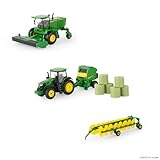
- Brand: John Deere
- Material: Metal Plastic
- Batteries required: False
- Batteries included: False
- Toy vehicle form: Tractor
The shift to tractors changed how farm work could be powered, but it did not mean implements disappeared. Tractor-powered systems use implements to perform field operations, linking the company’s early focus on plows with a broader equipment business. The cited milestones support that broad transition, not a claim that the 1837 plow itself directly evolved into a modern tractor-mounted implement.
What Deere’s current tillage lineup shows
Today, Deere’s tillage lineup includes chisel plows, disks, field cultivators, rippers, strip-till bars, and moldboards. The company lists the 995 reversible moldboard plow among its current models. Deere describes moldboard plows as tools for turning soil and field cultivators as tools for seedbed preparation.
Do these 3 things before closing this tab:
1Scan for outdated or missing drivers - takes under a minute2Repair Windows errors before they cause bigger problems3Fix the driver behind crashes, sound loss and screen glitchesRank #2

- Toy Tractor with Grain Drill: Durable die-cast metal and plastic tractor toy that's great for both indoor and outdoor play
- Smooth Ride: Both the 7215R tractor and 1590 grain drill feature free-rolling wheels
- Authentic Tractor Replica: Featuring John Deere colors and details, this 1:64 scale model is great for both kids and collectors ages 3 and up
- Collectable Tractor: Collectors will appreciate the easy to display package and the included collector's card
- Officially Licensed John Deere Product: Produced by TOMY – Our mission is to make the world smile!
This is a present-day connection, not a complete history of Deere implements or proof of an unbroken design lineage. The available company pages establish that plows remain in Deere’s portfolio and summarize current categories and uses; they do not trace the 995 back to the 1837 steel plow.
Independent reader supportYour contribution helps us test, update, and keep practical guides available for everyone.Where to see more of Deere’s history
Deere identifies its John Deere Historic Site with the first self-scouring steel plow and lists tours, artifacts, and blacksmith demonstrations. The company’s Tractor & Engine Museum in Waterloo presents equipment history from early machines to modern tractors. Deere’s visitor information says admission is free; check the official pages for current hours and visit details.
Quick Recap
Best Value

- 4555 Tractor
- 7720 Combine w/2 Heads
- 500 Grain Cart
Rank #4

- 3 Pack of John Deere Tractors includes 9620R, 4020, and 4960. Each of the tractors is L 3.4 inches x W 1.6 inches x H 2 inches
- Free rolling wheels and articulated parts
- Display box packaging is perfect for replica collectors
- Officially Licensed John Deere Product
- Farm toy fun for ages 3 and up
Rank #3
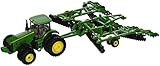
- Quality toy replica of a John Deere tractor and disk tiller
- Encourages imaginative play
- Authentic design and details
- Front and rear dual tires
- Oscillating die-cast front axle
Product prices and availability are accurate as of the date/time indicated and are subject to change. Any price and availability information displayed on Amazon at the time of purchase will apply.




