Quick wins for a faster PC:
Scan for outdated or missing drivers - takes under a minuteDriver Scan →Repair Windows errors before they cause bigger problemsFix Now →Fix the driver behind crashes, sound loss and screen glitchesFind Drivers →The 2024 study behind this story does not report a newly discovered iron ore deposit, and it does not estimate 55 billion tonnes. It dates when known iron ore deposits in the Hamersley Province of Western Australia’s Pilbara Craton formed: between 1.4 and 1.1 billion years ago. The 55-billion-tonne and trillion-dollar figures appear in secondary news and aggregation coverage from 2025 and 2026. I could not locate a primary technical estimate, resource classification, or reserve basis behind them, so they should be read as reported claims rather than established facts.
What the 2024 study actually measured
The study was published in PNAS in 2024. Its lead authors are Liam Courtney-Davies and Marco Fiorentini, with co-authors. The team used in-situ iron-oxide U–Pb geochronology, which dates the iron oxide minerals within the ore itself. That gives a direct timeline for the deposits rather than an age inferred only from the surrounding rock. The authors state: “Direct dating demonstrates that the major iron ore deposits in the region formed during 1.4 to 1.1 Ga.”

The main ore-forming event: 1.4 to 1.1 billion years ago
The dates cover the major preserved banded-iron-formation-hosted hematite deposits of the Hamersley Province. The paper names Mt. Whaleback, Mt. Tom Price, and Paraburdoo among the deposits studied. These are existing, well-known deposits, not new finds. The dates are considerably later than some earlier age interpretations. The authors argue that the deposits formed in connection with tectonic events linked to supercontinent assembly.
An earlier enrichment event: 2.2 to 2.0 billion years ago
The paper also records an older iron-enrichment event, dated to 2.2–2.0 billion years ago, preserved in hematite ore clasts. The study treats this as a separate episode from the later formation of the major preserved deposits. It should not be merged into a single age for the whole region.
Outdated Drivers Are Slowing You Down
One free scan finds every outdated or missing driver and matches the right update for your exact hardware.Free scan · exact hardware matchPC Slower Than It Used to Be?
A free scan shows the junk files, broken settings and background clutter dragging Windows down - then fixes them in one click.Free scan · Windows 10 & 11#1 Best Overall

- Hematite sample approximately 1" (3cm) in size
- Ideal for students learning about mineral streak tests - hematite's distinct red streak is unlike any other
- Perfect size for use in classroom identification labs and exercises, correlates well to Next Generation Science Standards Evidence Statements
- Good visual aid for other iron-bearing rocks and minerals
- Specimen comes in clear labeled and barcoded bag for ideal storage
Where the Hamersley Province is, and why it is not one deposit
The Hamersley Province is a geological region within the Pilbara Craton in Western Australia. A province is a large area that contains many deposits, so the phrase “the Hamersley iron ore deposit” does not refer to a single body of ore. The Pilbara is also not new to the global mining map; it is one of the best-known iron ore regions in the world. What the 2024 study adds is a more precise date for when the known deposits formed.
Where the 55-billion-tonne figure comes from
The figure of about 55 billion metric tonnes, and a trillion-dollar value, are repeated in secondary coverage published in 2025 and 2026, including a media aggregation site and a newsletter. The reporting I reviewed does not identify a primary estimate, a technical report, or a resource or reserve classification for either number. It also does not say whether the tonnage refers to total geological material, to classified resources, to reserves, or to a costed project. Phrases such as “55-billion-tonne iron ore find” and “world’s largest iron ore deposit” are search-style wording, not technical descriptions, and they are not supported by the peer-reviewed paper.
Rank #2
Tonnage, resources, reserves, and value are different claims
Much of the confusion comes from treating these terms as interchangeable. They answer different questions.
| Claim type | What it answers | Status for the 55-billion-tonne story |
|---|---|---|
| Age determination | When the ore formed | Established for major Hamersley deposits: 1.4–1.1 billion years ago (PNAS, 2024) |
| Gross in-ground tonnage | How much material is estimated to be in the ground, regardless of economics | Repeated by secondary coverage (2025–2026); no primary estimate located |
| Classified mineral resource | How much material is estimated with a stated level of geological confidence | Not stated in the reporting reviewed |
| Ore reserve | How much material can be economically mined under a defined plan | Not stated in the reporting reviewed |
| Dollar value | Tonnage multiplied by an assumed commodity price | Trillion-dollar figure reported secondarily; a gross value like this does not establish recoverable value |
A large tonnage in the ground is not the same as a mineable reserve. Recovering ore depends on grade, extraction and processing costs, infrastructure, permitting, and markets, and none of those are addressed in the sources reviewed.
Quick Recap
Best Value
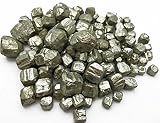
- 1.0
- Multiple pieces similar in size and quality to those pictured above
- Pieces measure approximately 1/4 to 1/2 inches
- Place of origin: China
Rank #4

- Stone Types: Pyrite
Rank #3

- HEMATITE | Hematite is made up of iron and oxygen, giving it a distinct red, earthy color. Although hematite can form in a variety of appearances, this mineral is instantly recognized by the reddish brown streak it leaves behind when powdered
- GREAT FOR GEOLOGY CLASSROOMS | Ideal for identification & classification exercises. Ideal for learning about mineral streak tests and provides a great visual aid for iron bearing rocks & minerals
- GEOLOGIST SELECTED | Each specimen is selected and hand processed by an actual geologist, ensuring each sample exhibits defining features
- LOCALLY PROCESSED | Our rock and mineral samples are sourced from a variety of locations around the world and are processed in Victor, NY
- INDIVIDUALLY PACKAGED & LABELED | Each specimen sample is packaged in a transparent bag, and is labeled & barcoded for easy identification
How to check a mining claim like this one
- Find the original document. Look for a peer-reviewed paper, a company announcement, or a regulator-filed technical report. If only news aggregation repeats a number, treat it as unverified.
- Check the classification. Exploration results, mineral resources, and ore reserves are distinct categories. A figure without one of these labels does not indicate what is economically recoverable.
- Identify the author and date. A tonnage estimate should name who made it, when, and on what data.
- Ask whether the deposit is new. Many headlines describe long-known deposits with newly measured dates or new analysis. Check whether the source reports a discovery or a reinterpretation.
- Separate age from quantity. A date of formation says nothing about how much ore exists or whether it can be mined.
- Be cautious with trillion-dollar values. These are usually gross figures built from tonnage and a commodity price, not estimates of profit or recoverable value.
“
Product prices and availability are accurate as of the date/time indicated and are subject to change. Any price and availability information displayed on Amazon at the time of purchase will apply.




