Do these 3 things before closing this tab:
1Clear out junk files and repair common Windows errors2Fix the driver behind crashes, sound loss and screen glitches3Repair Windows errors before they cause bigger problemsTexas Instruments’ June 2025 announcement of more than $60 billion for U.S. semiconductor manufacturing was an expanded and consolidated roadmap, not an entirely new $60 billion construction program. It covers seven 300mm fabs across Sherman and Richardson, Texas, and Lehi, Utah. The largest change was at Sherman, where TI raised the potential investment from roughly $30 billion to as much as $40 billion by adding two future fabs to the two already underway.
Since then, the first Sherman fab, SM1, has begun production. Other facilities are ramping, under construction or still planned, so the headline total does not mean all seven fabs are operating or that the full amount is being spent now.
What changed in TI’s investment plan?
The June 18, 2025 announcement brought together projects announced over several years and enlarged the Sherman portion of the roadmap. In November 2021, TI outlined a Sherman megasite plan of approximately $30 billion for four fabs. In 2025, it described up to $40 billion for Sherman’s four-fab build-out, including SM3 and SM4 as future additions to SM1 and SM2. The change is an expanded potential investment, not evidence that $10 billion in additional spending has already occurred. EE Times’ account of the Sherman plan provides the earlier-versus-updated framing.
The Lehi expansion and federal support also predate the 2025 total. TI announced the Lehi expansion, including LFAB2, in 2023. In August 2024 it announced a preliminary CHIPS Act funding agreement; the award agreement was finalized in December 2024. The following table shows how the June 2025 announcement grouped the facilities. TI has not published a full facility-by-facility dollar allocation for the more-than-$60-billion total.
Quick wins for a faster PC:
Clear out junk files and repair common Windows errorsFree Scan →Scan for outdated or missing drivers - takes under a minuteDriver Scan →Repair Windows errors before they cause bigger problemsFix Now →#1 Best Overall

- Product Number: FQ-WD002
- Warranty Policy: 1-Year Warranty.
- Product Condition: Original and Factory Packing.
- Parcel Packing: New and Sealed In Box with Protection.
- Customer Service: Prompt Reply and Technical Support.
| Site | Fabs | Status and investment information |
|---|---|---|
| Sherman, Texas | SM1, SM2, SM3 and SM4 | SM1 and SM2 were underway; SM3 and SM4 were identified as future capacity. TI said the Sherman investment could reach up to $40 billion. |
| Lehi, Utah | LFAB1 and LFAB2 | LFAB1 was ramping; LFAB2 was under construction. The expansion was announced before the 2025 consolidated total. |
| Richardson, Texas | RFAB1 and RFAB2 | RFAB1 is an established 300mm analog fab; RFAB2 was ramping toward full production. |
TI’s June 2025 announcement describes the seven-fab program and Sherman figure. Its manufacturing announcements include the earlier Lehi expansion.
Which fabs are producing, ramping or still planned?
A fab can be under construction, equipped, running a pilot line, producing initial chips or operating at mature output; those milestones are not interchangeable. The status reported by TI through its February 2026 materials separates the new capacity from facilities that remain future plans.
Sherman
- SM1: TI said production began on December 17, 2025. That milestone does not establish that the fab has reached full utilization or final capacity. TI’s production announcement reports the start.
- SM2: Its exterior shell was complete by June 2025, and subsequent company materials described progress toward future ramp.
- SM3 and SM4: These are future fabs in the long-range Sherman plan. The June 2025 announcement did not set guaranteed construction or production dates for them.
Lehi
- LFAB1: TI’s first 300mm fab in Lehi was ramping and supporting production transfers.
- LFAB2: Construction was underway, with shell work progressing; TI said it is designed to connect to LFAB1.
Richardson
- RFAB1: The established 300mm analog fab. TI identified it as the world’s first 300mm analog fab when it opened.
- RFAB2: TI’s February 2026 materials described it as ramping toward full production and designed to more than double RFAB1 capacity.
These updates appear in TI’s 2026 site-status presentation. Ramp rates and completed construction do not, by themselves, show how much product is being shipped; customer qualification and demand also affect output.
Rank #2

- Perfect choice for beginners to learn, electronics and program.
- The Basic Starter Kit is easy to use and you can learn to program at an introductory level.
- You can use ESP32 modules to control other modules, such as LED,DHT11,OLED module, etc
- The tutorial include codes and lessons.It will teach every users how to assembly Basic Starter Kit for ESP32.
- Please download our tutorial and learn after you receive the goods.
What kind of chips will the fabs make?
The plan centers on analog and embedded-processing semiconductors, not leading-edge logic processors of the kind used as flagship smartphone processors or advanced AI accelerators. Analog chips handle tasks such as managing power, sensing, converting signals and connecting components. Embedded processors control functions in vehicles, industrial equipment, personal electronics, enterprise systems and communications equipment.
Recommended Free Tools
These components can be small parts of a product but essential to its operation. A shortage of a power-management or control chip can constrain production even when more advanced processors are available. Expanding U.S. capacity for these products may add resilience in a segment that is important across many industries, but it does not make the United States self-sufficient in every semiconductor category.
Why does 300mm manufacturing matter?
A 300mm wafer has more usable area than a 200mm or 150mm wafer, so it can yield more dies from a wafer when the product and process are suited to that size. Producing more chips per wafer can reduce unit costs if yields and factory utilization are strong. TI’s strategy is to build dependable, low-cost 300mm capacity at scale, building on its Richardson manufacturing base.
Rank #3

- COMPATIBILITY: Development board supporting multiple wireless protocols including Bluetooth
- Thread, Matter, Zigbee, ANT, and NFC at 2.4GHz frequency
- PROCESSOR: Features the advanced nRF54L15 transceiver chip from Nordic Semiconductor for reliable wireless communications
- WIRELESS STANDARDS: Implements IEEE 802.15.4 protocol support for Matter, Thread, and Zigbee networking applications
- DEVELOPMENT PLATFORM: Comprehensive evaluation board designed for testing and prototyping wireless connectivity solutions
Wafer size alone does not guarantee cheaper chips. Economics also depend on process maturity, yield, equipment utilization, product mix, depreciation and customer demand. A large factory with expensive equipment can be less cost-efficient if it is underused; similarly, a new process may take time to reach stable yields and qualify products for customers.
How much government support is included?
The federal support is a portion of the broader manufacturing build-out, not a subsidy for the whole more-than-$60-billion program. TI’s finalized CHIPS Act award is up to $1.6 billion in direct funding for three specified 300mm fabs under construction: Sherman’s SM1 and SM2, and Lehi’s LFAB2. TI also estimated $6 billion to $8 billion in investment-tax-credit benefits associated with the projects. Those are separate forms of support, and the tax-credit figure is TI’s estimate rather than direct grant funding.
The distinction matters when interpreting the investment headline: the $60-billion-plus figure describes TI’s planned U.S. manufacturing investment across facilities at different stages, while the direct award and estimated tax benefits have their own terms and scope. The December 2024 award announcement identifies the three supported fabs. TI’s preliminary-agreement announcement describes the proposed direct funding and tax-credit estimate.
Rank #4
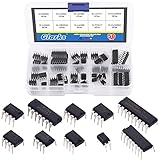
- ♛【What You Get】: This set includes 50pcs IC chips, LM324, ULN2003, ULN2803, each for 5pcs. LM358, LM386, LM393, UA741, NE5532, NE555, PC817, each for 10pcs. They are placed in a transparent plastic box, easy to transport and storage.
- ♛【High Temperature Resistance】: The IC chips have good high temperature performance and can work normally between -40 to 85 Celsius (-40 to 185 degree). So you don't have to worry about the high temperature after connecting them to the peripheral circuit, or burning out the it after long time use.
- ♛【Long Life Service】: ICs are made of high-quality materials, they are very durable, can serve you for a long time. And the safety and reliability are high, not easy to fail, so you can use it with confidence.
- ♛【Widely Application】: This IC chips can be used as low voltage quad operational amplifier, low voltage audio power amplifier, low power low offset voltage dual comparator, high gain operational amplifier, low noise dual operational amplifier, timer, photocouplers, high current drive array and Darlington arrays.
- ♛【Quality Assurance】: If you receive a defective product or have any problems during use, please feel free to contact us, we will provide return and exchange service at any time.
What does the plan mean for jobs, customers and U.S. supply?
TI says the combined sites could support more than 60,000 U.S. jobs and produce hundreds of millions of chips daily. “Jobs supported” should not be read as a count of permanent direct fab employees: the public announcement does not provide a breakdown in that figure between construction, direct employment and wider economic effects. The daily chip figure is a company projection for the combined sites, not a report of their current output.
TI’s announcement named Apple, Ford, Medtronic, NVIDIA and SpaceX as customers or partners. That does not establish that the new fabs are dedicated to those companies or that each will purchase a particular volume from them.
The company’s stated reasons for expanding include expected demand for analog and embedded chips, greater supply resilience, scale efficiencies from 300mm production and support for customers seeking dependable U.S.-based manufacturing. More domestic capacity can reduce exposure to some overseas disruptions. It cannot remove reliance on global suppliers for specialized manufacturing equipment, materials, packaging and other parts of the semiconductor supply chain. Nor does a long-term fab build-out translate automatically into near-term revenue or earnings.
What’s actually slowing this PC down?
Pick the symptom - the matching free tool is one click away.
Best Value

- DS3231 16-pin memory chips - AT24C32 ,extremely accurate I2C real-time clock (RTC), with an integrated temperature-compensated crystal oscillator (TCXO) and crystal.
- Integrated oscillator improve long-term accuracy of the device and reduces the number of components of the production line.
- Provides two configurable alarm clock and a calendar can be set to a square wave output. Address and data are transferred serially through an I2C bidirectional bus.
- Highly accurate RTC completely manages all timekeeping functions.The device incorporates a battery input, disconnect the main power supply and maintains accurate timekeeping.
- A precision temperature-compensated voltage reference and comparator circuit monitors the status of VCC to detect power failures, provide a reset output. In addition, RST pin is monitored as generating a μP reset.
How to judge whether the roadmap is on track
The most useful indicators are progress from construction to qualified, utilized production—not just the headline investment figure. Watch for:
- Construction and equipment: shell and cleanroom completion, followed by tool installation.
- Production qualification: pilot runs, initial production and the qualification of customer products, which can take time when products move from an older fab.
- Utilization and demand: whether customer orders support the planned capacity, particularly for future Sherman fabs.
- Capital spending: actual annual outlays compared with the long-term roadmap. In February 2026, TI expected approximately $2 billion to $3 billion of 2026 capital expenditures, excluding CHIPS Act benefits; that annual outlook is not the cost of the full program. See the February 2026 capital-management presentation.
- Workforce and execution: whether TI can recruit and train specialized workers as projects advance.
- Funding milestones: how construction and production progress against the conditions attached to government support.
The trade-off is familiar in large-scale manufacturing: U.S. production may improve geographic resilience, while labor, construction and operating costs can be higher. Building well ahead of demand creates room for growth but exposes the company to weaker demand or underused capacity. The timeline also matters: announcements and construction milestones precede customer-qualified output.
Key dates in the build-out
| Date | Milestone |
|---|---|
| November 2021 | TI announced its Sherman megasite plan; earlier plans contemplated approximately $30 billion for four fabs. |
| 2023 | TI announced the Lehi 300mm expansion, including LFAB2. |
| August 16, 2024 | TI announced a preliminary CHIPS Act agreement for up to $1.6 billion in direct funding and estimated $6 billion to $8 billion in investment-tax-credit benefits. |
| December 20, 2024 | The CHIPS Act award agreement was finalized for up to $1.6 billion supporting SM1, SM2 and LFAB2. |
| June 18, 2025 | TI announced more than $60 billion across seven U.S. fabs and up to $40 billion for four Sherman fabs. |
| December 17, 2025 | TI announced that production had begun at Sherman’s SM1. |
| February 2026 | TI reported site progress and forecast approximately $2 billion to $3 billion in 2026 capital expenditures, excluding CHIPS Act benefits. |
Sources: TI’s June 2025 announcement, SM1 production announcement, CHIPS Act award announcement and the February 2026 capital-management presentation.
Quick Recap
Product prices and availability are accurate as of the date/time indicated and are subject to change. Any price and availability information displayed on Amazon at the time of purchase will apply.




