NorthStar is not the only organization in commercial space situational awareness (SSA), but its announced space-based satellite approach differs from alternatives built around Earth-based radar, optical telescope networks, or data-analysis services. Providers worth evaluating include COMSPOC, ExoAnalytic Solutions, Kayhan Space, KBR, Slingshot Aerospace, the Space Data Association, LeoLabs, and Spaceflux. They are not established as interchangeable services: compare the orbit regimes covered, sensing method, data cadence, latency, outputs, availability, and contract terms before choosing.
What NorthStar announced—and what that establishes
NorthStar announced on January 31, 2024, that its first four SSA satellites had launched from Mahia, New Zealand. The company described the mission as the start of commercial space-based observations across near-Earth low Earth orbit (LEO), medium Earth orbit (MEO), and geostationary Earth orbit (GEO). NorthStar’s launch announcement

As an Amazon Associate I earn from qualifying purchases.
Rocket Lab reported that Spire built and operates the satellites, and described intended functions including object detection and tracking, orbit determination, collision avoidance, navigation, and proximity alerts. These are launch and capability announcements, not independent confirmation of present-day operational performance or commercial service availability. Rocket Lab’s announcement
What’s actually slowing this PC down?
Pick the symptom - the matching free tool is one click away.
NorthStar’s January 2024 description called the offering a commercial space-based SSA tracking service. The cited material does not verify its current fleet size, coverage, observation revisit rate, latency, accuracy, customer availability, or completion of expansion plans. Treat company descriptions of intended capability as attributed claims rather than service guarantees. NorthStar’s service announcement
Which companies are alternatives to NorthStar?
Government program announcements identify a set of providers active in SSA-related pilots, while technical sources describe distinct ground-based sensing approaches. Participation in a government program does not by itself prove that a company offers the same commercial product as NorthStar, or that a service is currently available.
Providers named in U.S. government SSA pilots
NOAA’s Office of Space Commerce and the Department of Defense named seven awardees for MEO/GEO SSA data-analysis pilot contracts: COMSPOC, ExoAnalytic Solutions, Kayhan Space, KBR, NorthStar, Slingshot Aerospace, and the Space Data Association. The list is evidence of participation in that pilot, not a ranking or a like-for-like commercial product list. NOAA Office of Space Commerce announcement
Rank #2

- Powerful Optical Performance: This telescope features a 90mm aperture and 900mm focal length refracting design, providing exceptional optical performance that allows you to easily observe deep space objects in the universe..
- Sturdy and Durable Mount: The sub-black Vertisteel Altazimuth Mount provides stable support, allowing the lens to move smoothly with high precision and maintain accurate positioning.
- Phone Adapter & Wireless Remote: This telescope not only includes an Digital eyepiece, but also a phone adapter and wireless remote. You can easily capture and share images and videos of your observations on your phone without physically touching the telescope. This allows for a steady and stable observation experience, while also making it convenient to share your discoveries with others.
- Suitable for Beginners and Professionals: This telescope is suitable for both beginners and professionals. Its user-friendly design and excellent optical performance make it an ideal choice for learning and researching astronomy.
- Lightweight and Portable: With a compact design, this telescope is easy to carry and set up, allowing you to observe deep space objects at multiple different locations. This makes it an ideal choice for travel and outdoor activities.
The Office of Space Commerce also named LeoLabs and Slingshot Aerospace among awardees of its Commercial COLA Gap Pathfinder. The program addresses the COLA gap: uncertain or incomplete positional data immediately after launch. This points to launch and early-orbit data as a relevant service need, but does not establish that these providers directly replace NorthStar’s announced offering. Commercial COLA Gap Pathfinder announcement
Do these 3 things before closing this tab:
1Repair Windows errors before they cause bigger problems2Scan for outdated or missing drivers - takes under a minute3Clear out junk files and repair common Windows errorsProviders and sensing methods described in technical sources
NASA’s 2024 Small Spacecraft Technology State of the Art report describes commercial optical telescope networks tracking objects in GEO, highly elliptical orbit, and MEO. It also describes LeoLabs’ distributed, Earth-based phased-array radar tracking service aimed at LEO. NASA’s 2024 report
Rank #3

- Tasco Space Station 600x50 is the perfect starter telescope for all ages! - H12 and H4mm eyepieces - Easy setup and breakdown
- Star Diagonal for easy no strain viewing - 2x Barlow lens to double image - 5x24 Finderscope - Full size aluminum tripod with accessory tray - Simple point and shoot
- The more you see of space, the deeper the mystery. And Tasco has everything the aspiring astronomer needs to bring the most spectacular celestial images right to your home. Our powerful line of telescopes can take you away to other worlds, to distant galaxies, to the most stirring depths of the universe
- H12 and H4mm eyepieces - Easy setup and breakdown - Star Diagonal for easy no strain viewing - 2x Barlow lens to double image - 5x24 Finderscope - Full size aluminum tripod with accessory tray
- With Tasco, you can travel light years into space and be back in time for dinner. Nothing against the planet Earth, but the universe has a lot to offer. We’ll provide the ticket
Spaceflux describes an optical SSA approach based on short-wave infrared technology, with tracking, characterization, analytics, and modular deployment options. That description identifies a different sensing architecture and service set; it is not independent evidence of comparative performance against NorthStar or other providers. Spaceflux’s service description
How space-based SSA compares with ground radar and optical tracking
The key distinction is where and how observations are collected. NorthStar announced dedicated space-based SSA satellites. Alternatives described in the sources use ground-based optical telescopes, phased-array radar, or analysis services. The available evidence supports comparing these architectures, but not declaring a performance winner.
Rank #4

- Main barrel length:850mm,caliber:90mm
- mirror:45 degree mirror,sun filter:front objective safety type,base:German equatorial instrument,total weight:about 10kg
- Model:,optical coating:multi-layer broadband green film,optical system:refractive
- Eyepiece/magnification:25mm/40x/120x,focal length:1000mm,eyepiece/magnification:10mm/100x/300x
- Barro lens:3x,tripod:reinforced stainless steel tripod,finder mirror:6x24 optics,accessory tray:upgrade accessory tray
| Approach | What the cited sources establish | What to verify with a provider |
|---|---|---|
| Space-based observation | NorthStar announced four launched SSA satellites and intended observations across LEO, MEO, and GEO in January 2024; current performance and availability are not verified. NorthStar launch announcement | Current operational status, orbit coverage, cadence, latency, measured accuracy, and service terms. |
| Ground-based optical telescope networks | NASA’s 2024 report describes networks tracking objects in GEO, highly elliptical orbit, and MEO. NASA report | Specific provider coverage, observation schedule, weather or visibility constraints, data delivery, and outputs. |
| Ground-based phased-array radar | NASA’s 2024 report describes LeoLabs’ distributed Earth-based radar tracking service aimed at LEO. NASA report | Specific coverage, revisit rate, latency, orbit-determination performance, and availability commitments. |
| Optical SSA using short-wave infrared | Spaceflux describes short-wave infrared optical SSA, tracking, characterization, analytics, and modular deployment options. Spaceflux service description | Which functions are operational, target orbit regimes, service levels, and evidence behind performance claims. |
| SSA data analysis or fused services | Seven organizations were named in the MEO/GEO data-analysis pilot; the award list does not establish identical products or current commercial availability. NOAA Office of Space Commerce announcement | Data sources used, supported regimes, analytical outputs, update frequency, integration, and data rights. |
How to evaluate a NorthStar alternative
For a professional buyer, the practical question is not simply which company “tracks satellites.” Match the provider’s documented service to the mission, orbit, response time, and operational decision it must support.
Quick Recap
Best Value
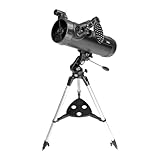
- Large 114 mm Aperture for Rich Views – The 114 mm (4.5″) mirror gathers substantial light, enabling detailed observations of the Moon’s craters, Jupiter’s moons, Saturn’s rings, and brighter nebulae.
- 500 mm Focal Length with Fast f/4.4 Optics – A focal ratio of roughly f/4.4 gives wide‑field views and shorter exposure time possibilities — ideal for beginners exploring deep sky and planetary targets.
- Carbon‑Fiber Wrap Optical Tube Design – The sleek carbon‑fiber wrap helps reduce tube weight and improves thermal stabilisation, making the telescope more portable and responsive in changing conditions.
- Complete Beginner Kit with Accessories – Includes two Plössl eyepieces (26mm & 9.7mm), a 2× Barlow lens (doubling magnification), red‑dot finder, smartphone adapter, full‑height tripod and pan‑handle alt‑az mount for intuitive control.
- Easy Setup & Educational Value – Designed for those new to astronomy: quick assembly, portable tripod, and software/star‑map tie‑in make it a strong stepping stone for night‑sky exploration.
- Define the orbit regime. State whether the requirement involves LEO, MEO, GEO, highly elliptical orbit, or more than one regime. Ask for explicit coverage limits rather than inferring coverage from a general SSA label.
- Identify the sensing architecture. Determine whether observations come from satellites, ground radar, optical telescopes, or fused sources. Architecture alone does not establish completeness or accuracy.
- Set cadence and latency requirements. Ask how often observations are made, how quickly usable data or alerts are delivered, and whether those figures are measured service commitments or planned capabilities.
- Specify the required outputs. Separate detection and tracking from orbit determination, conjunction screening, collision-avoidance support, characterization, and launch or early-orbit support. Confirm which outputs are actually included.
- Verify operational status and assurance. Ask whether the proposed capability is demonstrated, operational, contracted, or planned. Confirm service availability, geographic or sovereign requirements, and any stated service levels.
- Review commercial and technical terms. Request pricing, data rights, delivery formats, integration requirements, and contract terms directly from each provider. The cited sources establish no comparable prices.
What is not established by the available comparisons
- No independent, provider-by-provider performance ranking is established.
- A satellite launch, government pilot award, or company capability description does not by itself verify service continuity, customer outcomes, measured accuracy, or current availability.
- The sources do not establish comparable prices or prove that all named vendors sell services that can replace NorthStar’s announced space-based tracking approach.
Product prices and availability are accurate as of the date/time indicated and are subject to change. Any price and availability information displayed on Amazon at the time of purchase will apply.




