Natron Energy ceased operations on September 3, 2025, after failing to secure enough new funding and working capital. Its Holland, Michigan, plant and Santa Clara headquarters closed, affecting about 95 employees. The company’s proposed $1.4 billion, 24-GWh North Carolina factory never reached commercial construction or production.
That is a serious setback for U.S. battery manufacturing—but it does not prove sodium-ion technology failed or that America cannot make batteries. It shows a narrower, more consequential problem: the United States still struggles to finance and sustain emerging battery companies between promising technology, dependable customer demand, and profitable mass production.
As an Amazon Associate I earn from qualifying purchases.
What happened to Natron Energy?
Natron developed sodium-ion batteries using Prussian-blue-based electrodes. Its chemistry relied on materials including sodium, iron, manganese, carbon, and nitrogen rather than the lithium, nickel, cobalt, and graphite combinations used in many lithium-ion batteries. Natron described its chemistry as suitable for high-power applications, while the U.S. Department of Energy has assessed sodium batteries as a potential way to reduce exposure to constrained battery minerals.
Natron was not primarily targeting consumer electric vehicles. Its stated markets included data centers, telecommunications, backup power, and other industrial systems. The company promoted high power density, fast charging, long cycle life, and safety advantages for those uses. Those performance claims should be treated as company claims unless supported by independent testing.
#1 Best Overall

- 【Wide Device Compatibility】As an exclusive accessory for the Reveal series, this reveal lithium battery pack is specifically designed for Trail Cameras Ultra, X, X Pro, Pro 3.0, X Gen 2.0/3.0, XB, SK, and the entire Reveal Cellular Trail Camera series. It precisely matches device requirements, ensuring uninterrupted power supply for outdoor shooting
- 【High Capacity & Solar Endurance Support】Boasting a powerful 6000mAh capacity, this lithium battery pack meets the long-lasting power needs of outdoor monitoring. It is compatible with upgraded solar panels, enabling efficient solar energy storage to provide continuous and stable power for Reveal cameras. This realizes long-term sustainable operation without frequent battery replacement, and it works seamlessly with the reveal battery pack system
- 【Intelligent Power Management & Dual-Charging Flexibility】 Equipped with an LED power indicator for checking remaining charge without inserting into the camera, simplifying multi-battery management. It supports fast, flexible charging via both a Type-C port and a 12V DC port, compatible with solar panels and car adapters. LED lights display real-time charging status at a glance
- 【Extreme Weather Resistance & High-Quality Assurance】Crafted with high-performance Japanese battery cells, this reveal lithium battery pack delivers exceptional quality. It operates stably in extreme temperatures ranging from -4°F/-20°C to 113°F/45°C, ensuring outdoor devices like hunting cameras maintain continuous power supply and normal operation in all weather conditions—an ideal choice for outdoor use
- 【Cost-Effective & Sustainable Power Solution】 Utilizing a new 2025 rechargeable lithium battery design, it provides a high 6000mAh capacity for long-lasting power. This eliminates the frequent need to buy and replace AA batteries, offering an eco-friendly, durable, and significantly more economical power source for long-term outdoor use
Natron said its Holland facility opened in 2024 and was North America’s first commercial-scale sodium-ion battery factory. The plant was reported to have annual capacity of roughly 600 megawatts at full utilization. That was a real manufacturing foothold, but it was not equivalent to proving that the company could operate a large, profitable battery business.
In August 2024, Natron announced a much larger project in Edgecombe County, North Carolina. The proposed facility was expected to:
- represent nearly $1.4 billion in planned investment;
- occupy roughly 1.2 million square feet;
- produce up to 24 GWh of batteries annually; and
- create more than 1,000 jobs at full operation.
The $1.4 billion figure referred to Natron’s planned private investment, not $1.4 billion in public subsidies or money necessarily spent. The project was associated with North Carolina’s Job Development Investment Grant program, which generally provides benefits after a company meets investment and hiring targets. It was not an upfront check covering the entire factory.
Do these 3 things before closing this tab:
1Fix the driver behind crashes, sound loss and screen glitches2Repair Windows errors before they cause bigger problems3Scan for outdated or missing drivers - takes under a minuteThe shutdown timeline
- August 2024: Natron announced the proposed North Carolina expansion.
- By summer 2025: development activity had paused as the company struggled to raise the capital needed to proceed.
- August 27, 2025: the board reportedly concluded that efforts to raise sufficient new funding had failed.
- September 3, 2025: the company’s U.S. facilities closed, affecting approximately 37 Holland employees and 58 employees in Santa Clara.
Natron’s WARN filing reportedly said the company lacked the proceeds needed for additional working capital and operating expenses, including the ability to execute customer purchase orders. Its website now says that operations have ceased and provides a contact for creditors or claimants.
The public record supports describing a shutdown and asset- or claims-administration process. It does not, by itself, establish that Natron entered a conventional Chapter 7 or Chapter 11 bankruptcy. Those terms should be reserved for a confirmed court filing.
Why good battery chemistry was not enough
Battery companies must clear several expensive hurdles in sequence—and often pay for many of them at the same time:
Rank #2
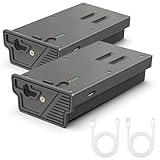
- 【Perfect Compatibility Reveal Battery Pack & LED Power Meter】This high-performance Reveal Battery Pack is perfectly compatible with Tactacam Reveal trail cameras (X Ultra 3.0 , X Gen 3.0, 2.0, X Pro 3.0, Pro, SK, XB, X). Featuring an LED battery meter, it provides a clear visual indication of remaining power. Flashing - charging and Light on -fully charged.
- 【High Capacity & Upgraded Solar Charging Support】With a powerful 6000mAh capacity, this rechargeable Reveal Battery Pack delivers long-lasting power for extended hunting trips or outdoor adventures. It’s compatible with Tactacam solar panels, allowing for continuous power supply and reducing the need for frequent recharging.
- 【Fast & Convenient Charging】Equipped with both a USB-C port and a 12V DC charging port, this battery pack offers flexible charging options. The included USB-C cable allows you to charge it with any standard USB charger, while the 12V port ensures compatibility with car chargers or solar panels. Fully charges in approximately 5 hours.
- 【Advanced Safety Protections】Built with an intelligent control chip and premium materials, this battery pack includes multiple safety features: over-charge, over-discharge, over-voltage, over-current, over-heating, and short-circuit protection. These ensure safe operation and extend the battery’s lifespan, providing reliable power for your hunting, trail camera battery, trail camera, cell cameras.
- 【Superior Temperature Adaptability】Designed for outdoor use, this battery pack operates seamlessly in extreme temperatures, ranging from -20°F to 140°F (-68°C to 60°C). Whether you’re in freezing winters or scorching summers, it delivers consistent performance, making it the perfect companion for year-round hunting and outdoor activities.
- laboratory research;
- pilot production;
- process and equipment qualification;
- customer safety and reliability testing;
- repeatable manufacturing yields;
- firm purchase commitments;
- positive margins; and
- financing for expansion.
Natron appears to have moved beyond laboratory work and into commercial production in Michigan. But operating one relatively small facility while attempting to commercialize a new product and finance a factory 40 times larger creates a major cash burden.
Quick wins for a faster PC:
Scan for outdated or missing drivers - takes under a minuteDriver Scan →Clear out junk files and repair common Windows errorsFree Scan →The company reportedly raised more than $363 million since its founding in 2012, including investment from Khosla Ventures, Liberty Oilfield Services, and United Airlines. It also received a reported $19.8 million ARPA-E award and additional equity and debt financing. The important question, however, was not simply how much money Natron had raised over its lifetime. It was whether the company had enough cash at the right time to pay workers and suppliers, maintain inventory, support customer testing, absorb delays, and keep its factory operating while new orders and financing were being negotiated.
Why purchase orders mattered
Natron’s reported search for new purchase orders illustrates the difference between customer interest and bankable demand.
Industrial customers may be interested in a new battery but still require:
- extended reliability and safety testing;
- integration with existing power systems;
- warranty and replacement commitments;
- evidence of consistent production capacity;
- competitive delivered-system pricing; and
- long-term service support.
A memorandum of understanding, pilot project, or prospective customer relationship may help a startup’s sales pipeline. It may not provide the firm revenue commitments that lenders and investors need before financing a large factory.
This creates a difficult timing problem. Customers often want proof that a company can manufacture reliably before committing to large orders. Investors want evidence of large orders before funding the manufacturing capacity needed to satisfy them. A startup must survive that gap with working capital.
Rank #3

- Package Includes: 1* 2600mAh 11.1v- 12v rechargeable battery pack, 1*12V battery charger, 1* cable connector, 1* DC5521 extension cord. The maximum output current is 6A (MAX)
- Wide Compatibility: Compatible with most 12V devices. Great for RC car, robot toy, DIY, solar panel, LED strip, CCTV camera, wireless camera, Bluetooth device, walkie-talkies, digital camera, video recorder, CD player, portable DVD player, MP3 player, electronic piano, router, mini Bluetooth Amp, turn signal, car DVR, etc
- Built-in Safety Chip: This 11.1v- 12v battery rechargeable comes with a built-in safety board. It protects the battery from over-charge, over-discharge, over-voltage, over-current, over-heat and short-circuit. Each battery is made with premium batteries to ensure safety and reliability
- Long Lifespan: This 11.1v- 12v lithium battery pack uses lithium-ion battery, no memory effect. The 11.1v- 12 v battery pack can handle over 800 charge and discharge cycles. No need to replace it often, so it’s both convenient and cost-effective
- Customer Support: If you have any issues or questions about the product, feel free to contact with us. We’ll get back to you quickly and help you sort it out
Did cheap lithium-ion batteries cause Natron’s failure?
Falling lithium prices and the scale of established lithium-ion manufacturing likely increased the pressure on Natron. But the available evidence does not establish that cheaper lithium was the sole or definitive cause of the shutdown.
Lithium-ion batteries compete from a position of enormous industrial maturity. Their manufacturers benefit from:
- large global factories;
- established equipment and supplier networks;
- years of process experience;
- known customer qualification procedures; and
- large existing markets, particularly electric vehicles and energy storage.
Sodium-ion batteries may reduce exposure to lithium, nickel, cobalt, or graphite constraints. That advantage does not automatically make a sodium-ion cell cheaper once equipment, labor, quality control, financing costs, warranties, installation, and system integration are included.
Natron also pursued a narrower initial market than the mass EV market. High-power industrial and backup applications can reward fast charging, cycle life, and safety, but they may have fewer potential customers and longer qualification cycles. A technically attractive product can therefore face a difficult commercial market.
Sodium abundance does not eliminate supply-chain risk
The phrase “sodium-ion” can create a misleading impression that abundant sodium makes the entire supply chain simple. A battery factory also needs active materials, electrolytes, separators, binders, coatings, current collectors, formation equipment, testing systems, and qualified suppliers.
The DOE has identified supply-chain challenges for sodium batteries, including electrolyte availability. Limited supplies of specialized components can raise costs and constrain production even when the primary active material is plentiful. The DOE’s sodium-battery supply-chain assessment emphasizes that a complete industrial ecosystem matters more than the abundance of one element.
Rank #4

- Energizer Double A Lithium batteries are the world's longest lasting AA batteries.
- These AA Energizer batteries power your most critical devices, great for smart home devices, outdoor surveillance systems, digital cameras, Blink outdoor cameras, and handheld games
- An Ultimate Lithium battery can hold power up to 25 years in storage for trustworthy backup energy, so you are always prepared
- Energizer lithium AA batteries are made with leak-proof construction to help protect devices (based on standard use)
- AA lithium batteries can perform in extreme temperatures from -40F to 140°F for year-round, indoor and outdoor use
Natron’s Prussian-blue chemistry may have reduced reliance on some constrained minerals. It still required dependable suppliers, specialized manufacturing processes, consistent yields, customer qualification, and enough cash to keep the system running.
What’s actually slowing this PC down?
Pick the symptom - the matching free tool is one click away.
What Natron says about U.S. industrial policy
Natron’s case shows the limits of treating factory announcements as proof of industrial capacity.
Government programs can help through research awards, tax credits, grants, loans, infrastructure, and procurement. They can lower a project’s costs or improve its expected returns. They cannot guarantee that:
- the technology will achieve commercial yields;
- customers will sign firm orders;
- private investors will continue funding losses;
- suppliers will be available at the required scale; or
- the finished product will beat established competitors on delivered cost.
Natron’s proposed North Carolina incentives were tied to future investment and hiring. Because the company could not secure the financing required to proceed, the promised jobs and production never became operating assets. This is not evidence that every incentive program is ineffective. It is evidence that project-level incentives cannot replace a complete commercialization system.
A stronger policy framework would focus on the “commercialization valley” between research and profitable volume production. That could include milestone-based financing, demand commitments from public or strategic buyers, support for domestic component suppliers, and clearer evaluation of production yield and customer contracts—not just announced capacity.
Free tools Windows power users keep installed
One-click scans. No signup required.
Does Natron prove the U.S. cannot make batteries?
No. The United States has operating battery plants, federal research programs, and companies pursuing lithium-ion, sodium-ion, solid-state, iron-based, and other chemistries. The DOE and ARPA-E continue to document domestic battery development, including a 2026-supported Mana Battery project focused on anode-free sodium cells.
Best Value

- Lithium Battery 12V Information: Type: 12V rechargeable lithium battery; Capacity: 10000mAh
- Battery Compatibility Range: This 12V battery pack is compatible with robot toys, remote-controlled batteries, DIY projects, LED light strips, solar panels, closed-circuit TV cameras, wireless cameras, walkie-talkies, digital cameras, video cameras, recorders, Bluetooth devices, CD players, players, portable DVDs, toy models, CCTV cameras, electronic pianos, routers, electric scooters, 12V turn signals, in-car DVRs, electronic pianos, routers, electric scooters, 12V turn signals
- 12V lithium battery with long lifespan: No memory effect, with over 800-900 charge/discharge cycles. No need to worry about frequent battery replacements, saving time and money.
- 12V battery with high capacity and genuine materials: Built-in protection board prevents overcharging, over-discharging, overvoltage, and short circuits, making it a safe 12V battery to use.
- Includes one 12V lithium battery*1, one 12V charger, one plug*1, one DC5521 12V cable*, one charging cable*1, and one 12V adapter plug.
Natron does support a narrower conclusion: the United States has not yet created a reliably repeatable path for turning many promising battery startups into durable, cost-competitive manufacturers.
That distinction matters for policymakers, investors, local officials, and workers. A successful laboratory result is not a successful factory. A factory is not a profitable business. And a large announced project is not the same thing as delivered domestic capacity.
Where sodium-ion batteries may still make sense
Natron’s shutdown does not show that sodium-ion batteries are technically useless. The chemistry may remain attractive in applications where energy density is less important than other characteristics, including:
Recommended Free Tools
- stationary energy storage;
- data-center and telecommunications backup power;
- high-cycle industrial systems;
- cold-weather deployments; and
- applications where safety and reduced exposure to constrained minerals justify a different cost structure.
Sodium-ion is not automatically a replacement for lithium-ion. The right comparison is the delivered cost and performance of the entire system, not the raw-material price or the name of the chemistry.
How to evaluate the next domestic battery project
Readers assessing a battery company, factory announcement, or local incentive package should ask:
- Are there firm customer contracts? Signed purchase agreements are stronger evidence than memoranda of understanding or public endorsements.
- Is production yield validated? Nameplate capacity is not the same as saleable output.
- How much working capital is available? The company must fund inventory, payroll, testing, warranty reserves, and delays.
- Does the process fit existing equipment? A new chemistry may require different electrode, electrolyte, formation, or quality-control systems.
- What is the actual market? A specialized industrial market may have attractive margins but fewer customers and longer sales cycles.
- What is the delivered system cost? Include installation, controls, maintenance, replacement, and integration—not only cell cost.
- How deep is the supplier network? Domestic raw materials do not guarantee domestic access to specialized components or equipment.
- Are the incentives durable and conditional? Future tax rules and performance-based grants can affect financing assumptions.
The broader lesson
Natron’s collapse is best understood as a commercialization and industrial-execution failure, not a public technical verdict on sodium-ion batteries.
The company had a credible strategic proposition, a Michigan production facility, government-backed research, and a proposed expansion with major job and capacity claims. It still could not secure enough funding and near-term demand to keep operating.
For the United States, the challenge is not merely inventing new battery chemistries or announcing factories. It is building companies that can survive the costly period between first commercial production and full-scale competitiveness. Until financing, suppliers, customers, manufacturing expertise, and policy support work together, promising domestic battery projects will remain vulnerable—even when the underlying chemistry may be sound.
Quick Recap
Product prices and availability are accurate as of the date/time indicated and are subject to change. Any price and availability information displayed on Amazon at the time of purchase will apply.




