Do these 3 things before closing this tab:
1Scan for outdated or missing drivers - takes under a minute2Clear out junk files and repair common Windows errors3Fix the driver behind crashes, sound loss and screen glitchesU.S. data do not establish a nationwide pumpkin shortage in 2026, or show that climate change caused one. The latest USDA figures show production among the states covered by its survey rose in 2025, though it remained below the average for 2022–2024. Weather can damage pumpkin crops, and imports supplement domestic supply, but those facts do not prove a current shortage. Whether pumpkins are hard to find depends on the type, location and selling season.
Is there a pumpkin shortage this year?
As of October 2026, the available national data do not establish an across-the-board U.S. shortage. USDA Economic Research Service (ERS) reports that the states in its top-state survey produced 1.47 billion pounds of pumpkins in 2025—about 4 percent more than in 2024, but 7 percent below the 2022–2024 average. Those figures describe a survey series, not a complete count of all 50 states. USDA ERS’s pumpkin production data provide the underlying context.
National annual production also cannot tell you whether a particular store, farm stand or region has pumpkins in stock in fall 2026. A shortage claim is most useful when it specifies what is scarce, where and when: for example, jack-o’-lantern pumpkins at local retailers, processing pumpkins for manufacturers, or canned pumpkin on grocery shelves.
What the production and availability figures mean
Production is concentrated in a few states
The top five producing states accounted for nearly 72 percent of the 2025 crop in ERS’s survey series. Illinois alone produced about 533 million pounds. A poor harvest in a major producing state could matter to particular markets, but national totals do not show how much product is available at any one seller.
#1 Best Overall

- Contents: This mixture of seeds includes more than 7 varieties of Pumpkins. A blend of Jack O' Lantern, Blue Jarrahdale, Atlantic Giant, Fairytale, Small Sugar, Jack Be Little, Cumshaw Green Striped, Connecticut Fields, Cinderella, Howden & more!
- Harvest: The different varieties of pumpkins grown from this seed mixture will be ready for harvesting from 90 days to 125 days. Placing straw underneath the fruits as they mature can prevent rot.
- Note: Take note that larger seeds grow larger varieties of Pumpkins and smaller grow medium to miniature sized pumpkins. Smaller seeds produce shorter harvesting dates and vice versa.
- Quality: All seeds packaged by Seed Needs are intended for the current and the following growing seasons. All seeds are stored in a temperature controlled facility that is free of significant amounts of moisture.
- Quantity: Seed Needs offers generous quantities. You can share with friends and family, or you can save the extra seeds until the following season, if properly stored.
National availability combines different uses
Pumpkins go to fresh and ornamental markets—including decorative pumpkins and pumpkins sold for direct consumption—as well as processing. ERS’s per-capita availability measure combines both markets and converts them to a fresh farm-weight basis; it is not a count of pumpkins shoppers can buy fresh.
That measure was 5.2 pounds per person in 2025. ERS reports an average of about 6 pounds per person in 2022–2025, compared with about 4 pounds in 2001–2004. These figures do not indicate that availability had collapsed, but they also cannot establish local retail stock. ERS explains the production and availability series.
Rank #2

- FOUR HEIRLOOM VARIETIES – Small Sugar, Jack O’ Lantern, Fairytale & Casper pumpkins for sweet pies, carving traditions, and fall decorating
- COOKING & STORAGE – Bake pies, roast seeds, or can pumpkin puree; dependable harvests for family meals and long-term food storage
- CARVING & hOLIDAY FUN – Grow classic orange Jack O’ Lanterns and ghost white Caspers for halloween, autumn décor, and seasonal traditions
- GROW ANYWHERE – Reliable germination in garden beds, raised planters, or containers; suitable for spring planting or fall gardening projects
- FAMILY OWNED USA SMALL BUSINESS – heirloom non-GMO seeds from Survival Garden Seeds, a trusted American brand; always open-pollinated, untreated, and quality tested for garden success
Different 2024 estimates use different methods
ERS’s April 2025 outlook estimated commercial production at 1.9 billion pounds in 2024—11 percent below 2023 and 19 percent below the 2022 peak. That estimate uses a broader method than the top-state survey series, which reported 1.44 billion pounds for 2024. The figures are not interchangeable, and neither should be presented as a complete measure of current 2026 supply. The 2025 ERS outlook describes its estimate.
How weather can affect pumpkin crops
Excessive rain can delay planting and fieldwork, interfere with crop establishment, and raise the risk of disease and rot. USDA’s Midwest Climate Hub describes these impacts, including labor challenges when wet conditions delay work in fields. Pumpkins are also sensitive to cold and frost, according to NOAA’s account of Illinois’s 2015 crop season.
Free tools Windows power users keep installed
One-click scans. No signup required.
Rank #3

- Fruit Size: Varied seed blend produces pumpkins ranging widely from two to twenty pounds in diverse, whimsical proportions.
- Appearance: Eclectic combination of bright orange, white, and bicolored rinds in smooth, warty, round, or flattened forms.
- Best Uses: Ideal for diverse doorstep displays, colorful carving selections, festive autumn decor, and school gardens.
- Growing Tips: Plant in fertile mounds with full sun, watering evenly to support diverse growth rates across mixed plants.
- Quality - All Primrose seeds packaged by Seed Needs are intended for the current and the following growing seasons. All seeds are stored in a temperature controlled facility that is free of significant amounts of moisture.
That season is a documented example of weather damage, not evidence that climate change caused a national shortage. Above-average rainfall and soaked soils during a critical growing period contributed to disease and rot, and USDA reports that heavy rainfall severely reduced Illinois’s 2015 pumpkin harvest. Mark H. Walberg, a University of Illinois Extension horticulture educator, was quoted in NOAA’s archived explainer: “They loved dry weather and hated, absolutely hated, wet weather—too wet and they suffered from rot and disease.” NOAA’s account of the 2015 season and the USDA Midwest Climate Hub’s discussion of agricultural impacts support the distinction between observed weather damage and climate attribution.
USDA’s Agricultural Research Service lists a 2024–2026 project studying pumpkin productivity and integrated pest management under higher temperatures and variable precipitation. That is research underway, not a completed finding about climate change’s effects on U.S. pumpkin supply. The project listing describes its scope.
Rank #4

- Name: Big Max Pumpkin | Type: Heirloom
- Size at Maturity: 100+ Pounds | Days to Maturity: 110 Days
- Light Requirement: Full Sun | Planting Time: Warm Season
- Sowing Method: Direct Sow
- Planting Depth: 1-1 1/2" | Plant Spacing: 48"
How imports fit into U.S. pumpkin supply
Domestic growers supply most pumpkins. ERS estimated that U.S. production represented more than 95 percent of total supply in 2024. Imports nevertheless supplement availability: they accounted for 5 percent of domestic availability over 2020–2024, the largest share in ERS’s record and more than twice the 2 percent share recorded for 2000–2004. ERS’s 2025 outlook reports these supply estimates.
For fresh pumpkins imported during 2020–2024, Canada supplied 54 percent, Costa Rica 33 percent, Panama 7 percent and Mexico 3 percent. ERS also reported that fresh pumpkin imports through February 2025 were 21 percent higher than in the same period a year earlier. That historical comparison shows imports can change; it does not establish a 2026 import disruption or trend.
Best Value
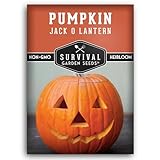
- HALLOWEEN CLASSIC – Reliable jack o'lantern pumpkin that grows 18–24 pound fruits, perfect for carving spooky faces or festive fall porch displays
- TASTY & VERSATILE – Smooth orange pumpkins that can be roasted, baked, or pureed for pies, soups, and other comforting fall recipes
- GROW WITH CONFIDENCE – Easy to cultivate in full sun with regular watering, producing uniform pumpkins ready in about 100 days
- PLANT NOW OR STORE – Seeds stay viable for multiple seasons when stored properly, so you can grow pumpkins this year or in the future
- FAMILY OWNED USA SMALL BUSINESS – Heirloom non-GMO seeds from Survival Garden Seeds, a trusted American brand; always open-pollinated, untreated, and quality tested for garden success
Trade figures require care: pumpkin exports are combined with squash and gourds in the trade category, and ERS estimates pumpkins make up half of that category. The combined figure should not be described as pumpkin-only. ERS discusses the trade data and its limitations.
Why pumpkins may be hard to find locally
A national harvest number is not a live inventory report. Local availability can differ by market and geography: ornamental pumpkins at a farm stand are not the same product as pumpkins grown for processing, and a national annual measure does not reveal the stock of fresh pumpkins at a particular retailer.
- Market: Is the claim about fresh or ornamental pumpkins, processing pumpkins, or canned product?
- Place: Is it about a national crop, a producing state, a local farm stand or a specific store?
- Time: Does the evidence describe the harvest year, or current retail stock?
- Supply: Does it account for domestic production and imports, rather than treating one as the whole supply?
- Cause: Does it document a weather impact, or establish a longer-term climate trend or attribution?
USDA’s processing-pumpkin insurance provisions list excessive moisture, abnormally hot or cold temperatures, and plant disease among specified causes of loss, subject to policy terms. This recognizes production risks for insurance purposes; it does not measure how often they occur or attribute them to climate change. USDA Risk Management Agency crop policies.
Quick Recap
Product prices and availability are accurate as of the date/time indicated and are subject to change. Any price and availability information displayed on Amazon at the time of purchase will apply.
What’s actually slowing this PC down?
Pick the symptom - the matching free tool is one click away.




