Quick wins for a faster PC:
Clear out junk files and repair common Windows errorsFree Scan →Fix the driver behind crashes, sound loss and screen glitchesFind Drivers →For the contaminants and veterinary-drug residues covered by Norway’s latest official monitoring, the 2025 results did not show levels above applicable legal limits. The Institute of Marine Research analyzed 1,913 farmed-fish fillet samples for its 2025 report, published in 2026. That is reassuring evidence about the samples tested—not proof that every fish is free of contaminants, a guarantee about any particular brand, or a personalized health-risk assessment.
Is Norwegian farmed salmon safe to eat?
The latest official monitoring results support a qualified yes for Norwegian farmed fish represented in the 2025 sampling program: regulated contaminant levels did not exceed applicable limits, and detected residues of two authorized anti-sea-lice medicines were below their maximum residue limits. The Norwegian Food Safety Authority also says environmental contaminant levels in farmed fish are well below limit values. Norwegian Food Safety Authority: Control of contaminants in fish
These findings concern measured samples and the substances analyzed. They do not establish that every fish has the same composition, that all possible substances have been assessed, or that a named product or brand was tested. The 2025 program included Atlantic salmon, rainbow trout, brown trout, Atlantic halibut and Atlantic cod; some analyses used pooled material from three fish from the same cage or farm. Sampling was randomized by season and geographic distribution, making it an official surveillance program rather than product-by-product certification. Institute of Marine Research: Annual report for 2025
What did Norway’s latest monitoring find?
The Institute of Marine Research’s 2025 report describes 1,913 farmed-fish fillet samples collected by the Norwegian Food Safety Authority and analyzed by the Institute. Its findings distinguish authorized medicines, illegal substances and regulated contaminants:
#1 Best Overall
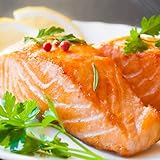
- Each salmon fillet is individually packaged for portion control and to reduce food waste. Each 6 oz to 7 oz package contains approximately 42 grams of high quality protein, >100% of the daily recommended value of both vitamin B-12, important for red blood cells, and Selenium, an important nutrient involved in DNA synthesis, thyroid hormone metabolism, and reproductive health.
- Flash freezing uses cold temperatures to maintain freshness, preserve nutrients and protect the product from external impurities.
- The American Heart Association recommends that people include at least two servings of fish per week in their diet (particularly fish high in omega-3s such as salmon).
- Norwegian Salmon is antibiotic-free and non-GMO. Norwegian salmon farmers have topped the Coller FAIRR ranking of the world’s most sustainable protein producers for three years running. According to the Norwegians, it was Norway that introduced Japan to eating salmon raw (Coho salmon generally should be cooked before eating).
- Today Gourmet ships all products in insulated boxes with either dry ice or frozen gel packs guaranteed to arrive frozen at your doorstep. We utilize a thermal bag as additional protection during the delivery process. Your product will arrive safely or we will replace it.
- Authorized anti-sea-lice medicines: Cypermethrin and deltamethrin residues were detected below their respective maximum residue limits (MRLs).
- Other authorized veterinary medicines: No residues were found in the analyzed samples, including medicines such as antibiotics, endoparasitic agents and sedatives.
- Illegal substances: No illegal substances other than three detections of leucocrystal violet were reported. A Norwegian Food Safety Authority follow-up considered sample contamination more likely than illegal use of crystal violet, but did not identify the contamination source.
- Regulated contaminants: The report found no exceedances of applicable limits for the regulated contaminants it covered.
Those are findings for the 2025 program, not statements that no residues or contaminants exist in any farmed fish. The report also surveyed substances without established maximum levels, including selected chemical elements, flame retardants, pesticides and chemicals associated with processing or aquaculture. Being included in monitoring does not itself mean a substance was found at a harmful level or that a legal limit was exceeded.
Does farmed salmon contain antibiotics?
The 2025 report found no residues of antibiotics or other authorized veterinary pharmaceuticals, apart from the below-MRL detections of cypermethrin and deltamethrin, in the samples analyzed. This supports a statement about that year’s sampled fish; it cannot establish the result for every fish or every product on sale.
Rank #2

- Pre-packed, Farm-raised Atlantic Salmon, Certified by Best Aquaculture Practices (BAP).
- Perfect for family meals or large gatherings.
- Ready to cook, grill or bake.
- Fresh Premium Salmon Quality for gourmet meals at home.
- Beautiful color and marble with a mild flavor.
Drug residues and environmental contaminants are governed by different kinds of limits. An MRL applies to residues of an authorized veterinary medicinal product in a specified food commodity. Norway’s report explains that residues below the established MRL are considered safe and not expected to pose a consumer-health risk. A detected residue below an MRL is still a detection; it is not the same as either zero residue or a legal exceedance.
What contaminants are found in Norwegian farmed fish?
The 2025 monitoring program covered regulated persistent pollutants and metals, including dioxins, dioxin-like PCBs, PCB-6, PFAS, mercury, cadmium and lead. It also noted that maximum levels for inorganic arsenic in fish fillets applied from 2025. The report’s findings should be read substance by substance: monitoring for an analyte does not mean that it was detected, and detection does not by itself establish an unsafe concentration.
Rank #3

- Pre-packed, Farm-raised Atlantic Salmon, Certified by Best Aquaculture Practices (BAP).
- Ready-to-cook; to grill, bake, broil, air fry, or pan-fry.
- Conveniently cut into two 6oz portions.
- Fresh Premium Salmon Quality for gourmet meals at home.
- Beautiful color and marble with a mild flavor.
Norway’s regulator explains that feed affects contaminant levels in farmed fish and that contaminants in feed are strictly regulated. Its guidance lists maximum limits for mercury, cadmium, dioxins and four PFAS: PFOA, PFOS, PFNA and PFHxS. Those maximum levels (MLs) are legal limits for named contaminants in food, not the MRLs used for veterinary-drug residues. Norwegian Food Safety Authority: Control of contaminants in fish
Are contaminant levels above legal limits?
The 2025 report found no exceedances for the regulated contaminants it covered. The 2024 annual report likewise reported no exceedances of the EU maximum levels it listed for dioxins, dioxins plus dioxin-like PCBs, PCB-6, mercury, lead, cadmium and PFAS. It also reported no residues of illegal substances and detected certain authorized anti-sea-lice residues below their MRLs. Institute of Marine Research: Annual report for 2024
Rank #4

- Farmed in norway
- Non-GMO fed
- One 8 ounce package of Changing Seas smoked salmon fillets
- Raised without antibiotics or hormones
- Smoked in germany
Norway’s regulator says fish containing levels above applicable maximum limits may not be sold. Its guidance describes Norway’s official control duties under the European Economic Area framework and the submission of results to the European Food Safety Authority. A finding of no exceedances in surveillance is evidence that the tested samples met the applicable limits; it is not a claim that all fish contain zero contaminants.
Independent reader supportYour contribution helps us test, update, and keep practical guides available for everyone.What remains uncertain about emerging contaminants?
Some substances investigated in the monitoring program do not have established maximum levels. The 2024 report says occurrence data for some emerging contaminants were too limited to assess how much fish contributes to consumers’ overall exposure. It reported that monitoring would continue and that data would be submitted to the Norwegian Food Safety Authority and the European Food Safety Authority. This uncertainty is distinct from evidence of an exceedance of a regulated limit: the available data were insufficient for an exposure estimate, not proof of harm or proof of absence.
Do these 3 things before closing this tab:
1Repair Windows errors before they cause bigger problems2Scan for outdated or missing drivers - takes under a minute3Clear out junk files and repair common Windows errorsBest Value

- Responsibly Farmed or sustainable wild-caught
- Certain preservatives prohibited, including sodium bisulfite and STPP
- Traceable to farm or fishery
What about radioactive substances and disease concerns?
Radionuclides
A separate Norwegian Food Safety Authority summary, published in 2022, reports that a study conducted in 2016 found cesium-137 levels in farmed salmon about three orders of magnitude below Norway’s maximum permitted level. The authority characterized the potential consumer-health risk from the measured radionuclides as very low. This is a specific, older finding about radionuclides—not a 2025 measurement of all contaminants. Norwegian Food Safety Authority: Very low levels of radioactive substances in Norwegian farmed Atlantic salmon
Fish health and environmental issues
Disease risks within fish farms are not the same as a consumer’s exposure to contaminants in food. A 2017 assessment by the Norwegian Scientific Committee for Food and the Environment considered whether cleaner fish used against salmon lice could transmit disease to farmed salmon. It described knowledge about infections in wild-caught cleaner fish as generally poor and identified amoebic gill disease as the single disease with justified suspicions of transmission at that time. That assessment concerns fish health, not evidence that eating salmon exposes people to those pathogens. VKM: Cleaner fish and the risk of transmitting infection to farmed salmon
How to interpret a contaminant claim
When evaluating a claim that Norwegian salmon is “toxic,” “clean” or safer than another fish, check what was measured and how the result is framed:
- Identify the substance and category: Is the claim about a veterinary-drug residue, a regulated contaminant, a radionuclide or an emerging substance?
- Check the sample and year: Official monitoring results describe the tested species and samples from a stated period, not automatically a particular brand or the entire market.
- Compare the result with the right limit: A medicine residue is assessed against its MRL; a named contaminant is assessed against its applicable ML.
- Separate detection from risk: Detection alone does not mean a limit was exceeded or establish a health effect.
- Keep evidence limits in view: For some emerging substances, occurrence data have not been sufficient to estimate fish’s contribution to overall exposure.
The reviewed official reports do not establish a brand ranking. A meaningful product comparison would require comparable measurements for the same analytes, sampling period and product type—not assumptions based on a country label alone.
What’s actually slowing this PC down?
Pick the symptom - the matching free tool is one click away.
Quick Recap
Product prices and availability are accurate as of the date/time indicated and are subject to change. Any price and availability information displayed on Amazon at the time of purchase will apply.




