Yes. Many repair shops charge more for a part than they paid for it, and that markup is a normal part of how shops price repairs. A markup alone does not show that a shop is overcharging: there is no universal fair percentage, and an online listing may not be the same part or include the same warranty, sourcing, or service.
What a parts markup means—and what it does not
A parts markup is the amount added to a shop’s cost to arrive at its selling price. It helps cover the work and costs involved in sourcing, stocking, and supplying parts, alongside the shop’s other operating expenses. It is not automatically evidence of price gouging.
The Internal Revenue Service’s March 2021 auto-repair examination guide says the shops it examined received an average 20% to 25% discount off retail on factory parts. That corresponds to a 25% to 33.3% markup over the discounted cost. The IRS also notes that non-factory parts can carry higher markups, including more than 100% on some water pumps and much more on small items such as gaskets and filters. These are historical observations from examined shops, not a current industry-wide standard or a measure of what is fair for a specific repair. IRS Publication 5495 (March 2021)
Why the quoted price may differ from an online listing
A price comparison is meaningful only when the parts and terms match. Check whether each quote is for the same brand and part number, and whether the part is OEM or aftermarket, new, remanufactured, or used. Warranty coverage, availability, sourcing, and who handles a failed part can also change the value of an estimate.
What’s actually slowing this PC down?
Pick the symptom - the matching free tool is one click away.
#1 Best Overall
A shop’s customer price minus a website’s listed price is not necessarily the shop’s profit. The shop’s wholesale cost may differ, and the online listing may cover a different part, warranty, or service arrangement. The IRS says a business-specific markup calculation is better based on supplier invoices and repair orders, which customers generally do not see.
Markup and gross margin are different
Markup is measured against the shop’s cost; gross margin is measured against the selling price. If a shop pays $100 for a part and sells it for $200, the markup is 100%, but the gross margin is 50% before overhead and other expenses.
Rank #2

- ✔ Professional Auto Shop Documentation Designed for mechanics and garages to create clear repair orders, invoices, and receipts ✔ 2-Part Carbonless Copies White & yellow duplicate sheets for instant copies—no carbon paper needed ✔ Perfect for Daily Shop Use Ideal for tracking vehicle repairs, parts, labor, and customer approvals ✔ Multi-Purpose Forms Use as work orders, invoices, receipts, or service records in any automotive business ✔ Durable & Easy to Write On Built for busy garages and mobile mechanics needing reliable paperwork
That distinction matters when interpreting shop-pricing guidance. PartsTech and the Institute for Automotive Business Excellence surveyed 618 U.S. general repair shop owners and managers; the survey was about shop practices, not consumer overcharging. Their sample pricing matrix applies different multipliers by part cost, ranging from 4.00× on parts costing $0–$2.50 (a 75.0% gross margin) to 1.70× on parts over $500 (a 41.1% margin). The matrix illustrates a shop-facing pricing strategy; it is not an observed average or a consumer fairness benchmark. PartsTech and the Institute for Automotive Business Excellence, Parts Markup Guide for Auto Repair Shops
The Institute recommends an overall 58% gross profit on parts as a shop-coaching target, not a threshold for deciding whether a customer is being treated fairly. Likewise, the survey’s finding that 67% of shops were “leaving money on the table” concerns shops’ own parts profitability, not the share of customers overcharged. PartsTech, Parts Markup Matrix
Outdated Drivers Are Slowing You Down
One free scan finds every outdated or missing driver and matches the right update for your exact hardware.Free scan · exact hardware matchPC Slower Than It Used to Be?
A free scan shows the junk files, broken settings and background clutter dragging Windows down - then fixes them in one click.Free scan · Windows 10 & 11Rank #3

- Premium Material: Our Telescoping Magnetic Pickup Tool is crafted from durable stainless steel tubes and a strong magnet, ensuring long-lasting performance; The cushioned grip handle offers comfort and control, making your tasks easier and more efficient
- Complete Set: You will receive 6 pieces of 20 lb Telescoping Magnetic Pickup Tool in black; Ideal for workers, carpenters, mechanics, and DIY enthusiasts, these tools help retrieve lost metal parts, nuts, bolts, and screws with ease
- Powerful Magnet: Each telescoping magnet boasts a maximum suction weight of 20 pounds, quickly attracting various magnetic parts; This enhances work efficiency and makes it an essential tool for workshops and home use
- Telescoping Design: The magnet stick extends from 7.1 to 30 inches, allowing you to reach objects near or far; Perfect for accessing tight corners behind cabinets, refrigerators, or car engines, providing flexibility and convenience
- Versatile Application: This pocket-sized Telescoping Magnetic Pickup Tool is great for finding metal nuts, bolts, screws, and other metal pieces; A must-have in any toolbox, it simplifies daily tasks and offers practicality for various situations
How to check a parts quote
- Get the estimate itemized. Ask to see parts, labor, fees, and taxes as separate line items.
- Identify the part. Ask for the brand and part number when available, whether it is OEM or aftermarket, and whether it is new, remanufactured, or used.
- Clarify the warranty. Ask what coverage applies to the part and labor if the replacement fails.
- Compare the same repair. Get another written estimate for the same vehicle, repair scope, and part quality. Check whether sourcing, fitment, programming, or other necessary work is included.
- Ask about a large difference before authorizing the work. A shop should be able to explain its line items. A refusal to explain them, or a mismatch between the described and installed part, is a more concrete reason for concern than markup alone.
Is a high markup illegal?
A high markup by itself does not establish fraud or illegality. Estimate, authorization, and disclosure rules can vary by location, so check your local consumer-protection or motor-vehicle repair rules if your dispute concerns a changed estimate or work you did not authorize.
Federal Trade Commission material does not set a universal parts-markup cap for repair shops. Its September 2026 automobile price-transparency FAQ concerns advertised vehicle prices and dealer-required fees, not repair invoices, and says the application of the FTC Act depends on the facts; the FAQ is not binding. The FTC’s 2021 Nixing the Fix report discusses repair restrictions and competition, including access to OEM and alternative parts, but does not measure how often shops inflate parts prices. FTC, Automobile Industry Pricing Transparency: FAQs · FTC, Nixing the Fix: An FTC Report to Congress on Repair Restrictions
Quick Recap
Best Value
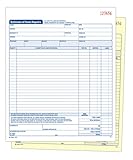
- Includes all information needed to estimate and bill for auto repairs
- 2-part carbonless (white, canary paper sequence)
- 8.38 x 10.69 inch forms
- 50 sets per book
- SFI Certified Sourcing
Rank #4

- Original formula for repairing dents, dings, holes, large rusted areas and scratches in vehicles
- Two-part lightweight compound mixes easily and spreads smoothly
- Spread easy and cures in only 20 minutes for same day repairs
- Formulated to be non-shrinking
- Suitable for wood, steel, aluminum, fiberglass, and concrete
Product prices and availability are accurate as of the date/time indicated and are subject to change. Any price and availability information displayed on Amazon at the time of purchase will apply.




