In March 2024, USDA’s Economic Research Service (ERS) revised its estimate of China’s soybean imports by relying on statistics reported by Argentina, Brazil, and the United States, with a lag to allow for delivery time. ERS said it changed its approach after a widening mismatch emerged between China’s official import figures and exporters’ shipment statistics in 2023. The report identified the discrepancy but did not explain its cause.
What changed in USDA’s estimate?
In its March 12, 2024 Oil Crops Outlook, ERS said it examined China’s official import statistics alongside figures from major exporters. For its estimate of China’s marketing year (MY) 2022/23 imports, it used official soybean statistics reported by Argentina, Brazil, and the United States, lagged to account for delivery time. USDA ERS’s March 2024 report describes that method.
The change was tied to a growing gap between China’s official import figures and shipments reported by major exporters during calendar 2023. ERS did not quantify that gap in the cited discussion or state why the sources diverged. The discrepancy alone therefore does not establish misreporting, smuggling, or a particular policy action.
How large were the revisions?
| Marketing year | Figure after the March 2024 update | Change reported by ERS | What the figure represents |
|---|---|---|---|
| MY 2022/23 | 104.5 million metric tons | Up 3.7 million metric tons | Revised historical estimate |
| MY 2023/24 | 105.0 million metric tons | Up 3.0 million metric tons | Updated forecast |
Both figures are from ERS’s March 2024 report. They are not the same kind of number: the MY 2022/23 figure revises an earlier estimate, while the MY 2023/24 figure was a forecast at the time.
What’s actually slowing this PC down?
Pick the symptom - the matching free tool is one click away.
#1 Best Overall

- High Yield Bush Growth: midori giant edamame seeds form 24-36 inch nitrogen-fixing bushes, rewarding vegetable garden growers in USDA 3-9 with crunchy pods rich in complete protein.
- Fast Germination: soybean seeds for planting sprout in 5-10 days at 70-90 °F, letting home garden beginners harvest tender edamame in just 80 days while heirloom seeds thrive in loamy soil.
- Nutrient-Rich Snack: soy beans deliver sweet nutty flavor and buttery texture; boil or freeze for soy-protein snacks, soy bean seeds to plant are ideal for survival gardening fans seeking clean non gmo edamame.
- Easy Direct Sow: edamame seeds for planting outdoors need 1" depth and 12" spacing, no trellis required; bush habit suits containers or raised beds, making veggie seeds ideal for small spaces.
- Disease-Smart Cultivation: edamame seeds to plant resist common pests when grown in full sun and evenly moist soil; gardening kit growers mulch to conserve water and pick bright green pods before they yellow.
Why shipment timing matters
Exporter shipment statistics and China’s reported imports do not necessarily describe the same cargoes in the same period. ERS said it lagged exporter statistics to account for delivery time. That adjustment is important when comparing trade figures: a shipment recorded by an exporting country may arrive and appear in China’s import data later.
For any China soybean-import figure, check four details before treating it as comparable to another number:
Rank #2

- Your hunt is in the bag - we deliver more quality seed for your money!
- Certified seed for maximum growth and attractant
- 1 bag (5 lbs) plants approximately 1/10 acre
- High protein and highly preferred forage for deer
- Non-GMO - ideal for mixing with other food plot seeds
- Publisher: ERS, USDA’s Foreign Agricultural Service (FAS) Beijing office, China Customs, or an industry source.
- Measure: customs-reported arrivals, exporter-reported shipments, an estimate, or a forecast.
- Period and date: the marketing year covered and when the figure was published.
- Timing adjustment: whether exporter shipments were lagged to account for transit and delivery.
What later USDA reporting says—and does not say
Later FAS Beijing reports continued to evaluate major exporters’ shipments to China against China Customs data. Its 2025 report also noted widening discrepancies between released Chinese soybean arrivals and exporter departures, and said industry forecasts varied because publishers used their own data and analysis. FAS Beijing’s 2025 China report provides that context.
In its 2026 annual report, FAS Beijing estimated MY 2024/25 and forecast MY 2025/26 using historical adjustments in the latest WASDE report and comparisons of exporter shipments with China Customs data. Its executive summary forecast China’s MY 2026/27 soybean imports at 108 million metric tons, 2 million metric tons above its MY 2025/26 projection. The 2026 FAS Beijing report explicitly says its forecasts and revised estimates are issued by FAS China and are not official USDA data. These later country-office figures should not be treated as interchangeable with ERS estimates, China Customs observations, or exporter shipment totals.
Quick Recap
Best Value

- HEIRLOOM VARIETY & HIGH YIELD: Outsidepride soy bean seeds is a robust heirloom strain known for its high yield, producing over 3 bushels per acre more than the popular Manokin variety, making it a valuable choice for maximizing harvest output. This variety is perfect for outdoor gardening enthusiasts looking to optimize their yard space.
- RICH IN PROTEIN & OIL WITH VERSATILE USES: Containing about 18% oil and 38% protein, this soybean variety is perfect for producing high-quality soy bean oil and protein-rich meal. These soybeans can be processed into a wide range of products, including soy milk powder, soy flour, soy protein, tofu, and various industrial non-food products, showcasing its versatility. Ideal for making various soy-based meals such as edamame snacks.
- OPTIMAL PLANTING GUIDELINES FOR MAXIMUM YIELD: For best results, plant soybean seeds at a depth of 0.75 to 1.5 inches, with row spacing between 7.5 and 15 inches, depending on soil type and tillage. This ensures uniform seed placement and optimal growth, adapting well to midwestern states and capturing a significant percentage of non-GMO acres.
- HIGH-PROTEIN ANIMAL FEED: The high-protein fiber left after oil extraction is ideal for animal feed, particularly for poultry and swine industries, which consume over half of the processed soybean meal. This meal is also crucial for cattle, other farm animals, and pets, ensuring they receive the necessary nutrients for growth and development. A great addition to feed mixes for cowpeas and other legumes.
- ECONOMIC AND NUTRITIONAL: As the most economically important bean globally, soybeans provide essential vegetable protein for millions and are key ingredients in hundreds of chemical products. A 60-pound bushel of our soybeans seed yields about 11 pounds of crude soybean oil and 47 pounds of soybean meal. Beneficial for producing shelf-stable goods for long-term use.
Rank #4
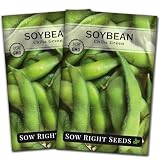
- Beautiful - Large full-color packet of Chiba Green Soybean (glycine max) seeds. These useful legumes have deep roots that fix nitrogen to the soil and help the plants survive heat and dry periods. Excellent cover crop and food source for a variety of animals such as deer, cattle, rabbits and chickens. Minimum of 13 g per packet (about 40 seeds).
- Productive - Chiba Green Soybean germinates in 10-14 days when soil temps are 65-75°F. Plant 1” deep and space 4-6” apart in an area with full sun. This variety will grow 1-3’ tall with a spread of 12-16”. Beans will mature in 65-75 days, plant in USDA zones 3-10.
- Good Eats - Harvest when pods are green and enjoy edamame or allow the pods to dry and shell to eat them boiled or steamed.
- Easy to Grow - Instructions included on each packet. Plus, we are available to answer all your questions. If these seeds don’t germinate, we will happily make it right for you.
- Safe and Sustainable - Our operation is fully solar powered, and Sow Right Seeds has taken the Safe Seed Pledge to sell only fresh Non-GMO heirloom seeds for you and your family.
Rank #3
- Productive - Chiba Green Soybean germinates in 10-14 days when soil temps are 65-75°F. Plant 1” deep and space 4-6” apart in an area with full sun. This variety will grow 1-3’ tall with a spread of 12-16”. Beans will mature in 65-75 days, plant in USDA zones 3-10.
- Good Eats - Harvest when pods are green and enjoy edamame or allow the pods to dry and shell to eat them boiled or steamed.
- Easy to Grow - Instructions included on each packet. Plus, we are available to answer all your questions. If these seeds don’t germinate, we will happily make it right for you.
- Safe and Sustainable - Our operation is fully solar powered, and Sow Right Seeds has taken the Safe Seed Pledge to sell only fresh Non-GMO heirloom seeds for you and your family.
Product prices and availability are accurate as of the date/time indicated and are subject to change. Any price and availability information displayed on Amazon at the time of purchase will apply.




