To write an ordinary U.S. personal check, fill in the date, payee, amount in numbers, amount in words, optional memo, and signature—in that order. Make sure both amounts match, and never sign a blank check.
Check layout at a glance
| Check field | What to enter |
|---|---|
| Date | The date you write the check |
| Pay to the order of | The person or business receiving payment |
| Amount box | The amount in dollars and cents |
| Amount line | The same amount written in words |
| Memo | Optional note about the payment |
| Signature | Your signature on the designated line |
Check layouts vary, but the fields are usually labeled. These instructions apply to ordinary U.S. personal checks.
How to write a check in 6 steps
1. Write the date
Enter the date on the line or in the box at the upper right. It records when you wrote the check.
2. Name the payee
On the “Pay to the order of” line, write the person’s or business’s name clearly. Check the spelling before filling in the other fields.
#1 Best Overall

- Compact and Sturdy: These checkbook registers offer clear pages with 17 lines each, making it easy to track account withdrawals; The bold layout and spacious rows and columns (0.32 in wide) provide a comfortable writing experience
- Simplify financial management: The Casmonal account books help you effortlessly remember automatic deductions, dodge overdraft risks, and gain insight into your spending patterns, making financial tracking simple and clear
- Financial instruments: These transaction Registers simplifie your financial monitoring, helping you easily manage your balance, precisely budget, and work towards your financial goals; It's a convenient tool for achieving financial success
- Personal and Small Business Finances: The check register simplifies tracking of payments and deposits, equipped with columns for item numbers, transactions, and balances, making it an ideal tool for managing both personal and small business finances
- Small and Portable: These compact 6x3 inches checkbooks are perfect for on-the-go financial tracking and feature a stylish calendar from 2026 to 2028, guiding you through a better financial journey
3. Enter the amount in numbers
Write the dollar amount in the small numeric box. For a round amount such as $20, write $20.00 if the field permits. Keep the number near the left side of the box rather than leaving unnecessary space before it.
4. Write the amount in words
On the long line below the payee, spell out the dollar amount and show the cents. For example, for $125.50, write “One hundred twenty-five and 50/100.” You can also express cents in words, such as “one hundred twenty-five dollars and fifty cents.” Either way, the words must represent the same amount as the numeric box. Follow instructions printed on the check or provided by your bank.
Rank #2

- 12 Easy Read Register Checkbook Transaction Registers: Balance your check account withdrawals with this checkbook register featuring 16 lines per pages. This thicker body paper is small enough to carry in your pocket or wallet. Column headings are bold easy to read.
- Made in the USA. Each register has 444 lines. Lines are gray in color. Standard checkbook registers having Item No. Date, Description of Transaction, Payment Debit, Deposit Credit and Balance Column.
- High-quality ink print is easy on the eyes and a great booklet for easy insertion into your checkbook.
- Calendars on Back: Check register has up-to date 2025-2026-2027 calendars printed on the back.
- Checkbook Measures: Checkbook register measures 6x3 inches.
If you finish the words before the line ends, draw a line through the unused space so additional writing cannot be added easily.
5. Add a memo, if useful
The memo line is optional. Use it for a short description, such as “monthly rent,” to help identify the payment in your records. It is not the payment authorization.
Recommended Free Tools
Rank #3

- 24 Easy Read Checkbook Registers for Personal Checkbook
- Standard checkbook register measuring 3" x 6".
- The white and blue background makes recording clearer and less prone to eye fatigue.
6. Sign the check
Sign on the designated signature line, generally at the lower right. Your signature authorizes the payment. Do not sign a blank check: a check bearing only your signature leaves the amount open for the payee to fill in.
Example: writing a check for $125.50
Use this as a field-by-field example, not as a check with real recipient or account details:
Rank #4
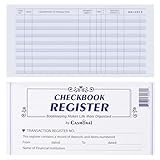
- Compact and Sturdy: These checkbook registers offer clear pages with 17 lines each, making it easy to track account withdrawals; The bold layout and spacious rows and columns (0.32 in wide) provide a comfortable writing experience
- Simplify financial management: The Casmonal account books help you effortlessly remember automatic deductions, dodge overdraft risks, and gain insight into your spending patterns, making financial tracking simple and clear
- Financial instruments: These transaction Registers simplifie your financial monitoring, helping you easily manage your balance, precisely budget, and work towards your financial goals; It's a convenient tool for achieving financial success
- Personal and Small Business Finances: The check register simplifies tracking of payments and deposits, equipped with columns for item numbers, transactions, and balances, making it an ideal tool for managing both personal and small business finances
- Small and Portable: These compact 6x3 inches checkbooks are perfect for on-the-go financial tracking and feature a stylish calendar from 2026 to 2028, guiding you through a better financial journey
- Date: The date you write it
- Pay to the order of: The intended person or business
- Amount box: $125.50
- Amount line: One hundred twenty-five and 50/100
- Memo: A brief purpose, such as “monthly rent,” or leave it blank
- Signature: Your signature on the signature line
Simple precautions while filling out a check
- Write clearly and check that the numeric and written amounts agree.
- Close unused space after the written amount with a line.
- A blue or black gel pen is one practical option; U.S. Bank recommends these colors and pen type in its check-writing guide.
These are basic precautions, not a guarantee against fraud. Banks’ handling of check dates and other processing details can vary, so do not assume a date alone determines exactly when a check will be processed.
Quick Recap
Best Value

- Practical set configuration: One set is equipped with 12 check registers, which can meet the needs of both long-term personal use and frequent transaction recording in small businesses, reducing the trouble of repeated purchases and being economical.
- Exclusive personal checkbook design: Crafted specifically for personal checkbooks, the 6"×3" size makes it easy to carry around, allowing individuals to record check transaction details at any time and effectively manage their personal finances.
- Wide range of financial scenarios: Applicable to a variety of financial scenarios, including personal and commercial banking, savings accounts, deposits, and credit card transaction records, fully meeting the recording needs of various financial activities.
- Flexible Blank Ledger Format: The blank ledger format provides you with great flexibility. You can freely set record items based on the characteristics of different financial businesses. Whether it is simple income and expenditure records or complex multi-category transaction details, you can easily handle it and achieve personalized records.
- Efficient Financial Management Assistant: As a professional transaction register, it helps you manage your finances efficiently. By recording every transaction in detail, you can clearly understand the flow of funds and accurately grasp your account balances, providing a strong basis for rational financial planning.
Product prices and availability are accurate as of the date/time indicated and are subject to change. Any price and availability information displayed on Amazon at the time of purchase will apply.




