Do these 3 things before closing this tab:
1Scan for outdated or missing drivers - takes under a minute2Repair Windows errors before they cause bigger problems3Fix the driver behind crashes, sound loss and screen glitchesYes, you can start an online store without buying or storing products in advance. The usual options are dropshipping, print-on-demand, digital products, affiliate selling, preorders, crowdfunding, and services. But “without inventory” does not mean free, passive, or risk-free: you still need money for samples, software, platform fees, payment processing, marketing, refunds, taxes, and working capital.
For most beginners, the strongest starting point is a narrow offer based on an existing skill, audience, or community—not a general store filled with products copied from a supplier catalog.
What “without inventory” really means
An inventory-free store avoids purchasing and storing physical stock before a customer orders. It does not necessarily eliminate ownership, fulfillment, or financial responsibility.
- No inventory held by you: Dropshipping and print-on-demand suppliers hold, produce, and ship products.
- No physical inventory: Digital products, software, memberships, and services are delivered electronically or performed by you.
- Inventory paid for after demand appears: Preorders and some supplier arrangements delay production or purchasing until sales are demonstrated.
- Inventory owned by someone else: Affiliate selling and some consignment arrangements let you promote products without taking ownership.
- Inventory stored by a third party: A fulfillment company or 3PL may warehouse products you already purchased. That is outsourced storage, not truly inventory-free commerce.
Shopify distinguishes dropshipping and on-demand printing from fulfillment services that store inventory on a merchant’s behalf. See Shopify’s explanation of fulfillment options.
#1 Best Overall
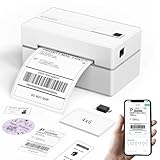
- Bluetooth Wireless Connection: KNAON Bluetooth shipping label printer enables wireless printing. For Mobile users, download the 'FlashLabel Pro' app from APP Store or Google Play for printing. Also, supports Windows and macOS, and can directly connect to the printer by downloading the 'FlashLabel Pro' App. Windows 7 or later computers can also print via Bluetooth by installing the latest advanced driver. Note: All devices CANNOT be connected directly to Bluetooth, and must be used through the 'FlashLabel Pro' app.
- USB Cable Connectivity: This printer ensures seamless USB connectivity with macOS, Windows (7 and above), ChromeOS, and Linux. KNAON printer features a built-in USB drive preloaded with drivers and tutorial videos for a fast and hassle-free setup. For ChromeOS, need to install 'FlashLabel' extension to your Google Chrome.
- Versatile DIY Labeling Options: KNAON Thermal Shipping Label Printer offers a vast selection of pre-designed templates, including 3,000+ templates, 5,000+ icons, and 100+ fonts available in the app. Designed for both professional and personal use, it supports various thermal paper sizes, ensuring effortless customization for all your labeling needs. Ideal for printing DIY shipping labels, barcode labels, thank-you labels, mailing labels, name tags, price tags, and various small thermal labels.
- Seamless Multi-Platform Compatibility: This Bluetooth shipping label printer works effortlessly with all major platforms, including Amazon, eBay, Shopify, USPS, UPS, Etsy, PayPal, Poshmark, DHL, and more, ensuring smooth and efficient label printing. (Note: Save the logistics label as a PDF file on the shipping platforms, then import it into the 'FlashLabel Pro' app for printing).
- Portable & Stylish Design: KNAON multi-function thermal label printer offers user-friendly operation in a compact design. Its perfect size (7.17 x 3.9 x 3.43 inches) makes it simple to store anywhere. With a fast printing speed of up to 180 mm/s and support for paper widths from 1.5 to 4.2 inches. The package also includes 10 test printing papers to get you started right away.
Six ways to sell without holding stock
| Model | What you sell | Who creates or holds it | Best suited to |
|---|---|---|---|
| Dropshipping | Existing physical products | Supplier | Niche retail and product curation |
| Print-on-demand | Custom apparel, mugs, wall art, and similar goods | POD provider produces after purchase | Designers, creators, and communities |
| Digital products | Templates, courses, ebooks, software, presets, or downloads | You create it once and deliver it digitally | Experts and creators |
| Affiliate selling | Recommendations and comparisons | Another retailer handles the transaction | Publishers and influencers with traffic |
| Preorders or crowdfunding | A physical product sold before production | You or a manufacturer produces later | Brands testing a differentiated product |
| Services and bookings | Consulting, coaching, design, classes, or memberships | You provide the service | Skilled professionals |
Dropshipping
In a typical dropshipping workflow, you list a supplier’s product, a customer buys from your store, the order is sent to the supplier, and the supplier picks, packs, and ships it directly to the customer. You keep the difference between revenue and costs.
The advantages are quick product testing, no bulk purchase, and a broad catalog. The disadvantages include lower margins, inconsistent quality, supplier stockouts, split shipments, weak branding, and limited control over delivery.
You remain responsible for the customer experience, accurate descriptions, refunds, complaints, and applicable retail obligations. Shopify recommends ordering supplier products yourself so you can assess processing and delivery performance. Read Shopify’s dropshipping overview and its compliance guidance.
Print-on-demand
With print-on-demand, you upload a design, choose a blank product, publish a listing, and the provider prints and ships the item only after it is ordered. This reduces unsold-stock risk and gives you more opportunity to differentiate than selling a generic catalog item.
However, base-product, printing, and shipping costs can leave less margin than bulk manufacturing. Product quality, color accuracy, sizing, delivery time, and replacement policies vary by provider and product. Order samples before launch. Printful explains its POD workflow.
Digital products
Digital products include spreadsheets, checklists, templates, fonts, presets, ebooks, paid newsletters, courses, memberships, plugins, stock media, and downloadable educational material.
They have no shipping and usually very low marginal delivery costs, but they still require expertise, production time, support, marketing, updates, and protection against unauthorized sharing. A digital product is not automatically passive income.
Affiliate selling
An affiliate site sends visitors to another retailer and earns a commission when a referral converts. You avoid fulfillment, refunds, and shipping, but you also lose control of checkout, pricing, stock, and the customer relationship.
The Tool Desk
Outbyte PC Repair FREEClear out junk files and repair common Windows errorsFree Scan →Outbyte Driver Updater FREEFix the driver behind crashes, sound loss and screen glitchesFind Drivers →This is better described as affiliate commerce or a product-recommendation business than as a conventional online store. Commission rates and program rules can change, and commercial relationships should be disclosed clearly.
Preorders and crowdfunding
Preorders and crowdfunding can validate demand before you commit to production. They do not remove responsibility. You need a realistic manufacturing and delivery plan, a refund policy, enough cash to handle delays, and communications that do not promise an unrealistic delivery date.
Consumer-protection and tax rules vary by the seller’s location, the customer’s location, the product, and the sales channel.
Services, memberships, and bookings
If you have a marketable skill, selling a service may be the most financially sensible no-inventory model. You can offer consultations, coaching, freelance work, classes, subscriptions, or memberships without product sourcing or shipping.
Quick wins for a faster PC:
Scan for outdated or missing drivers - takes under a minuteDriver Scan →Clear out junk files and repair common Windows errorsFree Scan →Rank #2

- Bluetooth Wireless Connection: KNAON Y41BT Bluetooth shipping label printer enables wireless printing. For iOS and Android users, need to download the 'FlashLabel Pro' App from Apple Store or Google Play. Windows 7 or later computers can also print via Bluetooth by installing the latest advanced driver. Mac users with M1/M2/M3/M4 processors can connect to the printer by downloading the 'FlashLabel Pro' App from Apple Store. Note: All devices CANNOT be connected directly to Bluetooth, and must be used through the 'FlashLabel Pro' app.
- USB Cable Connectivity: This printer ensures seamless USB connectivity with macOS, Windows (7 and above), ChromeOS, and Linux. KNAON printer features a built-in USB drive preloaded with drivers and tutorial videos for a fast and hassle-free setup. For ChromeOS, need to install 'FlashLabel' extension to your Google Chrome.
- Versatile DIY Labeling Options: KNAON Thermal Shipping Label Printer offers a vast selection of pre-designed templates, including 3,000+ templates, 5,000+ icons, and 100+ fonts available in the app. Designed for both professional and personal use, it supports various thermal paper sizes, ensuring effortless customization for all your labeling needs. Ideal for printing DIY shipping labels, barcode labels, thank-you labels, mailing labels, name tags, price tags, and various small thermal labels.
- Seamless Multi-Platform Compatibility: This Bluetooth shipping label printer works effortlessly with all major platforms, including Amazon, eBay, Shopify, USPS, UPS, Etsy, PayPal, Poshmark, DHL, and more, ensuring smooth and efficient label printing. (Note: Save the logistics label as a PDF file on the shipping platforms, then import it into the 'FlashLabel Pro' app for printing).
- Portable & Stylish Design: KNAON multi-function thermal label printer offers user-friendly operation in a compact design. Its perfect size (7.2 x 3.15 x 2.65 inches) makes it simple to store anywhere. With a fast printing speed of up to 180 mm/s and supports paper widths from 1.38 to 4.41 inches. The package also includes 20 test printing papers to get you started right away.
The constraint is your time and capacity. The business becomes more scalable when you package your expertise into a repeatable service, membership, or digital product.
Which model should a beginner choose?
- Have specialized knowledge? Start with a digital product or service.
- Have designs, a recognizable style, or an audience? Consider print-on-demand.
- Understand a narrow customer group and product category? Consider carefully tested dropshipping.
- Already have substantial traffic but no product? Affiliate selling may fit.
- Have a differentiated physical product idea? Consider a preorder or crowdfunding campaign.
Generic dropshipping is usually the least defensible option because many sellers can list the same products. The stronger advantage is a specific audience, useful content, proprietary designs, expert knowledge, or a better buying experience.
Step 1: Choose a narrow customer and use case
Define the buyer before choosing products. Answer:
- Who is the customer?
- What problem, identity, interest, or occasion does the offer address?
- Why would that customer buy from you rather than Amazon, Etsy, or a search engine?
- Can you reach this audience without paying more to acquire a customer than the order produces?
- Is the product safe and legally suitable for the intended market?
“A store for everyone” is not a useful niche. A clearer concept might be hiking planners for first-time backpackers, printable resources for independent therapists, custom apparel for a defined professional community, or meal-planning templates for people with a specific dietary need.
Step 2: Validate demand before building the store
Validation should test buying intent, not merely attention.
Free tools Windows power users keep installed
One-click scans. No signup required.
- Interview likely customers. Ask what they currently use, what frustrates them, and what they have already paid for.
- Study competitor reviews. Look for repeated complaints about quality, sizing, instructions, delivery, or support.
- Create a landing page or waitlist. Measure email signups and specific inquiries.
- Test a small number of listings or designs. Avoid building a large catalog before one offer shows promise.
- Use preorders only when timing is credible. A preorder is a commitment to fulfill, not free market research.
- Run controlled advertising only after modeling the economics. A click or view does not prove that the order can be profitable.
Search volume, social-media views, and “trending product” lists can suggest interest, but they are not proof of sustainable demand.
Step 3: Find and test a supplier
For dropshipping, evaluate:
- Product quality and consistency
- Processing and delivery times by destination
- Inventory synchronization
- Tracking availability
- Return address and return procedure
- Defect, damage, replacement, and refund policies
- Packaging and branding options
- Customer support responsiveness
- Product-safety documentation
- Country of origin, customs, and import implications
- Whether the supplier permits your intended sales channel
For POD, also compare blank-product quality, print method, color accuracy, print area, size range, fulfillment locations, shipping rates, branding options, and the sample-order process. Providers such as Printful offer integrations with several sales channels, but availability and requirements vary by channel.
Order a sample or test purchase
Before advertising, verify that:
- The product matches the listing.
- The packaging is acceptable.
- The invoice or packing slip does not confuse the customer.
- The delivery estimate is realistic.
- Tracking works.
- The item survives shipping.
- The return or replacement process is understandable.
- The supplier responds within an acceptable time.
Automation can reduce manual order entry, but it cannot tell you whether the product feels cheap, whether sizing is accurate, or whether the promised delivery range is realistic.
Step 4: Choose the sales channel
Shopify
Shopify is generally best for an owned brand, a controlled customer experience, or a store combining physical, POD, and digital products. It provides storefront infrastructure, hosting, checkout, analytics, and integrations—but it does not provide a guaranteed audience.
Recommended Free Tools
As listed on Shopify’s US pricing page on August 18, 2026, Basic was $39 per month when paid monthly or $29 per month when paid yearly. Online card rates started at 2.9% plus $0.30 on Basic. The page also listed third-party transaction fees of 2% for Basic, 1% for Grow, and 0.6% for Advanced when using a third-party payment provider. These are US figures, can change, and depend on country, plan, and payment setup. Check Shopify’s current pricing and its payment-fee documentation.
Etsy
Etsy can help eligible handmade, designed, personalized, vintage, and digital products benefit from marketplace discovery. The trade-off is dependence on Etsy search, policies, fees, and customer experience rules.
Etsy fees may include listing, transaction, payment-processing, advertising, currency-conversion, and other location- or program-specific charges. Review the current fee schedule and shop-opening requirements. Etsy may not require every seller to hold a business license as a platform, but local law may.
WooCommerce
WooCommerce suits people already using WordPress or those who want extensive control over hosting and customization. The software may be open source, but hosting, domain registration, paid extensions, security, backups, maintenance, and payment processing still cost money. See WooCommerce’s pricing information.
Rank #3

- Go Wireless by Bluetooth: Download the "NELKO"app to print via Bluetooth on your Nelko Bluetooth thermal label printer for iOS and Android. Printing shipping labels has never been easier. Windows 7 or later computers can also print via Bluetooth. For Mac users with M1 or M2 CPUs, install the app and connect to the printer via Bluetooth. Note: All devices cannot be directly connected to Bluetooth and need to be used through the app
- Print via USB: For Windows (7 and later), Mac OS,Chrome OS, you can connect the desktop label printer via USB cable. Note that Mac OS only works with USB connection, you can not print via Bluetooth
- Good Helper for Cost Saving: Advanced thermal direct technology is adopted to achieve the printing speed of 150 mm/s, up to 72 sheets 4x6 labels/min. High speed brings high efficiency and helps your business grow faster! 203 DPI makes printing clearer. No ink, no toner, only thermal labels needed. Both fanfold labels and roll labels could be used. Label size: labels width ranges from 1.54" to 4.1"(40-104 mm), such as 4x6, 3x2, 3x1, 2x1 thermal labels and so on
- Strong Platform Compatibility: This bluetooth shipping label printer can work with virtually all platforms, including Amazon, Ebay, Shopify, USPS, UPS, Esty, PayPal, Poshmark,etc.(Note: Please remember to save the logistics label as a PDF on the logistics platform, then upload it to the editor APP "NELKO" for printing
- Suitable for Commercial and Home Use: Printer driver, instruction videos and problem shooting videos are provided in U-Disk for better setting. Nelko PL70E label printer is much smaller than traditional printers and only requires a small piece of space to achieve printing. Very suitable for printing shipping labels, mailing labels, price labels, barcode labels, name tags and all kinds of small category labels
Other marketplaces
Amazon and similar marketplaces can provide reach, but they impose category rules, seller policies, fees, and intense competition. Amazon says referral fees vary by category and that additional selling-plan or fulfillment-related costs may apply. Review its current pricing before listing.
| Channel | Main strength | Main trade-off |
|---|---|---|
| Shopify | Brand and customer-experience control | You must generate traffic and pay platform costs |
| Etsy | Marketplace discovery | Policy, fee, and search dependence |
| WooCommerce | Customization and control | More technical administration |
| Amazon | Large potential audience | Competition, fees, and strict marketplace rules |
Step 5: Build a minimum viable store
Start with one customer segment, one core offer, and roughly three to ten products or variants. Include:
- A clear product name and benefit
- Accurate photos or mockups
- Dimensions, materials, compatibility, and limitations
- Processing and delivery estimates by geography
- Pricing and shipping charges
- Return, refund, replacement, privacy, and terms pages
- Contact information
- A reliable payment method
- Email capture with a clear purpose
- Basic analytics
A large catalog creates more opportunities for supplier errors, stock mismatches, pricing mistakes, split shipments, and customer-service problems before demand is proven.
Step 6: Price each order using contribution margin
Do not define profit as selling price minus supplier cost. Use:
What’s actually slowing this PC down?
Pick the symptom - the matching free tool is one click away.
Contribution margin = selling price
− product or production cost
− fulfillment cost
− shipping subsidy
− payment-processing fee
− marketplace or platform fee
− refund and replacement allowance
− advertising cost
Hypothetical example: Suppose a POD shirt sells for $30. Assume $12 for the blank shirt and printing, $5 shipping, $1.17 payment processing, $3 in marketplace and platform charges, $1.50 reserved for replacements and refunds, and $6 for customer acquisition. The contribution margin is:
$30 − $12 − $5 − $1.17 − $3 − $1.50 − $6 = $1.33That is not a guaranteed result; every provider, country, product, channel, tax treatment, and advertising campaign differs. It demonstrates why a product can appear profitable before all costs are included and produce little usable cash afterward.
Also consider cash timing. A supplier may charge you immediately while a payment processor pays out later. Keep a reserve for supplier bills, refunds, chargebacks, taxes, and advertising rather than treating every payout as spendable income.
Independent reader supportYour contribution helps us test, update, and keep practical guides available for everyone.Step 7: Configure fulfillment and customer service
The operational flow is:
- The customer places an order with your store.
- You or an integration sends the order to the supplier or delivery system.
- The supplier produces, picks, packs, and ships the order.
- Tracking is passed to the customer.
- You monitor delivery and handle questions, delays, defects, refunds, and replacements.
Your store should clearly explain processing time, estimated delivery ranges, tracking, split shipments, damaged orders, lost packages, return shipping, and personalized-product rules. A supplier’s policy may not match your customer-facing obligations, so read both before publishing.
PC Slower Than It Used to Be?
A free scan shows the junk files, broken settings and background clutter dragging Windows down - then fixes them in one click.Free scan · Windows 10 & 11Crashes, No Sound, or Screen Glitches?
Random freezes, missing sound and display glitches usually trace back to one bad driver. Find and replace yours safely.Free scan · under a minuteStep 8: Launch through one acquisition channel
Choose the channel that matches the business:
- Digital templates or expertise: Search-focused educational content and email.
- Visual POD products: Social video, creator collaborations, visual discovery, or marketplace search.
- Specialist dropshipping: Helpful content and community partnerships that build trust.
- Services: Referrals, professional networks, local partnerships, and targeted content.
- Affiliate commerce: High-quality comparisons and buying guides supported by credible traffic.
Do not spread a small budget across every channel. Test one route, track its customer-acquisition cost, and stop spending when the economics do not work.
Step 9: Measure the first 30 to 50 orders
Track visits, product-page views, add-to-cart rate, checkout starts, conversion rate, average order value, customer-acquisition cost, contribution margin, refund rate, delivery time, defect rate, support tickets per order, repeat purchases, and email signups.
The early objective is not maximum catalog size. It is determining whether you can acquire customers at a sustainable contribution margin while delivering an acceptable experience.
Risks and mistakes to avoid
Assuming “no inventory” means no money
You may still need funds for a domain, platform subscription, samples, design tools, supplier charges, payment fees, advertising, refunds, replacements, accounting, registration, and taxes. A small cash reserve is part of the startup plan.
Rank #4

- [HIGH TECH LABEL PRINTER] Equipped with a Japanese high tech thermal print head, 203 DPI high printing quality. No ink, No toner, Clean with no mess, economical. Works with both fanfold labels and roll labels. Label size: labels width ranges from 1.57" to 4.1"
- [PRINT WIRELESSLY]The label printer support printing wirelessly. For windows 8 or later and Mac, you can print via Bluetooth. For Android& iOS, you can’t print via Bluetooth on phone, need to download the App "Jadens printer" and print on it.
- [PRINT VIA USB] USB connection works with both Windows (7 and newer) and Mac OS (10.9 and newer) devices. Please long and press the feed button to identify and calibrate label size each time you change labels.
- [WIDE USAGE] JADENS thermal label printer is widely used to print labels from various marketplaces and shipping platforms, such as Endicia, Dazzle, ShipStation, Shipping Easy, Shippo, ShipWorks, Ordoro, eBay, Amazon, Easy, and Shopify. Use JADENS thermal label maker machine to print shipping labels, warehouse labels, market labels, helping increase your productivity. Ideal for your online small business for shipping packages.
- [EASY TO SET UP & RELIABLE AFTER-SALE SERVICE] Set up in one minute. Printer driver, instruction videos and problem shooting videos are provided in U-Disk for better understanding. Offer one year warranty; customer support can be reached out to email, phone, remote control.
Relying on one supplier
Stock can disappear, processing times can change, or an integration can fail to sync prices, variants, tracking, or cancellations. Have a pause, substitute, refund, or backup-supplier procedure.
Creating split-shipment problems
Products from multiple suppliers may arrive on different days, carry separate shipping charges, use inconsistent packaging, and require complicated partial refunds. Keep the initial catalog operationally simple.
Promising unrealistic delivery times
Processing estimates may exclude production, weekends, holidays, customs, carrier delays, address corrections, or peak-season congestion. State a reasonable range and geography rather than a false precise date.
Ignoring product safety and intellectual property
Use extra caution with cosmetics, supplements, food, children’s products, medical or health-related goods, electrical items, batteries, protective equipment, and products making safety or performance claims. With POD, use only artwork, fonts, photos, logos, characters, quotes, and likenesses you are licensed to use. “Found online” does not mean commercially licensed.
Calling the business passive
The work includes research, creation, marketing, supplier monitoring, customer support, refunds, compliance, bookkeeping, listing updates, and reputation management.
Legal, tax, and consumer obligations
Rules depend on your location, your customers’ locations, product category, sales channel, and business structure. This is general information, not legal or tax advice.
Before launch, check whether you need business registration, permits, product labeling, privacy disclosures, sales-tax or VAT registration, marketplace documentation, or special compliance records. Shopify notes that tax-service pricing and thresholds depend on factors including store creation date, location, plan, registrations, and sales volume; those service rules do not replace your underlying obligation to determine where tax must be collected and remitted. See Shopify’s tax-pricing guidance and consult a qualified professional for your circumstances.
Is an inventory-free store worth it?
It can be worthwhile as a low-upfront-risk experiment, especially when you have expertise, an audience, distinctive designs, or a clearly defined customer problem. It is not automatically easy or profitable, and it is not a way to eliminate financial risk.
Recommended Free Tools
Once demand is proven, buying inventory in bulk may improve margins, packaging, delivery control, and product availability. The sensible sequence is often to validate first without stock, then choose whether owning inventory creates a better business.
Frequently Asked Questions
Can I start an online store with no money?
You may be able to begin with free tools, an existing audience, or a marketplace account, but a genuinely operating store usually needs at least some cash for samples, payment timing, refunds, software, taxes, or customer acquisition. “No inventory” is not the same as “no startup costs.”
Do I need to order samples before selling?
For physical products, ordering at least one sample is strongly recommended. It lets you verify quality, packaging, sizing, delivery time, tracking, and the return or replacement process before customers experience them.
Is dropshipping legal?
Dropshipping is a business model, not a blanket legal exemption. You must follow the laws and platform policies that apply to your business, customers, products, advertising, taxes, privacy, safety, and returns. Requirements vary by jurisdiction.
Is print-on-demand better than dropshipping?
Neither is universally better. POD is often a better fit for original designs and communities; dropshipping may offer broader product selection. Compare differentiation, quality control, delivery, returns, fees, and contribution margin for the specific product.
Quick Recap
Product prices and availability are accurate as of the date/time indicated and are subject to change. Any price and availability information displayed on Amazon at the time of purchase will apply.




