The Tool Desk
Outbyte PC Repair FREEClear out junk files and repair common Windows errorsFree Scan →Outbyte Driver Updater FREEFix the driver behind crashes, sound loss and screen glitchesFind Drivers →The best way to get a business loan is to match the amount, repayment schedule, and loan type to a specific business need—then prove that the business can repay it under both normal and difficult conditions. The process is not standardized. A bank, credit union, SBA lender, nonprofit microlender, equipment-finance company, and online lender may evaluate the same business very differently.
This guide covers business financing in the United States. Requirements, loan programs, disclosures, and lender practices differ substantially in other countries. It is current as of August 10, 2026; SBA fees, eligibility rules, and program limits can change, so verify current terms with the SBA and lender before applying.
- Define exactly what the money will fund.
- Calculate the amount the business can safely repay.
- Choose a financing product that matches the use and cash-flow timing.
- Review personal and business credit.
- Prepare financial, legal, ownership, tax, and loan-purpose documents.
- Compare at least two or three legitimate lenders by total cost and contract terms.
- Submit a complete, consistent application.
- Read the collateral, guarantee, repayment, fee, covenant, and default provisions before signing.
How to Get a Business Loan
A business loan is not automatically a good solution just because a lender approves it. The right financing should fund a measurable business objective without creating a payment obligation that the company cannot withstand.
An established business with dependable cash flow should usually start with its existing bank or credit union, then compare community banks and SBA lenders. A startup or very small business may have better options through an SBA microloan intermediary, Community Development Financial Institution, equipment-finance company, nonprofit lender, owner investment, or carefully structured private financing. Online lenders may move faster, but faster funding can carry higher costs and more frequent withdrawals.
#1 Best Overall
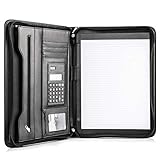
- Still superior, and now upgraded for life’s biggest advancements: Originally crafted to suit the advanced professional, we recently added smart changes to this customized vegan leather portfolio for those returning to pursue their MBA, or interviewing for that next wrung up the ladder; features include solar calculator, full PU leather interior, dual start zipper, and abundant storage so paper never crunches or falls out
- For million project masters: Juggle less, get more done. Professional, thoughtfully designed storage designed with those who “do it all” without batting an eye. Custom pockets allow you to quickly and easily access your tablet, pens, calculator, cards and everything else without giving it a second thought.
- Sleek & stunning in hand - Compact for travel: Leather folder looks gorgeous held in hand walking into the board meeting, law school, or interview while sliding neatly into handbags, backpacks while maintaining far greater storage than traditional leather planners.
- Give the gift that says, “I believe you will succeed” with this premium, practical, stylish gift for graduates, lawyers, business professionals and those on the rise. Carries your entire suite of supplies from travel tickets, documents, resumes, professional pens and everything you need to outshine others in the business world.
- Ultimate satisfaction: Quality. Service. Elation with everything you order from us, that’s the Cossini brand philosophy. From the luxurious PU leather, to the buttery smooth zipper pull, to the organization that flows with your changing life, you’ll feel satisfied with your decision to purchase.
First, decide whether borrowing is appropriate
Before completing an application, write down what the financing will accomplish. A strong request connects the dollars to a defined outcome, such as replacing unreliable equipment, filling a short-term inventory gap, opening a location, completing a signed contract, increasing production capacity, or refinancing debt on meaningfully better terms.
Ask four questions:
- What exact expense will the money cover?
- Why can the business not fund it from cash, vendor terms, or a delayed project?
- How will the financing produce revenue, reduce costs, protect cash flow, or preserve an important operation?
- What happens if sales are lower or customer payments arrive late?
Debt requires repayment with interest or fees. Equity financing exchanges capital for an ownership interest and may involve dilution, investor rights, reporting, and reduced control. Grants generally do not have to be repaid, but they are competitive, restricted, and not a dependable substitute for a loan. Receivables financing advances money against invoices or future receipts. A merchant cash advance generally involves purchasing future receivables rather than making a conventional loan.
Other possible funding sources include supplier credit, customer deposits, owner cash, a documented friends-and-family loan, or an investor. A personal loan or home-equity loan used for a business can put the owner’s personal assets, credit, and home at risk and should not be treated as a risk-free workaround for business underwriting.
Calculate how much to borrow
Separate three different questions:
- How much does the project require?
- How much will a lender approve?
- How much can the business safely repay?
The safest loan request is based on a sources-and-uses schedule, not on the maximum amount a lender advertises.
Recommended Free Tools
| Uses | Amount |
|---|---|
| Equipment or inventory | $ |
| Payroll or working capital | $ |
| Leasehold improvements | $ |
| Closing costs and fees | $ |
| Cash reserve | $ |
| Total project cost | $ |
Then list the sources: owner cash contribution, seller financing, grants, existing business cash, loan proceeds, and any other financing. This may show that the business needs a smaller loan than originally expected—or that the project is undercapitalized and needs more owner equity before borrowing.
Do not borrow only the exact purchase price if doing so leaves no reserve for payroll, taxes, insurance, rent, repairs, or delayed receivables. At the same time, do not add unnecessary cash simply because the lender offers it. Every extra dollar increases the repayment burden.
Use a 12-month cash-flow forecast
Prepare a monthly forecast showing expected cash collected, operating expenses, taxes, payroll, rent, insurance, owner draws, existing debt payments, and the proposed new payment. Include seasonality and the timing difference between issuing an invoice and receiving payment.
Build at least two cases:
- Base case: the forecast supported by recent results, contracts, customer orders, and realistic assumptions.
- Downside case: lower sales, higher costs, slower customer payments, or a delayed project.
The proposed payment should remain manageable in the downside case. A lender may approve a loan based on its own underwriting assumptions, but approval does not prove that the company can afford the debt.
Outdated Drivers Are Slowing You Down
One free scan finds every outdated or missing driver and matches the right update for your exact hardware.Free scan · exact hardware matchPC Slower Than It Used to Be?
A free scan shows the junk files, broken settings and background clutter dragging Windows down - then fixes them in one click.Free scan · Windows 10 & 11The Office of the Comptroller of the Currency explains that business cash flow is the primary repayment source for most small-business loans and that banks should consider current and expected cash flow under a reasonable range of conditions.
Illustrative payment calculation
A $100,000 loan at a hypothetical 10% fixed annual rate amortized over 60 months would have an approximate monthly payment of $2,124.70 and approximately $27,482 in total interest. This is an illustration, not a current market-rate quote and not a prediction of what any lender will offer.
A commonly cited underwriting rule of thumb is that income should be at least 1.25 times total expenses, including the new debt payment. This is a general benchmark—not a legal requirement, universal lender rule, or approval guarantee. Lenders may use their own debt-service coverage, cash-flow, collateral, and risk standards.
Before applying, create a debt schedule listing every existing loan, credit card, lease, line of credit, merchant advance, payment amount, maturity date, interest rate or factor rate, collateral, and personal guarantee. Add the proposed loan to that schedule and test the combined payment against actual cash flow.
What’s actually slowing this PC down?
Pick the symptom - the matching free tool is one click away.
Choose the financing product that fits the use
A term loan that matches a five-year asset to a five-year repayment period is structurally different from a daily-payment product used to cover a temporary receivables gap. Product selection should come before lender selection.
| Product | Best suited for | Advantages | Risks and limitations |
|---|---|---|---|
| Conventional term loan | Equipment, vehicles, expansion, renovations, or refinancing | Predictable payments and potentially lower cost | Usually requires stronger credit, cash flow, collateral, and documentation |
| Business line of credit | Seasonal needs, inventory, recurring working capital, or receivables gaps | Draw only what is needed and reuse available credit | May have a variable rate, renewal risk, fees, or a short repayment period |
| SBA 7(a) | Working capital, equipment, real estate, ownership changes, refinancing, or multiple purposes | Broad permitted uses; the federal guarantee may improve access | More documentation, lender underwriting, fees, and often a slower closing |
| SBA 504 | Owner-occupied real estate and major fixed assets | Long-term, fixed-rate financing through Certified Development Companies | Not a general working-capital product; project and eligibility rules apply |
| SBA microloan | Smaller startup or growth needs | Nonprofit intermediary support and financing for requests up to $50,000 | Amount is limited and terms vary by intermediary |
| Equipment financing | Machinery, vehicles, technology, and commercial equipment | The asset may secure the financing and the term can match its useful life | Specific-asset lien, down payment, and restricted use of proceeds may apply |
| Invoice factoring | Businesses with unpaid commercial invoices | Access cash before customers pay | Discount fees, customer notification, recourse risk, and potentially high effective cost |
| Merchant cash advance | Emergency revenue-based funding | Fast underwriting and, in some contracts, revenue-linked withdrawals | Factor-rate confusion, daily withdrawals, high effective cost, guarantees, liens, and aggressive default provisions |
| Business credit card | Small purchases, supplies, travel, and short billing cycles | Convenience, possible rewards, and introductory offers | High interest, revolving debt, personal guarantee, and poor fit for long-lived assets |
| Grant | Specific public, nonprofit, research, export, or local programs | Usually no repayment | Competitive, restricted, and unreliable as a general funding source |
| Equity financing | High-growth or risky ventures without predictable debt service | No scheduled principal-and-interest payment | Ownership dilution, investor rights, reporting, and possible loss of control |
The FDIC’s small-business financing overview describes common differences among term loans, lines of credit, equipment financing, and credit cards. The SBA grant information explains why grants are limited to particular programs and purposes.
Why merchant cash advances need separate treatment
The Consumer Financial Protection Bureau describes a typical merchant cash advance as an advance repaid through a fixed payback amount or a multiple such as 1.2 or 1.5, often through a percentage of future revenue or fixed withdrawals.
Rank #2

- ✅ STYLE MEETS FUNCTION – Elegant design featuring convenient, safe pockets ideal for documents, business cards, travel tickets, pitch proposals & resumes. Includes a pen holder & refillable writing pad
- ✅ SLEEK & PROFESSIONAL – Make a strong first impression with this modern portfolio with a classy piano black matte finishing. Fits most briefcases & bags
- ✅ PREMIUM DURABILITY – Ideal for today’s hectic business travel schedules, this document holder is water resistant and reinforced with accent stitching
- ✅ IDEAL GIFT – College graduation seeking out their first job? Looking to up your Wall Street game? This is the best gift for men & women!
- ++ ONE YEAR GUARANTEE ++ We stand fully behind the quality of our product & offer a full 1 YR WARRANTY
For example, a $20,000 advance with a 1.4 factor could require $28,000 to be repaid. That factor is not the same thing as an interest rate or APR; the effective annualized cost also depends on how quickly the balance must be repaid. A fixed payback amount may remain due even during a weak month, and daily ACH withdrawals can turn a temporary cash shortage into a deeper one.
Do these 3 things before closing this tab:
1Repair Windows errors before they cause bigger problems2Fix the driver behind crashes, sound loss and screen glitches3Clear out junk files and repair common Windows errorsRead claims such as no collateral or no personal guarantee against the actual contract. The Federal Trade Commission has described cases involving alleged unauthorized withdrawals and misrepresentations about guarantees and collateral. A business should use this product only after comparing the total repayment, withdrawal mechanics, default remedies, and alternatives.
SBA financing: what it is and what it is not
Current as of August 10, 2026: SBA fees, eligibility rules, and program limits are date-sensitive. Confirm the applicable terms with the lender and the SBA loan program pages before applying.
The SBA generally does not lend 7(a), 504, or microloan proceeds directly to the borrower. It establishes program rules and guarantees or supports financing made through participating lenders. The borrower applies through the lender; an SBA guarantee does not guarantee the borrower approval or forgive the borrower’s debt.
SBA 7(a)
The 7(a) program is the SBA’s primary business-loan program. Permitted uses can include:
Free tools Windows power users keep installed
One-click scans. No signup required.
- Real estate and buildings.
- Working capital.
- Refinancing current business debt.
- Machinery and equipment, including eligible AI-related expenses.
- Furniture, fixtures, and supplies.
- Complete or partial changes of ownership.
- Multiple-purpose loans.
The maximum 7(a) loan amount is $5 million. A business generally must be operating, for-profit, located in the United States, within applicable SBA size standards, creditworthy, able to demonstrate repayment ability, and unable to obtain the desired credit on reasonable terms from non-federal sources. Meeting SBA eligibility rules does not ensure that a participating lender will approve the application.
Important 7(a) categories include:
- 7(a) Small: up to $350,000.
- Standard 7(a): generally $350,001 to $5 million.
- SBA Express: up to $500,000, with a lower maximum SBA guarantee.
- Working Capital Pilot: monitored lines of credit, including borrowing against receivables or inventory when the business meets the program requirements.
According to the SBA’s lender guidance, maximum guarantees are generally 85% for 7(a) loans of $150,000 or less and 75% above $150,000. Standard 7(a) loans generally have a 75% maximum guarantee, while SBA Express generally has a 50% guarantee. The lender and borrower negotiate the interest rate subject to SBA maximums.
SBA 504
The 504 program provides long-term, fixed-rate financing for major fixed assets through Certified Development Companies. The maximum 504 loan amount is $5.5 million. It is designed primarily for owner-occupied real estate and other major fixed assets, not general working capital.
Eligibility generally includes operating for profit, being located in the United States or its possessions, meeting SBA size requirements, having tangible net worth below $20 million, and having average net income below $6.5 million after federal income taxes for the preceding two years. The business must also demonstrate qualified management, a feasible business plan, good character, and repayment ability. See the SBA 504 requirements for the current rules.
Quick wins for a faster PC:
Fix the driver behind crashes, sound loss and screen glitchesFind Drivers →Clear out junk files and repair common Windows errorsFree Scan →Scan for outdated or missing drivers - takes under a minuteDriver Scan →SBA microloans
SBA microloans are made by nonprofit intermediary lenders in amounts up to $50,000. They can generally fund working capital, inventory, supplies, furniture, fixtures, machinery, and equipment. The intermediary—not the SBA—underwrites and services the loan.
The SBA’s March 31, 2026 information described microloans as ranging from a few hundred dollars to $50,000, with repayment terms of up to seven years and generally fixed rates. Rates and underwriting are intermediary-specific and time-sensitive; compare the actual offer rather than relying on a program-wide rate assumption.
FY2026 7(a) fees
For 7(a) loans approved from October 1, 2025, through September 30, 2026, the SBA’s fee notice states:
- The lender’s annual service fee is 0.55% of the outstanding guaranteed portion. The lender may not pass this fee to the borrower.
- For maturities over 12 months, the upfront fee is 2% of the guaranteed portion for loans of $150,000 or less.
- For loans from $150,001 through $700,000, the upfront fee is 3% of the guaranteed portion.
- For loans from $700,001 through $5 million, the upfront fee is 3.5% of the guaranteed portion up to $1 million, plus 3.75% of the guaranteed portion above $1 million.
- Loans with maturities of 12 months or less have a 0.25% upfront fee on the guaranteed portion.
- Manufacturing businesses in NAICS sectors 31–33 may receive a 0% upfront fee on loans of $950,000 or less, subject to the notice’s exceptions.
- Veteran-owned SBA Express loans have a $0 upfront fee under the notice.
These are not permanent rates. Review the FY2026 SBA fee notice and confirm which fiscal-year rules apply on the approval date.
Combined 7(a) and 504 financing
The SBA announced that, effective July 4, 2026, eligible borrowers may combine a 7(a) loan of up to $5 million with a 504 loan of up to $5 million for up to $10 million in combined SBA-backed financing. This does not mean every business qualifies for $10 million. Separate program restrictions, project requirements, ownership rules, lender underwriting, repayment ability, and collateral considerations still apply. See the SBA announcement for the current policy.
What lenders typically evaluate
No single formula applies to every lender. Underwriting commonly focuses on repayment ability, credit, time in business, collateral, ownership, industry, and the reason for borrowing.
Rank #3

- Fireproof & Water‑Resistant:ZOOPIP fireproof 3-ring binder is made of anti-static, double-layered, non-itchy silicone-coated fiberglass that has passed the UL94 VTM-0/5VA flame-retardant test. The rigid hard shell protects birth certificates, passports, and vehicle titles from crushing and bending, while the fiberglass outer layer resists splashes and rain. A double zipper keeps the case closed so documents stay organized and nothing falls out. Splash-resistant only — do not submerge in water
- Heavyweight Pocket Folders :Designed for durability and organization, these letter-sized (8.5” x 11”) folders feature three-hole punches for easy binder integration and a generous capacity for extensive documents. Made of sturdy, acid-free polypropylene, each side-opening pocket with hook-and-loop tabs holds several sheets securely. External label slots let you sort tax, medical, and warranty documents at a glance. Available in 6 colors
- Security & Portability Combined: Made for Estate Planning, Family Records and Grab-and-Go Emergencies – One place for the paperwork you can never replace: deeds, wills, Social Security cards, insurance policies and passports. The built-in 3-digit combination lock keeps casual eyes out, and the carrying handle lets you grab the whole case and go when you need to evacuate fast
- Large Binder Organizer:(14.5"×12.4"×3.1") Works as your complete storage organizer. Its built-in zippered pouch safely stores small-sized necessities like pens, USB flash drives, and charging cords. The spacious interior easily fits over 400 sheets of paper, keeping your paperwork, stationery, charts, invoices, and photos neatly organized
- After-Sale Service: ZOOPIP stands behind every fireproof product we make. Please note: This flame retardant test does not mean the product is designed to withstand prolonged, direct exposure to fire indefinitely. If you encounter any quality issues, please contact us — we'll make it right
Repayment ability
Lenders may review historical revenue and cash flow, profitability or a credible path to profitability, existing debt, seasonality, customer concentration, the quality of accounts receivable, inventory turnover, owner compensation and distributions, and downside-case cash flow.
Revenue alone does not establish repayment ability. A business with high sales but thin margins, large customer concentration, frequent overdrafts, unpaid taxes, or heavy existing debt may be riskier than a smaller business with stable free cash flow.
Personal credit and guarantees
For a startup or closely held company, the owner’s personal credit can be important because the business may have little independent credit history. A credit-score threshold such as 670 is a market heuristic, not a universal requirement or approval guarantee.
A personal guarantee means the owner may be personally liable if the business fails to pay. Forming an LLC or corporation does not automatically prevent a lender from requiring a guarantee. A guarantee can expose personal income, savings, investments, vehicles, or other assets depending on the contract and applicable law.
Business credit
Business credit reports may contain trade accounts, payment history, public records, and lender-reported information. A new LLC does not automatically have a strong business-credit file. Before applying, review business and personal reports for inaccurate debts, duplicate accounts, outdated public records, and identity theft. Correct errors and keep evidence of disputes.
Collateral and liens
Possible collateral includes equipment, vehicles, real estate, inventory, accounts receivable, cash deposits, and other business assets. A lender may take a specific-asset lien or a blanket lien covering most business assets.
An offer described as unsecured may still require a personal guarantee, a blanket UCC-1 filing, ACH authorization, or other security. Ask exactly what the lender can claim after a default and whether a personal asset is included.
Time in business and startup evidence
Two years in business and $100,000 in annual revenue are often quoted online, but neither is a universal requirement. Established companies have more historical evidence; startups may compensate with strong owner credit, relevant management experience, a conservative business plan, personal liquidity, collateral, signed contracts or purchase orders, owner equity, and industry expertise.
Industry, size, and ownership
SBA size standards vary by NAICS industry and may be based on employee count or average annual receipts. Affiliates may count toward the calculation. Check the current SBA size standards rather than assuming that a business qualifies based only on revenue.
SBA eligibility can also depend on the business activity and ownership structure. Revised SBA ownership, citizenship, and residency requirements for 7(a) and 504 loans became effective March 1, 2026. Applicants affected by those rules should confirm the current requirements with the lender using the SBA procedural notice.
Gather the application documents
The exact list varies by lender, loan size, product, entity type, and complexity. These are documents commonly requested, not a universal checklist.
Business documents
- Legal business name and trade name.
- Entity type and formation documents.
- Employer Identification Number.
- Business address and ownership structure.
- Business licenses and permits.
- NAICS code or a clear industry description.
- Lease or property information.
- Franchise documents, if applicable.
- Business bank-account information.
Financial documents
- Two or three years of business tax returns, if available.
- Year-to-date profit-and-loss statement.
- Balance sheet.
- Cash-flow statement or forecast.
- Recent business bank statements.
- Accounts-receivable and accounts-payable aging reports.
- Inventory report.
- Existing debt schedule.
- Personal tax returns for owners, when requested.
- Personal financial statement.
- Evidence of owner equity or down payment.
Documents supporting the loan purpose
- Equipment quotes.
- Purchase agreements.
- Construction or renovation estimates.
- Real-estate purchase contract.
- Leasehold-improvement budget.
- Inventory or supplier invoices.
- Signed customer contracts or purchase orders.
- Acquisition documents and seller financial statements.
- Written explanation for refinancing or debt consolidation.
SBA documents
For a 7(a) loan, SBA Form 1919 collects information about the applicant, owners, loan request, existing indebtedness, prior government financing, and other eligibility matters. The lender—not the borrower—determines the final package and may request additional documents.
The current SBA origination procedures are contained in SOP 50 10, Version 8, effective June 1, 2025. Use the lender’s current checklist rather than relying on an old online application list.
Reconcile the documents before submission. Revenue on the application should match tax returns, financial statements, and bank deposits or have a clear explanation. Stale, incomplete, or contradictory documents can delay underwriting or cause a rejection even when the business might otherwise qualify.
Compare banks, credit unions, SBA lenders, CDFIs, and online lenders
| Lender type | Potential advantages | Trade-offs |
|---|---|---|
| Existing bank or credit union | Relationship history, potentially lower cost, and knowledge of business deposits | May require more documentation, stronger financials, collateral, or a longer operating history |
| Community bank | Local underwriting and possible willingness to understand the business context | Products, geography, and risk appetite vary |
| SBA lender | Access to broader-purpose financing and longer terms when eligible | More forms, program rules, fees, and potentially slower closing |
| CDFI or nonprofit microlender | Mission-based underwriting, technical assistance, and smaller-loan access | Loan amounts and geography may be limited |
| Equipment or real-estate specialist | Underwriting built around a particular asset | Proceeds may be restricted and the asset may be repossessed after default |
| Online lender | Convenience and potentially faster decisions or funding | Higher total cost, frequent payments, automatic withdrawals, and less flexible contracts may apply |
Compare written offers, not marketing claims. Review the rate, total repayment, fees, payment frequency, collateral, guarantee, prepayment terms, and default remedies. If one lender offers only a factor rate or total payback amount, do not compare it directly with a conventional loan APR without calculating the timing and frequency of payments.
Rank #4
![Pacific Mailer Padfolio Portfolio Leather Binder, Interview Legal Document Organizer, Business Card Holder Included Letter Sized Writing Pad [Piano Noir Faux Leather Matte Finish]](https://m.media-amazon.com/images/I/41CSIOr0ZoL._SL160_.jpg)
- Professional design: Slim and sleek, luxurious looking portfolio provides more confidence and will lead to more success in the meeting, proposal, presentation, interview, or making a sales. A handy memo pad is included in the portfolio so you will have access to write any notes anywhere as you go.
- High quality material: Made by superior quality of PU leather in a matte finish provides a more professionalism looking.
- Graduation gift: A great gift to the newly graduate students looking for their first job, with this portfolio it will lead them to a more successfully career during their interviews.
- Versatile organize: Looking for a portfolio that would fit everything on the go? A business card, a flyers, a pen / pencil, an employee ID card, a passport, or a document pocket. Our portfolio has all the pockets you need no matter if you running errands, meetings.
- Travel friendly: This padfolio binder is lightweight and compact and it is easily fits into briefcares and bags. Making it the perfect accesorry for on the go professionals.
Market evidence shows why lender choice matters. The Federal Reserve’s Small Business Credit Survey released March 3, 2026 found that, among surveyed employer firms, 60% applied for some type of financing during the prior 12 months. Of financing applicants, 42% received the full amount requested, 36% received some or most of the amount, and 22% received none. Applicants at small banks were more likely to be fully approved than applicants at other lender types. Also, 60% of borrowers using online lenders said their actual borrowing costs were higher than expected, compared with 37% for small-bank borrowers and 32% for large-bank borrowers.
This survey is a nationwide convenience sample, not a random sample of every small business, so it is useful market evidence rather than an individual approval forecast.
Nonemployer firms—businesses with no employees besides the owner or owners—often face a different financing reality. The Federal Reserve’s July 2026 nonemployer chartbook found that about half had no debt, 31% did not regularly use external financing, and 64% relied on owners’ personal funds to address financial challenges. A sole proprietor should therefore evaluate personal-liability exposure carefully before using personal credit or home equity.
Use SBA Lender Match appropriately
SBA Lender Match asks questions that may take about five minutes and may provide lender matches in about two days. It is not a loan application and does not guarantee funding. A match is a starting point for contacting lenders, comparing requirements, and asking whether the lender handles the specific SBA product and loan size needed.
Follow the application process
1. Write the financing request
Use one sentence that connects the amount, use, and expected result:
We are requesting $___ to pay for ___, which is expected to produce or save ___ by ___.
Separate permanent assets from temporary working capital. A five-year asset should not normally be financed with a product requiring daily repayment.
2. Build the repayment case
Prepare the base and downside forecasts, monthly payment estimate, existing debt schedule, cash-reserve target, seasonality explanation, and evidence supporting projected revenue. Signed contracts, purchase orders, supplier quotes, and historical customer-payment data can make assumptions easier to evaluate.
3. Screen eligibility
Check business formation, industry, SBA size status if relevant, ownership and residency rules, personal and business credit, tax filing status, existing government debt, liens, bankruptcies, delinquencies, collateral, and required owner contribution.
4. Approach the right lenders
A practical sequence is:
- Existing bank or credit union.
- Local community bank or credit union with experience in the industry.
- SBA lender, including through Lender Match.
- CDFI or nonprofit microlender.
- Equipment or commercial-real-estate specialist.
- Online lender, only after calculating total cost and reviewing contract risk.
5. Submit targeted, consistent applications
Keep a master application file with exact revenue figures, owner names and percentages, existing debt, requested amount, purpose of funds, tax-return figures, bank-statement figures, and explanations for unusual deposits, losses, overdrafts, or recent changes. Do not send conflicting figures to different lenders.
6. Respond to underwriting questions
Expect questions about declining sales, overdrafts, tax liens, late payments, large owner withdrawals, customer concentration, losses, unpaid taxes, existing guarantees, recent ownership changes, and the use of proceeds. Real-estate, equipment, acquisition, and SBA transactions may also require appraisal, lien, environmental, valuation, insurance, or legal review.
Quick wins for a faster PC:
Fix the driver behind crashes, sound loss and screen glitchesFind Drivers →Clear out junk files and repair common Windows errorsFree Scan →Scan for outdated or missing drivers - takes under a minuteDriver Scan →7. Review and close
Do not treat a term sheet, prequalification, or verbal approval as final funding. Compare the final documents with the offer, verify the net proceeds, and confirm every condition that must be satisfied before disbursement.
8. Manage the loan after funding
- Deposit proceeds into the business account.
- Use the funds only for the approved purpose.
- Keep receipts, invoices, and project records.
- Set aside loan payments before owner distributions.
- Monitor variable-rate exposure and financial covenants.
- Contact the lender early if cash flow deteriorates.
- Do not stack new short-term financing on top of an existing daily-payment product without analyzing total debt capacity.
Read the loan offer like a contract
Compare the following items in writing:
Price and proceeds
- Interest rate and whether it is fixed or variable.
- Base index and adjustment frequency for a variable rate.
- Annual percentage rate, if supplied.
- Origination, underwriting, packaging, broker, and documentation fees.
- SBA guarantee fee, if applicable.
- Appraisal, environmental, legal, filing, and closing charges.
- Amount actually deposited after fees.
- Total dollars repaid.
Repayment mechanics
- Monthly, weekly, or daily payments.
- Fixed payment or percentage of revenue.
- Whether there is a genuine payment adjustment if revenue falls.
- Balloon payment or final lump sum.
- Draw period and renewal requirement for a line of credit.
- Minimum-use or unused-line fees.
- Prepayment penalty or whether early payoff reduces the cost.
- Whether the lender can demand full repayment.
- How a rate adjustment changes the payment.
The SBA advises borrowers to ask about interest rates, credit-score requirements, cash-flow requirements, prepayment penalties, grace periods, and whether the lender can demand full repayment of principal.
Security and default provisions
- Personal guarantee and whether it is limited or unlimited.
- Spousal guarantee, where applicable.
- Specific-asset lien or blanket UCC-1 filing.
- Cross-default clauses connecting this loan to other debt.
- Confession-of-judgment-like language, where permitted or attempted.
- ACH authorization and the lender’s withdrawal rights.
- Default rate, late fees, collection costs, and attorney fees.
- Financial covenants.
- Restrictions on additional borrowing or owner distributions.
- Required insurance and reporting obligations.
- Remedies after default.
Business borrowers may not receive all of the same disclosures and protections that apply to consumer credit. The legal treatment depends on the product, contract, state law, and business structure. If the language is unclear or the personal exposure is substantial, have a qualified attorney or accountant review it before signing.
Special situations
Startup with no revenue
A traditional bank loan is difficult without historical cash flow. A business plan alone does not make a speculative loan bankable. Consider an SBA microloan, CDFI, equipment financing, owner investment, a qualifying grant, a documented friends-and-family loan, equity financing, or contract- or purchase-order-based financing. Strong owner credit, relevant management experience, personal liquidity, collateral, signed contracts, and an owner contribution can strengthen the application—but may also increase personal risk.
Best Value

- Note: Our padfolio comes with a letter size notepad (25 pages), but does not include a pen or cards
- All-In-One Organizer: Left side stores A4 docs, 13" tablet, phone, mult cards, and pens; right side secures letter-size/A4 paper and legal pads and pen
- Compact & Portable: Measuring 13.4" × 11" × 1", this portfolio binder fits effortlessly into handbags, backpacks, or briefcases, making it convenient for daily meetings and business travel
- Premium Craftsmanship: Made of premium faux leather with neat stitching for durability, zipper closure to keep items secure, and a stain-resistant finish is easy to clean
- Perfect Accessory: Sleek, organized, and designed for easy access to documents during interviews and conference meeting, it is a practical gift for graduates, men and women
Bad personal credit
Weak personal credit may increase pricing, require collateral, limit the amount, or lead to denial. Check the credit reports for errors, lower revolving balances where possible, resolve tax liens and delinquent accounts, reduce the request, and consider a nonprofit lender or CDFI. A cosigner shares liability and should be used only with a clear written understanding of the risk. Avoid daily-payment financing that could intensify the existing cash-flow problem.
No collateral
Ask what no collateral actually means. It may still mean a personal guarantee, blanket UCC lien, ACH authorization, or a claim against business assets. Confirm whether the lender can pursue personal assets and whether other lenders’ collateral is affected.
Seasonal business
A line of credit may fit recurring inventory or receivables gaps, but it may be reduced, canceled, or not renewed. A monthly term loan may be safer than daily or weekly withdrawals when revenue is highly seasonal. Model the lowest-revenue months, not just the annual average.
Business acquisition
Expect review of seller financial statements, valuation, purchase-price allocation, buyer equity injection, transition plans, management experience, working capital after closing, lease assignment, customer concentration, and SBA change-of-ownership rules. A 7(a) loan can permit some ownership changes, but it is not automatically available for every acquisition.
Recommended Free Tools
Refinancing existing debt
Productive refinancing lowers total cost, improves the payment schedule, or replaces a risky short-term obligation with a sustainable structure. Debt stacking merely replaces one payment with another or adds a new payment before the old one is gone.
Ask whether the new loan lowers the total cost, whether the existing debt has a prepayment penalty, whether the new lender adds collateral or a broader personal guarantee, whether the maturity simply stretches out an excessive total cost, and whether the refinance releases or adds liens.
Urgent cash need
Fast funding may make sense for a short-lived, highly profitable opportunity with a clear repayment source. It is not a cure for a structurally unprofitable business. Before accepting an urgent offer, calculate net cash received, total contractual repayment, payment frequency, the percentage of average daily deposits being withdrawn, default consequences, and whether the lender can access the operating account directly.
Sole proprietors, non-U.S. owners, nonprofits, and restricted industries
Sole proprietors may have no separate legal entity protecting personal assets, and lenders may rely heavily on the owner’s personal credit and tax returns. Non-U.S. owners, nonprofits, and businesses in restricted or ineligible industries should verify requirements directly with the lender and, for SBA financing, review current ownership, residency, business-activity, and size rules. Do not rely on an old article or a generic online eligibility list.
The Tool Desk
Outbyte PC Repair FREERepair Windows errors before they cause bigger problemsFix Now →Outbyte Driver Updater FREEScan for outdated or missing drivers - takes under a minuteDriver Scan →If the application is denied
- Ask for the specific reason. It may be insufficient cash flow, credit history, collateral, time in business, documentation, industry, debt load, or an eligibility issue.
- Check for inaccurate information. Review personal and business credit reports, tax returns, financial statements, and bank deposits.
- Reduce or restructure the request. A smaller amount, equipment-specific loan, line of credit, or longer amortization may fit better.
- Add owner equity or collateral carefully. More equity can reduce lender risk, but personal collateral and guarantees increase the owner’s exposure.
- Improve the repayment case. Resolve delinquent taxes, reduce expensive debt, strengthen margins, document contracts, and build a reserve.
- Try a better-matched lender. A community bank, SBA lender, CDFI, or microlender may evaluate the situation differently.
- Do not immediately replace the denial with expensive daily-payment debt. Compare the total repayment and default risk before accepting a fast offer.
Red flags and advance-fee scams
A legitimate lender may charge a disclosed application, appraisal, or processing fee. However, a company that promises guaranteed approval in exchange for an upfront payment is a major warning sign. The FTC warns against advance-fee loan claims such as bad credit is no problem, guaranteed approval, or demands for money before delivering the loan.
Be cautious if a provider:
- Promises approval without reviewing financial information.
- Refuses to disclose the total repayment amount.
- Describes a factor rate as though it were an interest rate.
- Pressures you to sign immediately.
- Requests payment by wire, gift card, cryptocurrency, or a personal account.
- Claims no collateral or no personal guarantee but will not show the contract.
- Requires daily withdrawals without testing them against the lowest-revenue month.
- Uses a broker but does not disclose compensation or lender identity.
Verify the lender’s legal identity, physical address, licensing where applicable, privacy practices, complaint history, and complete contract before sending bank credentials or paying a fee.
How long does business-loan funding take?
Timing depends on the product, lender, loan size, collateral, complexity, and document quality. Online lenders may fund quickly; Bankrate has reported online funding in as little as 24 hours and SBA loans taking up to 90 days. Those are reported ranges, not promises. Bank and SBA transactions can take weeks or months when they involve appraisals, environmental review, ownership changes, real estate, or incomplete records.
The fastest way to prevent avoidable delay is to submit complete, reconciled documents, explain unusual transactions before the lender asks, respond promptly to follow-up questions, and apply for a product whose underwriting matches the business situation.
What’s actually slowing this PC down?
Pick the symptom - the matching free tool is one click away.
Frequently Asked Questions
Does the SBA give business loans directly?
Generally, no. The SBA sets program rules and guarantees or supports loans made through participating lenders. The borrower applies through the lender, and the SBA guarantee does not guarantee approval or eliminate the borrower’s repayment obligation.
Do I need two years in business or a 670 credit score?
Not universally. Those are commonly quoted market heuristics, not fixed requirements. Lenders may weigh cash flow, personal and business credit, collateral, management experience, owner equity, industry, and the loan purpose differently.
Is an online business loan better because it funds faster?
Not necessarily. Faster underwriting can come with higher total cost, weekly or daily payments, automatic withdrawals, and less flexible default terms. Compare total dollars repaid and contract risk rather than speed alone.
What should I do if I cannot offer collateral?
Ask whether the offer still requires a personal guarantee, blanket UCC lien, or ACH authorization. Consider a smaller request, equipment financing, an SBA microloan, CDFI, or nonprofit lender, and verify the contract’s personal-liability provisions.
Free tools Windows power users keep installed
One-click scans. No signup required.
The Bottom Line
The right business loan is the one whose purpose, term, payment schedule, and total cost fit the business’s real cash flow. Define the use of funds, borrow only what the downside forecast can support, compare multiple lenders, and read every guarantee, lien, fee, withdrawal, covenant, and default provision. If a lender will not clearly explain the total cost or personal risk, do not sign simply because the funding is fast.
Quick Recap
Product prices and availability are accurate as of the date/time indicated and are subject to change. Any price and availability information displayed on Amazon at the time of purchase will apply.




