Quick wins for a faster PC:
Repair Windows errors before they cause bigger problemsFix Now →Scan for outdated or missing drivers - takes under a minuteDriver Scan →Clear out junk files and repair common Windows errorsFree Scan →Choose workers’ comp form integration software by first separating two jobs: generating current jurisdictional forms from claims data and filing structured claim data with state agencies through electronic data interchange (EDI). Some workflows need one; others need both. Then verify state coverage, compatibility with your claims platform, data mapping, testing and error handling, update ownership, and total implementation and operating requirements.
Decide whether you need forms, EDI, or both
A form library and an EDI service solve related but different problems. A form service supplies documents and may populate them with information held in a claims system. EDI transmits structured claim data to an agency according to that jurisdiction’s reporting requirements. A product that generates forms does not necessarily submit EDI transactions, and an EDI connection does not necessarily provide a complete, maintained form library.
| # | Preview | Product | Price | |
|---|---|---|---|---|
| 1 |

|
Alabama workers' compensation: With forms | $215.00 | Buy on Amazon |
| 2 |
|
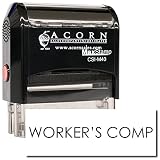
Insurance Stamp - Red Ink Self-Inking Workers Comp Stamp, Ideal for Clinical Office Staff, Durable,... | $11.95 | Buy on Amazon |
As an Amazon Associate I earn from qualifying purchases.
Draw the workflow you need before comparing products: claim data capture, form creation or transaction preparation, review, submission, acknowledgement, correction of errors, and record retention. Mark where a person or system performs each step. This makes it easier to identify whether you need a form API, EDI connectivity, workflow tools, or a combination.
Check jurisdiction coverage and ongoing maintenance
List every state and federal jurisdiction in scope, along with the claim stages and specific forms or transactions your team handles. Ask vendors to confirm coverage at that level—not just that they support “workers’ comp.” Find out how they detect form revisions or standards changes, who reviews them, and how updates reach your production system.
#1 Best Overall
WorkersCompensation.com describes its Simply Forms service as providing more than 1,100 documents, continuous updates, and printable and savable forms from First Report of Injury through claim closure. The vendor also says its API can connect with existing desktop and browser-based claims systems and that customers can add custom forms and letters. These are product-page claims, not independently verified results; confirm the particular jurisdictions, forms, and update process your operation needs.
The product page attributes this promotional statement to Insurity, without naming a speaker or role: “Monitoring and managing compliance changes for all 50 states and federal jurisdictions can be a time-intensive process. The Simply Forms product by WorkersCompensation.com provides real-time updated versions of the necessary state forms required for filing and eliminates the need for our customers to monitor and review compliance updates themselves.” Treat this as customer testimony presented by the vendor, not as an independent assessment of compliance or time savings.
Evaluate the integration and the data behind it
An API mention alone does not establish that a product works with your claims platform, its version, or your configuration. Ask for a demonstration using your actual interface and representative forms or transactions. Identify which source fields populate which form fields or EDI data elements, and whether mappings can be reviewed, changed, and tested.
Do these 3 things before closing this tab:
1Fix the driver behind crashes, sound loss and screen glitches2Repair Windows errors before they cause bigger problems3Scan for outdated or missing drivers - takes under a minute- Platform fit: Confirm supported claims systems and versions, interface type, and whether the connection has been validated for your desktop or browser-based environment.
- Mapping control: Review how the software handles missing, conflicting, or differently formatted data, and who can change mappings.
- Exceptions: See how users find and correct validation failures, rejected transactions, duplicate claims, and amended records.
- Auditability: Check what submission, acknowledgement, mapping, and correction history is retained and accessible to your team.
Verify each jurisdiction’s EDI rules and onboarding
EDI requirements and filing routes are jurisdiction-specific. Pennsylvania’s workers’ compensation EDI materials identify Claims Release 3 standards developed by the International Association of Industrial Accident Boards and Commissions. The state’s implementation resources include event and data-element tables, edit matrices, a testing strategy, error-code descriptions, mapping references, form-to-transaction guidance, and change logs. Ask a prospective vendor to show how it supports the applicable state materials and how your team will validate its own mappings.
Rank #2
- RED INK SELF-INKING WORKERS COMP STAMP EFFORTLESS OPERATION: Enjoy the simplicity of the Self-Inking Workers Comp Stamp, designed for easy, one-handed operation. Perfect for busy clinical office staff, it delivers up to 10,000 clear and sharp impressions with just a press. Refillable for long-term use.
- PRECISION AND CLARITY: Each stamp utilizes advanced laser engraving technology, ensuring every "Workers Comp" imprint is precise and legible. This red ink insurance stamp is essential for processing work-related patient documents efficiently.
- INSURANCE STAMP TIME-SAVING TOOL: Streamline your office workflow with this quick and reliable stamping solution. Ideal for marking multiple patient records accurately, it helps clinical staff manage paperwork for work-related incidents without hassle.
- DURABLE DESIGN: Built to last, the Self-Inking Workers Comp Stamp features a robust construction and a refillable ink pad, making it a choice for medical offices. Its compact size, 1/2" x 1-1/2", fits comfortably in any desk setup.
- PROFESSIONAL PRESENTATION: Enhance the professionalism of your office with this essential tool. The bold red ink stands out on documents, ensuring the "Workers Comp" message is noticed immediately, facilitating smoother insurance processing.
Pennsylvania says acceptance of First Reports and Subsequent Reports through EDI depends on completing a Trading Partner Agreement packet and successfully testing. It describes three filing routes: the WCAIS web portal, a transaction partner, or a direct filer. Its agency materials also define EDI as computer-to-computer exchange of standard business data used for accident, payment, insurance, and medical information. The agency says EDI can transfer large volumes more efficiently and accurately than paper; that is a general explanation, not a measured outcome for a particular vendor.
Virginia’s rules illustrate why state-specific confirmation matters: the Virginia Workers’ Compensation Commission says EDI became the required method for reporting workplace injuries and payments to injured workers there beginning in October 2008. Virginia also describes registration before production approval and review of failed transactions. Its public list names Riskonnect, Ebix, HealthTech, Verisk, Mitchell, and Aerie EDI Group as vendors handling Virginia EDI reporting. The Commission says its list may not include every capable vendor and explicitly does not endorse or recommend any vendor. Treat the names as a starting point for verification, not a ranking or guarantee of fit.
Independent reader supportYour contribution helps us test, update, and keep practical guides available for everyone.Compare vendors against the same requirements
| Selection area | What to verify |
|---|---|
| Jurisdictions and content | States and federal jurisdictions, exact forms, claim stages, transactions, and how revisions are detected, reviewed, and deployed. |
| Integration | Supported claims platforms and versions, interface method, and demonstrated fit with your desktop or browser-based system. |
| Mapping and validation | Field-to-form or field-to-EDI-element mappings, customization and testing options, and handling of missing, conflicting, or invalid values. |
| EDI readiness | Supported state standards and releases, transactions, filing routes, registration or Trading Partner Agreement requirements, and state testing responsibilities. |
| Exceptions and records | Visibility into rejections, edit errors, duplicates, corrections, acknowledgements, and the audit trail available to staff. |
| Operations | Who monitors changes and maintains mappings; how updates are announced, tested, approved, and deployed; and what support and training are included. |
| Deployment and economics | Implementation work, internal staffing, ongoing fees, volume limits, and contract terms. The reviewed product and agency pages do not establish comparable prices or quotes. |
Use a practical selection process
- Inventory scope. Record jurisdictions, claim stages, forms, and transactions. Separate document generation from agency EDI reporting.
- Map the current workflow. Follow claim information from capture through form or transaction preparation, review, filing, acknowledgement, rejection correction, and retention.
- Confirm state prerequisites. For each jurisdiction, check the current implementation guide, standard or release, registration, testing, accepted routes, and transaction requirements with the agency.
- Run a scenario-based demonstration. Have vendors use your claims platform and representative forms or transactions. Include missing data, a rejected record, a duplicate, a correction, and a form or standard update.
- Assign update and exception ownership. Document who monitors changes, maintains mappings, handles failures, and approves and deploys updates after launch.
- Compare full operating requirements. Include implementation effort, internal resources, support, training, recurring costs, and any volume limits. Request comparable written terms; public information reviewed here does not provide them.
What public product information cannot establish
A product-page feature list is not a compatibility matrix, security review, implementation plan, service-level commitment, or independent performance comparison. The available Simply Forms information does not detail pricing, implementation scope, security documentation, or platform-by-platform compatibility. The state pages describe requirements and filing options, not a complete assessment of private vendors. Obtain those details directly from vendors and the relevant agency, and verify current versions and availability before procurement.
Recommended Free Tools
Quick Recap
Product prices and availability are accurate as of the date/time indicated and are subject to change. Any price and availability information displayed on Amazon at the time of purchase will apply.




