Choose the least complex CRM that reliably handles the customer work your business does now and has a credible way to grow with it. Start by mapping how leads and customers move through your business, define essential workflows, compare the full cost of suitable plans, then test the same real tasks in each finalist with the people who will use it.
Start with the work, not the feature list
A CRM is useful when it gives the team a dependable place to manage customer information and act on it. Before comparing vendors, write down the customer journey from first inquiry through sale and follow-up. Salesforce recommends mapping the process and identifying users before evaluating tools (Salesforce CRM checklist).


- Where do leads come from, and who is responsible for responding?
- What stages does a prospect move through, and what qualifies a deal to advance?
- What customer history should staff be able to find quickly?
- What happens after a sale, such as onboarding, support, repeat sales, or renewal?
- Which employees will use the CRM, and what outcome matters most: fewer missed follow-ups, clearer pipeline visibility, or better customer service?
Keep the answers specific. “Improve sales” is hard to evaluate; “every open opportunity has an owner, a next action, and a due date” gives you a testable requirement.
Separate essentials from features you may need later
For many small businesses, a sensible starting shortlist is contact and lead records, a pipeline that reflects the actual sales process, interaction history, reminders or tasks, and reporting that supports decisions. These are building blocks, not a mandate to buy the most elaborate plan. Microsoft and Xero Canada also identify core CRM functions, data handling, and integrations as selection considerations (Microsoft’s small-business CRM guide; Xero Canada’s CRM guide).
Quick wins for a faster PC:
Scan for outdated or missing drivers - takes under a minuteDriver Scan →Repair Windows errors before they cause bigger problemsFix Now →#1 Best Overall
| Decision area | What to verify | Common trade-off |
|---|---|---|
| Contacts and leads | Import process, duplicate handling, search, ownership, and segmentation. | A basic system may leave more cleanup to staff; a complex data model can take longer to set up. |
| Pipeline | Whether you can define stages, record deal value, assign owners, and report on progress. | Preset stages are quick to use but may not match the way your business sells. |
| Tasks and automation | Reminders, follow-up workflows, lead routing, and repetitive task handling. | Automation can save effort, but advanced rules may require a higher tier and careful configuration. |
| Reporting | Whether owners can see the pipeline, activity, lead sources, or other measures they actually use. | More dashboards are not useful if the data is incomplete or nobody reviews them. |
| Integrations | Support for the email, calendar, accounting, e-commerce, marketing, or service tools the business relies on. | A broad ecosystem can reduce tool switching, while adding setup work or paid add-ons. |
| Usability and adoption | Ease of setup, training, daily tasks, and mobile use if relevant. | A feature-rich platform is a poor fit if staff avoid entering or updating information. |
| Security and privacy | Access roles, encryption, backups, data export or location, vendor terms, and obligations under applicable laws. | General security claims do not establish fit with your specific legal and data responsibilities. |
| Growth | How the system handles additional users, records, workflows, integrations, and plan changes. | Paying for unused capacity can waste budget; overlooking a likely expansion can make a later transition costly. |
Consider marketing automation, ticketing, advanced customization, AI, and forecasting only when you can name the workflow they will support and the expected benefit. A feature should earn its place through a current need, not a speculative promise.
Check integrations and customer-data flow
List the systems that hold customer context: email and calendar, accounting, online store, customer support, and communication tools. For each connection, verify the exact integration and what information syncs, in which direction, and how often. A product listing that says two systems “integrate” does not necessarily mean the specific records or updates you need will transfer automatically.
Rank #2

- Income And Expense Log Book: This Income and Expense Record Book(8.5" x 10.5") is a necessary item for any small business owner or entrepreneur. It is an essential part of any business - helping you understand your overall earnings to determine if you are profitable.
- Daily Tracking and Weekly Overview: let our log tell you if you are profitable today! There are two pages per week to help you you track your income and expenses. At the end of each day or week, you can note whether you made a profit or a loss for the day.
- Clear P&L Statement For Your Business: This income and expense book makes it easy to see your expenses and how they fluctuate from time to time. This makes it easy for you to decide where you can cut back on expenses and assess your total annual net profit.
- Main Features: Expense Review + Income Review + Weekly Pages + Summary of The Year + Twin-Wire Binding + Waterproof Cover + Rounded corner design + Thicker paper
- Effective Organization: This budget book has a twin-wire binding and you can easily lay it flat at 180°. This effective design can help you work better and bring you great convenience in the process of using.
Repeated manual entry creates extra work and can leave the CRM record incomplete. Include the people who manage those systems in the review, and confirm whether integration access is included in the plan or requires an add-on or separate configuration.
Compare the full cost, not just the advertised starting rate
Microsoft’s small-business guide gives a broad range of free to $50 per user per month on a page accessed in 2026. This is a general vendor-guide indication, not a current quote or like-for-like comparison: region, billing cadence, number of users, included features, and tier affect the price. Check the current official pricing and terms for each finalist before committing.
Rank #3
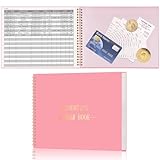
- Easy To Track Your Finances: HAUTOCO accounting ledger book keeps you on top of your expenses and income! Help you keep your money organized, spend well, and set and achieve financial goals
- Premium Material: The accounting ledger book has a total of 120 pages and 3,000 lines of entries. It is made of 100gsm thick paper to reduce ink leakage; it is equipped with a waterproof and sturdy PP cover to protect the inner pages
- Practicality: The expense tracker notebook measures 10.1 x 7.8'', and the large size gives you enough space to record each of your transactions; there are 2 PE large pockets at the back of the account book to store important tickets and loose items
- Manage Your Finances Effectively: Undated accounting books with number, date, description, account, payment or deposit amount, and total balance. You will be able to easily analyze your financial activities and quickly prepare accurate financial statements
- Ideal For Small Business or Personal Use: An accounting log journal can track your business or personal financial status. With a clear record of transactions, you can find unnecessary expenses or fraudulent charges
Build a comparable estimate using the plan and setup your business would actually need. Salesforce advises including costs beyond the subscription, such as onboarding, migration, training, and add-ons (Salesforce CRM checklist). Its UK guide also notes that buying features à la carte may lower the initial cost but add up as needs expand (Salesforce UK small-business CRM guide).
- Required user seats and the cost of adding staff.
- Contact, record, storage, or usage limits that could trigger an upgrade.
- The tier required for essential features, reports, automation, or integrations.
- Paid add-ons and separate services needed to connect existing tools.
- Billing commitment and whether the quoted rate depends on annual payment.
- Data cleanup and migration, onboarding, training time, and ongoing administration.
Compare the cost of the plan that meets your requirements, not the lowest visible entry price. Recalculate when you add users or need marketing or service workflows. A free or entry plan can be a measured starting point if it supports the pilot; HubSpot’s guidance promotes staged plan selection, but it is vendor-authored rather than neutral comparative advice (HubSpot small-business CRM).
Independent reader supportYour contribution helps us test, update, and keep practical guides available for everyone.Test finalists with the same real workflow
A polished demo can show what a product is capable of without showing how it feels in your team’s daily work. Salesforce recommends testing the same real workflow across candidates. Use a small, clean sample of business data and have daily users complete identical tasks in each finalist.
- Import a small set of contacts or leads and check how duplicates and missing fields are handled.
- Create a deal, assign an owner, and move it through the stages that match your process.
- Log an interaction and confirm that another relevant user can find the customer history.
- Set a follow-up task or reminder, then check whether it is easy to see and complete.
- Find a customer record and produce a report that answers one of the business’s real questions.
- Ask each user to note confusing steps, missing information, and workarounds; compare those observations alongside the plan cost.
Judge the system on whether staff can complete the workflow clearly and consistently—not on the length of the feature list. If the pilot requires extensive workarounds or extra manual entry, revisit the fit before signing up or importing more data.
Best Value
Review security, migration, and the growth path
Before choosing a vendor, ask how you can export records, what migration assistance is available, and what happens to your data if you leave. Review permissions, encryption, backups, privacy terms, and data location against the types of information you hold and the rules that apply in your jurisdiction. Microsoft includes security and scalability among small-business CRM considerations, but general product guidance cannot replace checking your own obligations (Microsoft’s small-business CRM guide).
Then check how the chosen plan changes as the business adds users, records, workflows, or integrations. A credible growth path does not mean paying for future capacity now; it means understanding the next tier, migration options, and likely cost before growth makes the current setup inadequate.
Make the decision against a short scorecard
For each finalist, record whether it meets each must-have, the total cost for the expected setup, the integration and data-export answers, and what daily users found during the pilot. Weight the requirements by business impact: a CRM that prevents missed follow-ups may matter more than one with a larger menu of optional tools.
Choose the smallest plan that supports the validated workflow. Upgrade only when a specific capability has a defined use and its expected value justifies the additional cost. If none of the finalists passes the same practical test, revise the requirements or process rather than forcing a purchase.
Free tools Windows power users keep installed
One-click scans. No signup required.
Quick Recap
Product prices and availability are accurate as of the date/time indicated and are subject to change. Any price and availability information displayed on Amazon at the time of purchase will apply.




