How much emergency savings should I keep? A practical starting point is three to six months of essential expenses; the FDIC recommends at least six months, while FINRA calls three to six months a good goal. How much emergency savings do I need at each stage of wealth? U.S. government and investor-education guidance does not set targets by net worth. Your reserve depends more on monthly costs, income reliability, likely emergencies, obligations, and access to other money than on a wealth label.
Why emergency savings are not set by wealth tier
A household’s net worth does not tell you how quickly it could pay rent, replace a broken water heater, or cover expenses after a job loss. Wealth may include a home, investments, or retirement assets that take time to access or could have an unacceptable cost to sell. Conversely, a household with modest assets may have stable income and low essential costs. The official guidance cited here gives no formula that assigns a different number of months to a particular net worth, portfolio size, or wealth stage.
As an Amazon Associate I earn from qualifying purchases.
That makes “stage of wealth” more useful as a prompt to revisit your risks than as a savings bracket. A new earner, a household building assets, and someone with substantial wealth can each use the same expense-based calculation, then adjust the target for their own circumstances. The CFPB puts the key qualification plainly: “The amount you need to have in an emergency savings fund depends on your situation.” The CFPB’s emergency-fund guide encourages people to consider unexpected expenses they have faced and how much those events cost.
Set a baseline from essential monthly expenses
First calculate what it costs to keep your household functioning for one month if you cut back on discretionary spending. Include essential housing costs, basic utilities, groceries, insurance, transportation, minimum required debt payments, and necessary care or medical costs. Use your real bills and spending rather than a general percentage of income. The purpose is to estimate the cash needed to continue meeting obligations during a disruption—not to reproduce your usual lifestyle in every detail.
#1 Best Overall

- 【1mm Reinforced Body & Secure Key Lock】Engineered with a heavy-duty steel core and finished with a durable powder-coated layer, this cash box achieves a solid 1mm total reinforced thickness—delivering a noticeably sturdier feel than the flimsy 0.5mm bodies found on standard models. The smooth key lock keeps your cash, checks, and valuables secure, while the wide-grip handle makes it effortless to carry to garage sales, yard sales, farmers markets, or food truck setups. Comes with 2 keys so you'll always have a backup.
- 【Auto-Pop Coin Tray with Spill-Proof 1.8cm Foam Liner】Say goodbye to rattling coins and messy spills. The 5-compartment tray automatically pops open when unlocked, and the 1.8cm deep foam lining gently cushions coins in place—effectively silencing noise during transport and preventing coins from popping out, even on bumpy rides. The quiet operation also makes it ideal for home use as a budgeting envelope system without disturbing others.
- 【Finger-Safe Bill Clips with Calibrated Tension - Upgraded Springs】Four spring-loaded clips hold 1/5/10/20 bills firmly against the wind on blustery outdoor days. We re-engineered the clip tension to strike the perfect balance: bills stay put when you need them to, but release smoothly without the painful snap-back that can pinch your fingers—a thoughtful upgrade for busy market days, bake sales, and ticket booths.
- 【Hidden Storage Under the Cantilever Tray】Lift the cantilever-style coin tray to reveal a concealed rear compartment. Stash 50/100 bills, receipts, or small valuables separately from daily transaction cash, keeping large denominations discreet and organized. This dual-level layout keeps everything visible and within reach, helping you make change fast when the line starts to grow at your church fundraiser or carnival booth.
- 【Versatile Size That Fits Your Hustle】Measuring 11.8 x 9.5 x 3.54 inches, this compact cash drawer slides neatly into desk drawers for office petty cash management, tucks into market crates, and sits stably on vendor event tables without hogging space. Ideal for small businesses, pop-up shops, school fundraisers, charity bake sales, or even as a cash gift box—wherever cash flows, it's ready to go.
Multiply that monthly amount by a planning horizon. FINRA calls three to six months of savings a good goal; the FDIC recommends at least six months of living expenses. These are broad rules of thumb from different U.S. authorities, not a universal mandate, a guarantee that every emergency will be covered, or a scientifically established threshold for every household. The lower end can be a useful initial milestone; the higher end is a more conservative baseline. Your circumstances can justify aiming outside that range.
| Illustrative essential costs per month | Three months | Six months |
|---|---|---|
| $2,000 | $6,000 | $12,000 |
| $3,500 | $10,500 | $21,000 |
| $5,000 | $15,000 | $30,000 |
These are arithmetic examples, not recommended amounts for a particular income or wealth group. If your actual essential costs are different, substitute them. The relevant measure is how many months of your own core expenses the reserve would cover, not whether the balance looks large compared with your net worth.
Adjust the target for the risks your household actually faces
After setting a baseline, ask what might make a disruption more costly or harder to manage. The CFPB suggests considering the unexpected expenses you have encountered and their costs. A car repair, medical bill, home repair, or income interruption can each call for money, but they are not interchangeable risks: one unexpected bill may be manageable with a smaller buffer, while a prolonged interruption can require months of core costs.
The Tool Desk
Outbyte Driver Updater FREEFix the driver behind crashes, sound loss and screen glitchesFind Drivers →Outbyte PC Repair FREEClear out junk files and repair common Windows errorsFree Scan →Rank #2
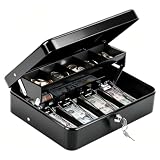
- 【 Built for Vendors: 1mm Thick Steel Security & Portability】Designed specifically for small business owners and market vendors, this cash box is crafted from 1mm thick heavy-gauge steel to resist drops, impacts, and forced entry during busy flea markets or yard sales. The robust 1mm metal build ensures your earnings stay secure, while the smooth key lock system and widened handle make it easy and safe to transport between your car and booth. Includes 2 keys for backup convenience
- 【 Smart Organization: Auto-Pop Tray & Hidden Compartment】Maximize efficiency with a cantilever coin tray that lifts automatically to reveal organized slots for coins. Crucially, it features a hidden rear compartment perfect for storing $50/$100 bills, receipts, or USB drives separately from daily change. This "cash drawer" style design keeps high-value items out of sight and secures your most important assets during transactions
- 【Windproof Bill Clips: Secure Cash Management Outdoors】Say goodbye to scattered cash. Our 4 strong spring clips are calibrated to hold bills ($1-$20) firmly in place, acting as a windproof solution for outdoor events like farmers markets and food trucks. While the grip is secure to prevent loss in the wind, the clips are smooth enough for quick access, allowing you to make change rapidly even when lines are long
- 【Perfect Fit for Mobile Business & Home Use】Measuring 11.8" x 9.45" x 3.54", this portable money box strikes the ideal balance between capacity and portability. It fits neatly into market crates, under vendor crates, or in desk drawers. Whether you are running a school fundraiser, managing a food truck, or organizing household savings, it provides ample space without taking up valuable room
- 【Professional Finish & Durable 1mm Construction】Finished with a sleek, scratch-resistant black coating, this 1mm thick metal cash box maintains a professional look even after repeated use. It is a reliable, long-lasting investment for anyone needing a secure cash handling solution. Backed by superior material thickness and quality construction, it withstands the rigors of daily commerce, keeping your financial operations organized and professional
Income reliability and replacement time
Consider how predictable your pay is, whether household income comes from one source or several, and how long replacing a lost income source might take. If earnings vary, a month with unusually high income may not be a sensible basis for estimating recurring costs. A household with irregular earnings may find it useful to build its reserve around typical essential expenses and the periods when cash flow is weakest. The cited authorities do not prescribe a fixed extra number of months for variable income, so make any adjustment based on your actual interruption risk rather than treating it as an official rule.
Obligations and likely large bills
Dependents, required debt payments, medical needs, or a home and vehicle that you must maintain can change the consequences of an emergency. List the costs that would still fall due if your income dropped, and note likely repair or care expenses. You do not have to assume every possible bill will occur at once; the exercise is to identify exposures that a simple monthly-expense figure may miss.
Other resources and their real access cost
Count another resource as a substitute for cash only if you can reach it in time and without an unacceptable loss, tax consequence, penalty, or other cost. Investments can fall in value, and retirement assets may have restrictions or consequences when withdrawn. The reviewed guidance does not endorse market investments or retirement accounts as equivalent to an immediately accessible emergency reserve. A high net worth on paper therefore does not automatically remove the need for liquid savings.
Rank #3

- FIREPROOF RESISTANT INSULATION: KYODOLED fireproof storage safe box is made of sturdy double cold rolled steel construction on all sides and is equipped with fire resistant insulation. Please note that the lid will have a slight gap with the box due to the convenience of opening and closing, but please rest assured that he will not affect the function of fire resistant! It will keep your valuables safe, organized.
- LARGE CAPACITY: KYODOLED Fireproof Document Box Exterior size is 12.6'' x 8.3'' x 3.58''. 𝐈𝐧𝐭𝐞𝐫𝐧𝐚𝐥 𝐝𝐢𝐦𝐞𝐧𝐬𝐢𝐨𝐧𝐬 𝐢𝐬 11.6" x 7.3" x 3.1". 𝐓𝐡𝐞 𝐥𝐞𝐭𝐭𝐞𝐫 𝐬𝐢𝐳𝐞 𝐝𝐨𝐜𝐮𝐦𝐞𝐧𝐭𝐬 𝐧𝐞𝐞𝐝 𝐭𝐨 𝐛𝐞 𝐟𝐨𝐥𝐝𝐞𝐝. Fire Resistance Security Chest can protect your most valuable items including passports, licenses, certificates,cash, precious photos, jewelry and so on.
- PRIVACY KEY LOCK:The personal metal lock box is equipped with key lock with 2 keys, keeping your items away from children and prying eyes.Align the key with the lock hole, turn the key clockwise and the case will be opened. Very easy to operate.
- LIGHT WEIGHT ANF PORTABLE HANDLE: The fire proof document box is designed with high quality plastic handle. The metal lock box is a good choice that not too thin or too heavy for safe home use or long or short travel.
- HIGH-QUALITY & DURABLE: KYODOLED Fireproof Box with Key Lock is durably crafted of solid steel with a powder-coated, scratch-resistant. Simply insert your valuables into bag and lock up,it provide you double security and maximum protection.
Use wealth stages as review points, not preset balances
There is no evidence-based chart that says a person at a particular wealth level needs a particular number of months. Instead, use changes in your finances to recalculate the same expense-and-risk framework. The examples below describe decisions to revisit, not fixed targets for “beginner,” “middle,” or “wealthy” households.
Recommended Free Tools
| Financial situation | What to examine | How to use the reserve framework |
|---|---|---|
| Starting to save or building a first buffer | Core monthly bills, the most common costly surprises, and whether any amount can be set aside without missing essentials | Begin with an affordable contribution and build toward a month-based goal over time. A small reserve can help with an immediate bill, but it is not the same as months of income protection. |
| Growing income or accumulating assets | Whether spending and obligations have risen, whether income is dependable, and whether assets can be reached quickly without loss or penalty | Recalculate essential costs when your household changes. Do not reduce cash reserves solely because investments or net worth have grown. |
| Substantial wealth or complex finances | Which assets are genuinely liquid, how quickly funds can be transferred, and what selling or withdrawing would cost during a disruption | Set aside funds for the time-sensitive needs you want to meet without relying on a forced sale. Wealth may affect your options, but it does not produce an official smaller-months target. |
For instance, if a household’s essential costs are $3,500 a month, the arithmetic baseline is $10,500 for three months or $21,000 for six. If that household later acquires investments, the expense calculation has not changed; what may change is the inventory of other resources and the price or delay involved in reaching them. This example illustrates the method, not a recommendation based on wealth.
Do not confuse a small emergency with months of protection
Survey measures can make preparedness look different depending on the question asked. In its report on U.S. households in 2025, published in May 2026, the Federal Reserve said 55 percent of adults reported setting aside money for three months of expenses in an emergency or rainy-day fund. That was unchanged from 2024 and below the 59 percent high reported in 2021. Separately, 63 percent said they would cover a hypothetical $400 expense using cash or its equivalent. The $400 response measures capacity to handle a specified bill; it does not show that a person has three months of expenses saved.
Rank #4
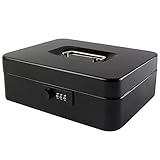
- DURABLE AND UNBREAKABLE: The cash box is unbreakable in our daily life due to strong metal material. Besides, the inner removable money tray is so sturdy built that you have no reason to worry about the security of your items.
- ADVANCED COMBINATION LOCK: The locking device consists of a 3-number combination lock ,which contributes to protect your valuables.It is unnecessary for you to be afraid of losing your keys results from the well-designed code system, which can be simply set or changed.
- REMOVABLE MONEY TRAY: The inner cash tray of the storage box is made up with five compartments, so your cash, coins and keys are able to be accepted separately. Besides, there is huge space for you to take care of checks, receipts and valuables at the bottom of the box.
- WIDE MULTIPURPOSE APPLICATION: The locking cash box is capable of varied occasions. No matter where you are, for instance, school, office, factory, supermarket and anywhere else, the lock box could actually breathe new life into your lifestyle.
- SIZE AND COLOR: The size of the cash boxes is 9.84"x 7.87"x 3.54" (250*200*90mm), and the color is black, a very classic color.
The same Federal Reserve report shows differences in reported three-month emergency savings by family income and age. These are survey responses, not prescribed savings targets for those groups.
| Group | Adults reporting three-month emergency savings in 2025 |
|---|---|
| Family income below $25,000 | 21% |
| Family income $25,000–$49,999 | 39% |
| Family income $50,000–$99,999 | 55% |
| Family income $100,000 or more | 75% |
| Age 18–29 | 37% |
| Age 30–44 | 49% |
| Age 45–59 | 55% |
| Age 60 or older | 71% |
Those figures describe how respondents reported their savings, not whether a given household has enough for its own expenses or what it ought to save. The Federal Reserve report treats the three-month-fund question and hypothetical $400 question as distinct measures.
Choose a place that balances access and safety
Emergency money needs to be available when a bill is due, while being kept somewhere that does not expose the reserve to avoidable loss. The CFPB says, “You want to make sure this fund is safe, accessible, and in a place where you’re not tempted to spend it on non-emergencies.” FINRA likewise recommends a safe place without investment risk and immediate access. In the United States, the following options have different trade-offs; account terms and insurance eligibility matter.
Best Value

- 【Resettable 3-Digit Combination Lock】: Open the box with the factory code 000. With the dials centered on the current code, move the internal lever from A to B, choose a new combination, then return the lever to A. Center every digit precisely so an adjacent number is not recorded by mistake
- 【Removable Tray for Organized Storage】: The removable coin tray separates loose change and compact items, while the lower compartment provides space for folded bills, receipts and other small essentials. Lift out the tray whenever you need access to the storage area below
- 【Compact Size with Carry Handle】: Measuring 7.87 x 6.30 x 3.35 inches, this small cash box fits neatly on counters, shelves or inside many drawers. The built-in handle makes it convenient to carry between home, work and temporary selling events
- 【Cash & Medication Storage】: Organize coins, folded bills, receipts, photos and appropriately sized medication in one compact lock box. The combination lock supports controlled access at home or in shared spaces. Use certified child-resistant storage whenever that level of protection is required
- 【Cold-Rolled Steel for Everyday Use】: The metal body and black finish suit routine use at home, in offices, at garage sales, school events and vendor tables. The box provides everyday organization and basic access control; use a high-security safe for large amounts of cash or irreplaceable valuables
| Option | Access and protection considerations | Important limitation |
|---|---|---|
| Bank or credit union savings account | A dedicated account can separate reserve money from everyday spending. Confirm that the institution and account qualify for applicable U.S. deposit insurance and check how quickly you can transfer or withdraw funds. | Specific rates, fees, and terms vary; no particular account or provider is established as best here. |
| Certificate of deposit (CD) | The FDIC includes insured savings accounts and CDs among savings options. | The FDIC cautions that a CD may charge a penalty for early withdrawal, so money locked into a term is not necessarily instantly accessible. |
| Prepaid card | The CFPB lists a prepaid card as one possible place to keep emergency savings. | Check the card’s access terms and protections before relying on it for a large reserve; the cited guidance does not establish a particular card’s insurance status or fees. |
| Cash at home | Cash is immediately at hand for some needs. | The CFPB warns that cash can be stolen, lost, or destroyed. Keeping the entire reserve this way exposes it to those risks. |
The FDIC’s U.S. consumer guidance covers insured savings accounts and CDs and notes the possible early-withdrawal penalty. The CFPB guide discusses savings locations and the safety and access trade-offs. No account-yield comparison or current rate is established by these sources, so compare the current terms for accounts available to you rather than choosing by a general claim about returns.
Build the fund without destabilizing monthly cash flow
If your current balance is far below your goal, treat the goal as a direction rather than a reason to delay saving until you can contribute a large amount. FINRA says that setting aside any amount you can afford is helpful. The CFPB also recommends making a goal, contributing regularly, tracking progress, managing cash flow, saving some one-time inflows, and considering automatic transfers.
- Choose a first milestone. Write down your essential monthly costs and select a practical initial balance or month-based goal. A first milestone is a progress marker, not proof that every kind of emergency is covered.
- Find a sustainable contribution. Review your cash flow and choose an amount you can save without making essential bills late or relying on costly borrowing to get through the month.
- Make saving recurring if your balance allows. A scheduled transfer can make contributions consistent. Set the transfer date and amount with your paycheck and bill schedule in mind; if the account may be too low when a transfer occurs, adjust the timing or amount to avoid overdraft risk.
- Use one-time money deliberately. If you receive a tax refund or another one-time inflow, consider directing a portion toward the reserve while accounting for immediate obligations.
- Track progress and revise the target. Check the balance and essential expenses periodically. Recalculate after a change in income, household obligations, or recurring costs instead of tying the target to net worth alone.
CFPB guidance supports starting with an affordable amount, recurring contributions, monitoring balances, cash-flow management, and saving part of a one-time inflow. FINRA’s financial-hardship guidance frames three to six months as a good goal while emphasizing that any affordable amount helps.
Set rules for using the reserve and rebuilding it
Decide in advance what qualifies as an emergency so the fund is less likely to be spent on ordinary discretionary purchases. A necessary car or home repair, medical bill, or loss of income fits the kinds of unexpected costs commonly cited in consumer guidance. A planned annual expense is different: when possible, budget for it separately so it does not repeatedly drain money intended for sudden disruptions.
When you use the fund, note the expense and begin restoring the balance as cash flow permits. If you have to use savings for a genuine emergency, that is what the reserve is for; rebuilding is a next step, not a reason to treat the use as failure. The CFPB recommends setting guidelines for what counts as an emergency and replenishing savings after withdrawals.
Sources and scope
This article describes U.S.-oriented consumer guidance. The Federal Reserve survey is about U.S. adults, and FDIC deposit insurance applies within the U.S. system under its eligibility rules. Month-based recommendations are starting points, not personalized financial advice; the authorities cited do not publish a wealth-stage schedule. The guidance referenced here comes from the CFPB page modified October 29, 2025; FINRA’s investor education page dated April 23, 2024; FDIC guidance dated January 2025; and the Federal Reserve’s May 2026 report covering 2025 household data.
Quick Recap
Product prices and availability are accurate as of the date/time indicated and are subject to change. Any price and availability information displayed on Amazon at the time of purchase will apply.
Quick wins for a faster PC:
Repair Windows errors before they cause bigger problemsFix Now →Fix the driver behind crashes, sound loss and screen glitchesFind Drivers →Clear out junk files and repair common Windows errorsFree Scan →



