Do these 3 things before closing this tab:
1Repair Windows errors before they cause bigger problems2Scan for outdated or missing drivers - takes under a minute3Clear out junk files and repair common Windows errorsAt a U.S. insured bank, opening several accounts does not create a new $250,000 insurance limit for each account. The FDIC combines deposits by depositor, bank, and ownership category. For qualifying joint accounts, each co-owner’s ownership share is added across all joint accounts at that bank; each person’s combined joint-category interest is insured up to $250,000. Federally insured credit unions use NCUA share-insurance rules. These are U.S. rules: a country that calls a product a “fixed deposit” may have a different deposit guarantee scheme.
What the $250,000 limit applies to
FDIC deposit insurance is calculated per depositor, per FDIC-insured bank, and per ownership category—not per account number, certificate, or product. The FDIC’s consumer guidance, “Understanding Deposit Insurance,” states the standard limit as $250,000 for each depositor, at each insured bank, in each ownership category. When one person holds several accounts in the same category at the same bank, the balances are added together before coverage is determined.
As an Amazon Associate I earn from qualifying purchases.
That distinction matters for certificates of deposit (CDs), often called fixed deposits in other countries. A CD is an account product; its term, interest rate, or separate account number does not by itself create a separate insurance category. If you have multiple deposits at one bank, first classify each account by its actual ownership arrangement, then total the balances within each category.
The Tool Desk
Outbyte PC Repair FREEClear out junk files and repair common Windows errorsFree Scan →Outbyte Driver Updater FREEFix the driver behind crashes, sound loss and screen glitchesFind Drivers →The institution also matters. A bank’s deposit insurance is generally administered by the Federal Deposit Insurance Corporation (FDIC). Federally insured credit unions are covered under National Credit Union Administration (NCUA) share-insurance rules. Confirm which institution holds the deposit and that it is insured; a brokerage, brand, or account service may not itself be the bank or credit union where funds are deposited.
#1 Best Overall

- FIREPROOF RESISTANT INSULATION: KYODOLED fireproof storage safe box is made of sturdy double cold rolled steel construction on all sides and is equipped with fire resistant insulation. Please note that the lid will have a slight gap with the box due to the convenience of opening and closing, but please rest assured that he will not affect the function of fire resistant! It will keep your valuables safe, organized.
- LARGE CAPACITY: KYODOLED Fireproof Document Box Exterior size is 12.6'' x 8.3'' x 3.58''. 𝐈𝐧𝐭𝐞𝐫𝐧𝐚𝐥 𝐝𝐢𝐦𝐞𝐧𝐬𝐢𝐨𝐧𝐬 𝐢𝐬 11.6" x 7.3" x 3.1". 𝐓𝐡𝐞 𝐥𝐞𝐭𝐭𝐞𝐫 𝐬𝐢𝐳𝐞 𝐝𝐨𝐜𝐮𝐦𝐞𝐧𝐭𝐬 𝐧𝐞𝐞𝐝 𝐭𝐨 𝐛𝐞 𝐟𝐨𝐥𝐝𝐞𝐝. Fire Resistance Security Chest can protect your most valuable items including passports, licenses, certificates,cash, precious photos, jewelry and so on.
- PRIVACY KEY LOCK:The personal metal lock box is equipped with key lock with 2 keys, keeping your items away from children and prying eyes.Align the key with the lock hole, turn the key clockwise and the case will be opened. Very easy to operate.
- LIGHT WEIGHT ANF PORTABLE HANDLE: The fire proof document box is designed with high quality plastic handle. The metal lock box is a good choice that not too thin or too heavy for safe home use or long or short travel.
- HIGH-QUALITY & DURABLE: KYODOLED Fireproof Box with Key Lock is durably crafted of solid steel with a powder-coated, scratch-resistant. Simply insert your valuables into bag and lock up,it provide you double security and maximum protection.
How coverage works for joint accounts
For a qualifying joint account, the FDIC calculates each co-owner’s interest, then aggregates that person’s interests across all qualifying joint accounts at the same insured bank. Each co-owner can receive up to $250,000 of coverage in the joint-account category. The limit is not $250,000 for every joint account, nor is it a single $250,000 shared among everyone on an account.
The FDIC’s joint-account guide describes the limit as $250,000 for each co-owner’s combined interests in all joint accounts at the same insured depository institution. The calculation follows the people and their ownership interests across accounts, including accounts with different combinations of co-owners.
Qualification requirements
A title that lists two people does not automatically establish a qualifying joint account. Under the FDIC’s guidance, owners must be natural persons and each co-owner must have equal rights to withdraw funds. Account records must also satisfy the applicable signature requirements. The FDIC states an exception to the signature requirement for CDs; that exception does not eliminate the other qualification rules.
Unless the bank’s records clearly indicate a different ownership share, the FDIC assumes co-owners own equal shares. Keep account documents and bank records consistent with the actual arrangement. Do not assume that a private understanding about who contributed money will necessarily alter the insurance calculation if the institution’s records do not clearly show it.
A practical method for calculating joint-account coverage
- Identify the institution. Establish whether the money is held at an FDIC-insured bank or a federally insured credit union. Use the insurance system for that institution, rather than assuming the same rules apply everywhere.
- Group accounts by institution and ownership category. Put accounts at the same insured institution together, then separate single-owner, joint, and other applicable categories. A new account number or different balance type does not alone make a new category.
- List the actual owners of each joint account. Use the account title and institution records to determine who is a co-owner. Distinguish owners from beneficiaries, who may receive funds later but are not necessarily current co-owners.
- Determine each co-owner’s share in each account. Follow clear ownership records and applicable rules. If records do not clearly indicate different shares, the FDIC generally assumes equal ownership.
- Add each person’s shares across every joint account at that bank. Include accounts with different co-owner combinations. Each person’s total is tested against that person’s joint-category limit.
- Compare each total with the applicable limit. For a qualifying FDIC joint-account owner, compare the combined interest with $250,000. Any amount above the limit is not insured in that category under the stated rules.
For example, imagine two people hold a qualifying joint CD with a balance of $500,000, split equally, and neither has any other joint-account interest at that bank. Each person’s $250,000 share is within the joint-category limit, so the CD is fully insured under the FDIC example. The condition about having no other joint interests is crucial: balances in other joint accounts at that bank also count toward each person’s total.
Rank #2
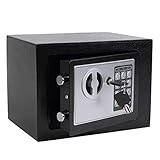
- STRONG & SECURE:Digital Locking- the Electronic Safety Lock Box Is Equipped with an Easy to Program Digital Keypad That Is Simple to Lock and Unlock by Entering Your Security Combination. Two Emergency Keys Are Included for Faster and More Immediate Access.
- SMART CAPACITY:0.2-cubic-feet, Exterior :9.05" x 6.69"x 6.69", Interior size: :6.29" x 8.9" x 5.12" (Pls pay full attention to the dimension for this MINI safe box),It gives you easy personal access to your valuables .
- STRONG & SECURE: The mini safe box is made of reinforced solid steel wall construction. Dual security steel door locking bolts & a corrosion & stain-resistant powder coat finish keeps the drop box safe.
- Durable powder coated finish, Magnetic lock for auto-locking;
- Easy to install: The home safe box has pre-drilled holes for wall or floor mounting, Includes mounting bolts.
Why multiple co-owner groups change the answer
Consider the FDIC’s worked example involving three joint accounts totaling $750,000, owned in different combinations by Mary, John, and Robert. Across all three accounts, Mary’s ownership interests add to $330,000; John’s also add to $330,000; Robert’s add to $90,000. Mary and John are each insured for $250,000 and each have $80,000 uninsured. Robert’s $90,000 is fully insured. In the example, $590,000 of the combined deposits is insured and $160,000 is uninsured.
The result cannot be determined just by checking whether each account’s balance is below $250,000. A person may have a share in several accounts, and those shares accumulate in that person’s joint category. Conversely, another co-owner in the same set of accounts may have a smaller aggregate interest and remain fully covered. The FDIC example demonstrates why a useful worksheet lists each owner’s share account by account before totaling.
Free tools Windows power users keep installed
One-click scans. No signup required.
| Owner | Combined interests in the FDIC example | Insured | Uninsured |
|---|---|---|---|
| Mary | $330,000 | $250,000 | $80,000 |
| John | $330,000 | $250,000 | $80,000 |
| Robert | $90,000 | $90,000 | $0 |
| Total across the three accounts | $750,000 | $590,000 | $160,000 |
These are the figures in the FDIC’s official example, not a separate coverage rule or a typical depositor outcome. For your own accounts, the relevant calculation depends on the ownership of each account and the other deposits held by each owner in the same category at that institution.
Joint accounts and other ownership categories
A depositor may qualify for separate coverage in more than one ownership category at the same insured bank, provided each category’s requirements are met. The FDIC gives the example of a person with deposits in a single account and an interest in a joint account: the single-account deposits and joint-account interest can be insured separately because they belong to different categories. Aggregation still applies within each category.
An account that names beneficiaries may be evaluated under trust-account rules rather than as a joint account. A beneficiary is not necessarily a current owner with withdrawal rights. Do not classify an account simply by counting the names on its title: determine whether each person is an owner now or a beneficiary who may receive funds later. The FDIC’s consumer and account guidance explains that the account’s legal arrangement and records affect its category.
Rank #3

- 0.5-cubic-feet security safe with electronic lock and 3 operation indicator lights; powered by (4) AA batteries (not included)
- Includes 2 emergency override keys to protect against forgotten passcodes or dead batteries; keep keys in a well-hidden, secure location
- Strong steel construction with carpeted floor to protect against scratches and damage; pry-resistant concealed hinges; adjustable/removable interior shelf.
- Pre-drilled mounting holes with four expansion bolts are included to mount safe to wall, floor, or shelf
- Exterior measures 13.8 x 9.8 x 9.8 inches (WxDxH); Interior measures 13.6 x 7.2 x 9.7 inches (WxDxH); door thickness is approximately 2 inches; product weight is 18.26 pounds
Changing the order of names on a joint account, or substituting “and,” “or,” or “and/or,” does not raise coverage. The underlying owners, their rights, and whether the account meets the qualification rules are what matter. Account-title formatting is not a way to multiply the insurance limit.
Outdated Drivers Are Slowing You Down
One free scan finds every outdated or missing driver and matches the right update for your exact hardware.Free scan · exact hardware matchWindows Errors? Fix Them Before They Spread
Repair common Windows errors and clear accumulated junk for a smoother, more stable PC - no reinstall needed.Free scan · no reinstallFDIC bank coverage versus NCUA credit-union coverage
These are separate insurance systems based on institution type, not competing products. The NCUA’s “Share Insurance Coverage Overview,” dated October 29, 2024, describes coverage up to $250,000 per share owner, per insured credit union, per ownership category. The detailed joint-account qualification points in this article are based on FDIC guidance; do not assume a particular credit-union account meets identical requirements without consulting NCUA guidance and the credit union’s records.
| Question | FDIC-insured bank | Federally insured credit union |
|---|---|---|
| Regulator’s insurance system | Federal Deposit Insurance Corporation (FDIC) | National Credit Union Administration (NCUA) |
| Published standard limit in the cited guidance | $250,000 per depositor, per insured bank, per ownership category (FDIC consumer guidance accessed 2026) | Up to $250,000 per share owner, per insured credit union, per ownership category (NCUA overview dated October 29, 2024) |
| How same-category accounts are handled | Deposits in the same category at one insured bank are aggregated | Coverage is stated per share owner, insured credit union, and ownership category; consult NCUA guidance for the account arrangement |
| Joint-account details covered by the cited guidance | Co-owner shares in qualifying joint accounts at the same bank are combined for each owner | Not stated in the cited NCUA overview; verify the applicable NCUA rules for the account |
A credit union may call a term deposit a share certificate rather than a CD. That product name does not make it an FDIC-insured bank deposit; confirm the institution’s insurance status and apply the appropriate NCUA rules.
Independent reader supportYour contribution helps us test, update, and keep practical guides available for everyone.Records and checks to make before relying on a calculation
- Verify the insured institution. Identify the actual bank or credit union holding the funds and confirm its insurance status. Do not assume two different account brands necessarily mean two different insured institutions, or that similar names mean they are the same.
- Collect statements and ownership documents. Record each account balance, the institution, named owners, and any records that specify unequal interests or withdrawal rights.
- Separate owners from beneficiaries. Note whether people listed are present co-owners or are named to receive funds under a beneficiary arrangement.
- Include every relevant account at that institution. A CD should be considered alongside the owner’s other accounts in the same category, not in isolation.
- Use an official estimator or seek a determination for complicated cases. The FDIC and NCUA provide official coverage resources. If the ownership arrangement, bank records, or institution identity is unclear, ask the institution or regulator with the account details rather than treating a general example as a personalized determination.
Common mistakes that can leave a balance uninsured
Counting the limit once per account
Several joint CDs at one bank do not each give every owner a fresh $250,000 joint-category allowance. Add each co-owner’s interests across all qualifying joint accounts at that bank.
Checking only the total account balance
A joint account’s balance alone does not tell each owner’s covered amount. Determine shares first, then aggregate each person’s shares across accounts. The FDIC’s three-account example shows that one co-owner can exceed the limit while another remains fully insured.
Rank #4
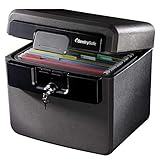
- FIRE AND FLOOD PROTECTION FOR ESSENTIAL PAPERS: UL Classified to withstand high temperatures for up to thirty minutes and ETL Verified to protect contents during water exposure, helping safeguard critical paperwork during common home emergencies
- DESIGNED FOR IMPORTANT DOCUMENT STORAGE: Spacious interior fits hanging file folders and is ideal for organizing passports, birth certificates, insurance records, and legal paperwork
- KEY LOCK SECURITY YOU CONTROL: Durable key lock helps prevent unauthorized access and keeps the lid securely closed during fire events. Two keys are included for backup access
- HOME FRIENDLY SIZE WITH PORTABLE DESIGN: Compact footprint fits easily in closets, offices, or under desks while remaining portable enough to relocate when needed
- BUILT FOR EVERYDAY PEACE OF MIND: Black exterior offers a clean, neutral look that blends into home or office spaces while providing dependable document protection year round
Treating a beneficiary as a co-owner
A beneficiary designation does not necessarily make the beneficiary a current account owner. The account may be assessed under trust-account rules, so establish the legal category instead of assuming it is joint.
Relying on name order or wording
Putting one owner’s name first or changing “and” to “or” does not increase coverage. Accurate ownership, rights, and institution records—not stylistic title changes—control.
Applying U.S. limits to another country
“Fixed deposit” is used internationally, but the limits discussed here are U.S. FDIC and NCUA rules. A depositor outside the United States, or with funds in a non-U.S. scheme, should check that jurisdiction’s deposit guarantee rules and covered-institution definitions.
What this means for a fixed deposit
Before opening another CD or renewing one, calculate coverage for the owner—not just the individual certificate. Confirm the institution, classify the account, identify every co-owner and share, and add that person’s interests in all accounts in the same category at that institution. A second account can be useful for savings or maturity planning, but a second account number alone does not expand the FDIC limit. For credit-union share certificates, use NCUA rules and confirm the specific ownership arrangement.
No general article can determine coverage for every contract or legal arrangement. The institution’s insurance status, account documents, bank records, and precise ownership rights may affect an actual calculation. The FDIC and NCUA limits and examples described here are regulator guidance, not a substitute for reviewing those facts.
Quick Recap
Product prices and availability are accurate as of the date/time indicated and are subject to change. Any price and availability information displayed on Amazon at the time of purchase will apply.




