Recommended Free Tools
Fish farming can produce animal food with less feed than many livestock systems, but that does not make it automatically better for the environment than livestock or crop farming. The outcome depends on what is farmed, where and how it is produced, what goes into its feed, and which impacts are counted. A fair comparison uses the same measure of food output and includes the relevant supply-chain stages.
What counts as “traditional agriculture”?
The phrase can mean crop farming, livestock production, or both; aquaculture also covers many different species and methods, from freshwater ponds to marine farms. Comparing “fish farming” with “agriculture” as if each were one uniform system can therefore mislead. A useful comparison names the species or crop, production method, location, output measure, and impacts included.
Choose a common functional unit: for example, a kilogram of edible product, a kilogram of protein, or a calorie of food. A kilogram of live animal weight is not equivalent to a kilogram of edible fish, meat, or crop. The comparison should also use a consistent life-cycle boundary. Counting only the farm can omit feed production, hatcheries, processing, and transport; expanding the boundary to include those stages can change the result. FAO comparative-assessment proceedings emphasize normalized units, comparable methods, and accounting for externalities.
Why fish can use feed efficiently
Fish are ectothermic (poikilothermic): unlike mammals and birds, they do not use feed energy to maintain a constant internal body temperature. Water also supports their bodies, reducing the energy needed to support posture. These biological differences can leave more consumed energy available for growth than in terrestrial livestock. They help explain a potential feed-efficiency advantage, but do not determine a farm’s total environmental impact.
Free tools Windows power users keep installed
One-click scans. No signup required.
#1 Best Overall

- YEAR ROUND WATER GARDEN: The Back to the Roots Water Garden Duo allows you to grow a succulent or houseplant garden all year round and comes with everything you need to get started - no green thum or big backyard needed.
- CONVENIENT AND EASY: Harvest organic microgreens from your aquarium in just 10 days; Your Water Garden becomes a self-cleaning fish tank that also grows fresh food up top; The fish waste fertilizes the plants on top and the plants clean the water
- THE PERFECT LIVING HOME DECOR OR GIFT: Each Back to the Roots Water Garden Duo comes with a free STEM curriculum on aquaponic and hydroponic systems to encourage your kids to learn more about it; This award-winning ecoystem is also the perfect gift.
- COMPLETE AQUATIC ECOSYSTEM KIT: This DIY aquaponic fish tank kit is fully equipped with everything you need to get started - radish and wheatgrass seeds, water conditioner, a growing medium for your seeds to take root, water dechlorinator, fish food, and even a fish coupon
- MADE IN THE USA: Back to the Roots indoor gardening kits are crafted with care in the USA. For any concerns with your kit's performance, please contact us for assistance. Refill kits are also available
Historical feed and food-conversion figures
The following figures come from two dated reports and describe the comparisons those reports cited. They are not current universal averages or a guarantee about any particular farm.
| Measure | Reported comparison | Source and qualification |
|---|---|---|
| Dry feed per kilogram of edible mass | Aquaculture systems: 2.5–4.5 kg; conventional terrestrial animal production systems: 3.0–17.4 kg | FAO Global Conference on Aquaculture proceedings, 2010; a range across systems, not a current global average. |
| Feed to add one kilogram of edible weight | Beef cattle: over 10 kg of feed; catfish: less than 3 kg | FAO Global Conference on Aquaculture proceedings, 2010; the report’s cited examples. |
| Share of food consumed converted to protein | Fish: 30%; poultry: about 18%; pigs: about 13% | FAO-hosted HLPE report, 2014; the report’s cited comparison, not a value for every production system. |
| Grain needed to produce one kilogram of protein | Beef protein: 61.1 kg of grain; pork protein: 38 kg; fish protein: 13.5 kg | FAO-hosted HLPE report, 2014; the report’s cited comparison, not a current universal requirement. |
Feed conversion varies with species, feed formulation, farm conditions, and measurement method. The figures use different measures, so they should not be combined into one ranking. The 2010 proceedings also note the need for more comprehensive comparisons.
Rank #2
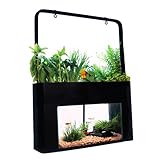
- The AquaSprouts Garden is a self-sustaining aquarium & aquaponics kit for the home, office or school
- Fish fertilize the plants. Plants clean the water for the fish. Once up & running, aquaponics requires minimal water changes & no filter replacements
- Grow your favorite veggies, herbs and greens anywhere, all-year-round. No need for added fertilizers—let your fish friends provide the nutrients your plants need
- Perfect tool to explore how our natural environment works and great option for those with limited space
- Fits any standard 10-Gallon aquarium (approximately 20" X 10" X 12") from any manufacturer (not included)
Land, water, and other inputs
A fish farm does not use pasture in the same way as grazing livestock, but that does not mean its food is land-free. Feed may depend on crops and other inputs produced elsewhere; farms also require sites, infrastructure, seed or hatchery inputs, and sometimes substantial processing. A farm’s direct footprint is only one part of its supply chain.
Water needs and effects differ by system. Freshwater farms may compete with other users for water, while water and land can also be tied up indirectly in feed production. Local conditions matter: the availability of suitable sites, freshwater, energy, and feed can constrain expansion. Converting land or water uses for aquaculture has sometimes disrupted existing users and caused ecological damage. The FAO-hosted HLPE report highlights concerns associated with shrimp, salmon, and intensive aquaculture, but impacts depend on site and practice rather than following automatically from a species label.
Do these 3 things before closing this tab:
1Clear out junk files and repair common Windows errors2Fix the driver behind crashes, sound loss and screen glitches3Repair Windows errors before they cause bigger problemsRank #3

- Set Contents: Aquarium, LED light, fish tank filter, water pump,fake plants; Aquarium size: 18.1 x 9.4 x 12.9inch, Capacity: 3.7 Gallon
- Adjustable Light Color: You can choose red, orange, yellow, green, blue, purple and other light colors; This not only promotes the growth of fish, but also makes the underwater world more colorful
- Fish Tank Self Cleaning: The aquarium filter uses a combination of physical and biological filtration to improve the filtration effect; Multiple filter cotton can filter impurities and fish manure, improve water quality, and ensure a clean aquatic environment in the aquarium; The filter can generate abundant bubbles and water flow to provide sufficient oxygen for the fish
- The aquarium is made of glass material; Create a colorful underwater world for your aquarium
- Great Decorations: This fish tank can be used as a decoration for bedrooms, living rooms and offices; The Aquarium is packaged beautifully which makes it a perfect product for kids, family and friends
Climate emissions, waste, and ecological risks
Emissions depend on farm conditions and supply chains
Feed production is typically a major greenhouse-gas emissions factor in fish farming, according to FAO guidance. Farms can also use energy for aeration, temperature regulation, and water circulation; processing and other later supply-chain stages may add emissions if included in the assessment. Freshwater ponds can emit methane under some conditions. Temperature, oxygen, organic matter, sediment carbon, and vegetation influence those emissions, so a pond result should not be generalized to all aquaculture.
An FAO technical paper assessed Nile tilapia in Bangladesh, Indian major carps in India, and striped catfish in Viet Nam. It found variation within each system and across production stages, and identified more consistent farm practices as a way to improve efficiency and reduce emissions. Those findings concern the three systems studied, not aquaculture worldwide.
Rank #4
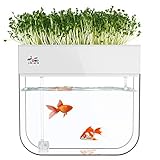
- Fish Tank & Seed Sprouter: The fish waste fertilizes the plants, and the plants clean the water for fish.
- Self Cleaning System: Plants consume fish dung as nutrients, so the tank requires 50% fewer cleanings than traditional fish tanks.
- Siphon Oxygen Supply: The water level of the tank is tidal-like fluctuation, and the roots of the plants can breathe regularly, no need watering or fertilizing. Meanwhile a natural oxygen supply is brought to the fish.
- Educational Product: Use the system at home or in a classroom. Let kids learn germination and teach concepts like food sustainability, aquatic environments, and animal care.
- Great Gift: A wonderful gift for kids, parents, teachers, foodies and gardening lovers. (Note: Search B08BR8H72X for the pump spare parts.)
Local ecological effects
Potential concerns include nutrient and organic waste, habitat conversion, escaped farmed animals, disease, and interactions with wild populations. Their importance depends on species, siting, containment, health management, and waste treatment. These impacts belong in a comparison alongside feed, water, and emissions; a favorable feed-conversion figure alone cannot settle the question.
Independent reader supportYour contribution helps us test, update, and keep practical guides available for everyone.When fish farming and agriculture are integrated
Fish farming and crop production can complement one another rather than compete. FAO describes the use of agricultural by-products, including manure and crop residues, as aquaculture fertilizer or feed inputs. Rice-fish systems are another example: fish can be raised alongside rice, and integrated pest management may reduce pesticide use. Whether these arrangements work well depends on local conditions and management.
Best Value
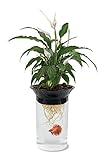
- BETTA TANK and HYDROPONIC PLANTER: See nature in motion through our Aqua-Ponic Tanks. Each fish tank is made from ultra-clear plastic, and replicates nature’s metabolic cycle by providing a healthy and symbiotic environment for fish and plants.
- YOUR BETTA’S NEW HOME: Bettas are the most popular fish for our 0.5 Gallon Aqua-Ponic Tank. With that said, please decrease the water level about an inch, giving them enough space to breathe from the water’s surface. Weekly partial water changes are highly recommended.
- SUGGESTED PLANTS: Most indoor house plants and kitchen herbs are suitable for planting atop. This includes Peace Lily, Chinese Evergreen, Lucky Bamboo, English Ivy, Mint, Watercress, Chives, or any leafy Lettuce. We recommend using established plants instead of starting from seed.
- ADDITIONAL FEATURES: Our Aqua-Ponic Tanks come with ceramic planting media, which retain water and support the root growth for any plant you choose. To add water into the tank, simply water the plant, allowing the runoff to enter the tank. As for feeding your fish, you’ll need to lift the black plastic top.
- MEASUREMENTS: Overall = 5.9" (Dia) x 8.25" (H) / Tank Interior = 4.25" (Dia) x 7" (H) / Enclosed Pot = 5.9" (Dia) x 2.25" (H)
FAO cites examples of rice-fish farms with net-income increases ranging from 7% to 65%; the publication year for that FAO discussion is not confirmed, and the figures are examples rather than expected gains. The same discussion cites an Indian Council of Agricultural Research report describing a twelve-fold increase in economic benefits for integrated rice-fish farming with vegetables or fruit on field bunds compared with traditional rice farming; the year of that cited report is not specified in the passage. Neither figure should be treated as a universal result or a forecast for a new farm.
How to compare two specific systems fairly
Before deciding whether one system performs better, define what is being compared and use the same accounting boundary for both. FAO comparative-assessment proceedings stress that management can strongly influence impacts and costs; their conclusion is that a well-managed farm can have much lower impacts and costs than a poorly managed farm producing the same commodity.
- Food output: Compare edible product, protein, or another shared measure—not live weight on one side and edible yield on the other.
- Feed: Record the quantity and ingredients, including the land and water impacts embodied in feed inputs.
- Land and water: Include direct farm requirements as well as resources used to produce feed and other inputs, and note local competition with existing users.
- Energy and climate: Set out whether the assessment includes farm energy, feed production, pond methane where relevant, processing, and transport.
- Ecosystems and pollution: Consider nutrient and organic waste, habitat conversion, escapes, disease, and effects on wild populations.
- People and livelihoods: Include food and nutrient output, access to resources, employment, and consequences for people already using the land or water.
- Context and management: Identify species, farming method, intensity, climate, site conditions, and mitigation practices.
There is no established current global, like-for-like footprint ranking that settles fish farming against crops and livestock across all these dimensions. The useful conclusion is specific to the systems being compared and the impacts counted.
Quick Recap
Product prices and availability are accurate as of the date/time indicated and are subject to change. Any price and availability information displayed on Amazon at the time of purchase will apply.
What’s actually slowing this PC down?
Pick the symptom - the matching free tool is one click away.




