What’s actually slowing this PC down?
Pick the symptom - the matching free tool is one click away.
High fertilizer prices are a reason to review your field’s nutrient budget—not to cut every application by a fixed percentage. Use current soil and, where appropriate, plant tests, account for nutrients from other sources, and follow local crop recommendations to find a rate that balances crop needs, costs, and nutrient-loss risk.
Why fertilizer prices make rate reviews worthwhile
USDA Economic Research Service reporting on March 27, 2025, said fertilizer prices had fallen from their 2022 highs but remained above pre-2021 levels. Since 2020, fertilizer represented 33–44% of corn operating costs and 34–45% of wheat operating costs in the historical ranges reported by USDA ERS. These are ranges over time, not current cost shares for every farm; prices and farm economics change with market conditions. USDA ERS price context
A high market price alone does not show that a field is overfertilized. It does increase the value of checking whether the planned rate is supported by current field evidence and expected crop returns.
Should you use less fertilizer when prices are high?
Possibly, but the right adjustment depends on the field, crop, nutrient, and other available nutrient sources. Avoid applying a blanket percentage cut: a reduction that saves money on one field could limit yield or return on another.
#1 Best Overall

- FEEDS UP TO 3 MONTHS: Miracle-Gro Shake 'N Feed Tomato, Fruit & Vegetable Plant Food is a plant fertilizer that feeds plants for up to 3 months, and nourishes above and below the soil
- FORMULATED WITH CALCIUM: This plant food for vegetables contains calcium to help form stronger cell walls, producing better quality and longer-lasting fruits and vegetables
- WHERE TO USE: For use with vegetable, fruit, and tomato plants, whether in-ground or indoor or outdoor container plants
- HOW TO APPLY: Apply this garden product evenly onto the soil and work into the top 1-3 inches of soil for in-ground plants, or lightly work into the soil of established container plants; water to start feeding
- COVERAGE: One 4.5 lb. container of Miracle-Gro Shake 'N Feed Tomato, Fruit & Vegetable Plant Food feeds up to 128 sq. ft.; reapply every 3 months and water regularly for a beautiful garden all season long
A four-year USDA Agricultural Research Service study at nine Texas sites found that enhanced soil-test recommendations reduced fertilizer rates by 30–50% and fertilizer costs by 23–39%. Reported yields were not significantly reduced (0–6%); oat yields increased 5%. Those are results from the study’s locations and conditions, not a forecast for other farms. The authors emphasized that the findings “do not indicate that fertilizer application should be avoided” and said rates should be chosen carefully after considering all sources of plant-available nutrients. USDA ARS study publication record
How to calculate a field’s fertilizer rate
- Start with current field evidence. Use soil tests and, where appropriate, plant tests to identify what is already available and what the crop needs. Recommendations should reflect the nutrient source being used.
- Set a realistic yield target. Base the nutrient plan on realistic yield goals, crop uptake needs, and recommendations from your local land-grant university. Credit nutrients from manure, previous crops, legumes, residues, irrigation water, and soil organic matter where applicable.
- Review the whole nutrient plan. USDA Natural Resources Conservation Service (NRCS) describes nutrient stewardship in terms of the “right source, at the right rate, at the right time, and to the right place.” Match source, timing, and placement to crop needs and site conditions, and consider whether conservation practices affect nutrient requirements. USDA NRCS nutrient-management guidance
- Compare the economics for the field. Weigh expected crop yield and return against fertilizer and crop prices, nutrient credits, testing costs, and the practicality of changing application. NRCS’s N FACT decision aid accounts for location, expected weather, residual soil nitrogen, rotation, planting date, and fertilizer and crop prices, but it is specific to Iowa. Farmers elsewhere should use local recommendations and tools. USDA NRCS N FACT guidance
- Consider variable-rate application where it fits. GPS guidance and variable-rate equipment can help match nutrient amounts to historic yields and soil-test levels. This is an option when field variation and equipment economics justify it, not a requirement for every farm.
Can a soil test save money on fertilizer?
A soil test can help identify nutrients already present and support a rate tailored to the field, which can prevent spending on nutrients the crop does not need. Its value depends on representative sampling and recommendations suited to the crop, soil, and region. For commercial crop decisions, use a qualified laboratory or local extension guidance; a consumer kit should not be assumed to provide recommendations suitable for commercial production.
Rank #2

- For more nutritious and tasty vegetables
- Optimum levels of primary plant nutrients
- Contains no GMOs, chicken manure or sewage sludge
- Feeds for several months
- Made with 100% organic and natural ingredients
Why rate is only part of nutrient management
Application rate is one part of the plan. Source, timing, and placement influence whether nutrients are available when and where the crop can use them. Excess nutrients can be lost through volatilization, leaching, emissions, or runoff, so management affects both input costs and environmental risk. USDA ERS overview of fertilizers and pesticides
Be cautious about relying on national crop-use tables as if they were current field recommendations. USDA ERS documentation notes that several crop-specific datasets were last updated through 2015 or 2016; local recommendations and current tests are more appropriate for setting a rate. USDA ERS fertilizer-use data documentation
Quick Recap
Best Value

- 3 MONTHS OF FEEDING: Miracle-Gro Shake 'N Feed All Purpose Plant Food feeds plants for up to 3 months, and nourishes above and below the soil
- GROW STRONGER PLANTS: This plant food contains vital micronutrients to grow stronger, vibrant, and more productive plants (vs unfed plants)
- FOR ALL PLANTS: Use this all-purpose plant food outdoor or indoor to feed container plants or plants in outdoor in-ground and raised bed gardens, including flowers, vegetables, and herbs
- APPLICATION: Apply this continuous release garden product evenly onto the soil and work into the top 1-3 inches of soil for in-ground plants, or lightly work into the soil of established container plants; water to start feeding; reapply every 3 months
- NOURISHES ABOVE & BELOW THE SOIL: Indoor and outdoor plant food contains natural ingredients to feed soil microbes that break down the ingredients into nutrients that support root strength and development which increases water efficiency
Rank #4
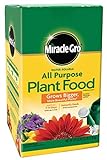
- FEEDS ALL PLANTS: Miracle-Gro Water Soluble All Purpose Plant Food is a plant fertilizer that feeds all outdoor, in-ground and indoor plants, including roses, flowers, houseplants, vegetables, and trees
- PROMOTES GROWTH: Use this all-purpose plant food outdoors and indoors to grow bigger, more beautiful plants (vs unfed plants); starts working instantly to promote quick, beautiful results
- NPK: 24-8-16 outdoor and indoor plant food contains Nitrogen (N), Phosphorus (P) and Potassium (K) which are key nutrients plants need to thrive
- APPLICATION: To use as plant food indoors, mix 1/2 tsp per gallon of water in a watering can; to feed outdoor plants, mix 1-1/2 tbsp per 1-1/2 gallon of water in any watering can or use with the Miracle-Gro Garden Feeder
- COVERAGE: One 3 lb. container of Miracle-Gro Water Soluble All Purpose Plant Food can be used as an outdoor and indoor plant food for houseplants, vegetables, flowers, trees, roses and more; feeds approximately 1,200 sq. ft. of garden area
Rank #3
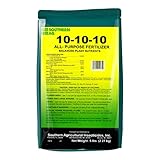
- Size: 5 LB
- Uniform, homogenous granular formulation .
- CONTAINS: 10% Nitrogen, 10% Phosphorus (P205), 10% Potassium (K20) plus minor elements .
- APPLICATION: Broadcast evenly over area and water in.
- For large quantity discount consideration or to request a mixed multi-pack, please message us.
Product prices and availability are accurate as of the date/time indicated and are subject to change. Any price and availability information displayed on Amazon at the time of purchase will apply.




