A hay moisture tester can make bale and baling decisions better informed, but it cannot make moisture uniform or guarantee safe storage. A handheld electronic probe gives a quick estimate; reliable decisions depend on representative readings, the hay and bale type, and the storage plan.
What a hay moisture tester tells you
Most handheld electronic testers estimate moisture by measuring electrical conductance or resistance between contacts on a probe and translating that signal into a percentage. The display is available quickly, making the tool useful for checking hay in the field or in bales. It is an estimate, not a laboratory measurement: readings can vary with bale density, crop texture, probe placement, dew, and wet or dry pockets.
Use the meter alongside inspection and handling, not instead of them. A result that conflicts with what the hay looks or feels like is a reason to sample again or cross-check, not to accept one source of evidence blindly.
How much moisture is appropriate?
There is no single cutoff that applies to every crop, bale format, and storage situation. Extension recommendations differ: Virginia Cooperative Extension’s November 2025 review gives 15%–18% as a general ideal moisture range at baling; Penn State Extension describes 14%–18% as ideal for the bale type to reduce overheating risk in storage; and University of Minnesota Extension gives 15%–20% as its optimum range for dry hay, recommending below 20% for dry storage. University of Florida IFAS states a 13%–15% target for hay. These are institutional recommendations with differing contexts, not results of one controlled comparison. See Virginia Cooperative Extension, Penn State Extension, University of Minnesota Extension, and University of Florida IFAS Extension for their guidance.
Free tools Windows power users keep installed
One-click scans. No signup required.
#1 Best Overall

- Deep Core Testing - 20" Reinforced Probe: Push the reinforced stainless steel probe into dense square or round hay bales to check moisture below the surface after baling, before storage, or before transport. Built for alfalfa, forage, mixed hay, and routine harvest-season checks
- Moisture & Temperature in One Meter: Reads hay moisture from 8% to 45% and temperature from 32°F to 210°F, helping you monitor bale conditions before moving hay into the barn, shed, trailer, or storage area
- Clear Readings in Farm Conditions: Backlit LCD display helps you read results during early morning work, inside darker barns, or out in the field. Large glove-friendly buttons support easy operation, while the 3-minute auto-shutoff helps save battery life between checks
- Calibration Clip Included: Use the included calibration clip to help verify readings before testing, with a reference value of 24.7% ±1.5%. Handy for quick checks on a truck tailgate, workbench, barn shelf, or near your hay storage area
- Farm-Ready Kit with Carry Bag: Includes the hay moisture tester with attached 20 inch probe, calibration clip, and carry bag for keeping the meter in your tractor cab, pickup truck, barn, or tool area. Powered by 1x 9V battery, not included
Too-wet hay can heat, mold, and lose dry matter; under some conditions, heating can create a fire hazard. Hay baled too dry can lose leaves and nutrients. Large, dense bales retain heat and moisture longer than smaller packages, so bale format and storage conditions matter. These ranges concern dry hay; baleage and silage use different moisture levels and preservation requirements.
Which testing method should you use?
| Method | What it does and how long it takes | Best use and limitation |
|---|---|---|
| Handheld electronic conductance probe | Measures electrical resistance or conductance at probe contacts; essentially immediate. | Fast spot checks. Readings vary with density, material, dew, placement, and location, so take multiple readings. |
| Baler-mounted electronic sensor | Estimates moisture continuously as the bale forms. | Helps track changes across a field, but can differ from a handheld tester and respond to density and windrow conditions. Treat it as a trend and decision aid; see the AgraTronix operator’s manual. |
| Heat-type tester | Uses the weight change of a known forage sample as it dries; Virginia Tech says a typical run takes 25–35 minutes. | Generally more accurate than an electronic conductance estimate, but slower and dependent on a representative sample and correct procedure. See Virginia Tech’s method guidance. |
| Microwave drying | Weighs a forage sample, dries it, and reweighs it until weight is constant; the cited Virginia Tech method takes about 20–30 minutes. | Useful as an on-farm check and more accurate than an electronic conductance estimate. Requires a scale, sample preparation, repeat weighing, and short heating intervals to avoid ignition. Follow the procedure in Virginia Tech’s guidance. |
| Hand or squeeze test | Uses touch to judge a handful of forage; immediate. | Free and quick, but crude and dependent on experience. It is not a substitute for measurement when moisture is borderline. |
For a handheld tester, choose a probe suited to the bale you need to sample, a display you can read, and a clear procedure for repeat readings and calibration checks. Check the maker’s stated forage and bale range. No particular model is assessed here.
Rank #2

- 20" Deep Probe for Bale Checks: Long metal probe helps reach deeper into round and square hay bales for internal moisture and temperature readings
- Monitor Stored Hay Conditions: Helps check moisture buildup and internal bale heat during routine storage and harvesting inspections
- Fast Backlit Readings: Displays moisture from 8%–45% and temperature from 32°F–210°F on a clear LCD screen for field use
- Built for Routine Farm Checks: Supports testing in multiple bale locations for more consistent field reference readings
- Calibration Clip Included: Includes calibration clip and auto power-off function for routine agricultural use and periodic checks
How to take useful readings
- Check the meter instructions. Follow the maker’s directions for calibration or checks, probe placement, and how long to hold the probe. Do not assume one meter is calibrated for every forage or bale configuration.
- Sample more than one location. Take readings from representative material rather than relying on one point. Moisture can vary across a bale or windrow; exposed surfaces and the center may differ. Virginia Tech notes that some electronic testers call for several readings and an average.
- Keep your technique consistent. Insert and hold the probe the same way each time. Nebraska Extension warns that wiggling the probe or changing its insertion angle changes the reading. Its guide to using hay moisture testers also stresses that experience helps interpret readings accurately.
- Record what may affect interpretation. Note crop species and texture, bale density, surface wetness or dew, and whether the hay has received a drying agent or preservative.
- Look for patterns and investigate outliers. A sudden rise in one section of the field may signal wetter material. Pause to inspect and resample that area rather than assuming either that the meter has failed or that the display is automatically correct.
- Cross-check consequential or conflicting results. If a decision has significant storage consequences, or the reading does not fit the physical condition of the hay, use a heat-type or microwave drying method with a representative sample and the correct procedure.
As Bruce Anderson, Extension Forage Specialist at the University of Nebraska–Lincoln, puts it: “With experience, you can interpret readings accurately and get the guidance you need.”
Independent reader supportYour contribution helps us test, update, and keep practical guides available for everyone.Make the decision for the bale and storage plan
Use local extension guidance and the tester’s manual to interpret a reading for the crop, bale size and density, humidity, and storage method involved. A meter helps reveal variation and identify material that deserves attention; it cannot prove that every part of a bale is at the same moisture or that storage will be safe.
Quick Recap
Best Value

- 【Professional Tester】Our TK100H portable hay moisture tester has a wide measurement range (0-80%) through the temperature and humidity compensation technology, high accuracy (±0.5%n), fast measurement speed (1 second), stable performance, convenient and efficient. hay moisture meter sensors quickly measure moisture deep inside the material. PLEASE NOTE that this product can operate at temperatures ranging from -10 to 60 degrees Celsius, but cannot measure temperature.
- 【Wonderful Use Experience】The backlit digital display provides accurate and clear readings even in dark environments. Our hay moisture tester probe have the freedom to choose between manual and automatic shutdown, which is important to maintain battery life and ensure reliable performance.
- 【Excellent Capability】This hay bale moisture tester is small, lightweight and includes a tote bag for easy carrying. With temperature and humidity compensation technology, this hay moisture probe has high measurement accuracy and good stability. The moisture measurement time is shortened, the entire operation process is less than 1 minute, and the measurement value is displayed in real time.
- 【Generally Applicable】Use this moisture meter for hay to detect the moisture mass of hay and quickly obtain an accurate percentage of water. Suitable for testing alfalfa, leymus, forage grass, orchard grass wolftail or other hay. If you're a rancher, farmer or hay producer, by using our hay moisture tester, you can effectively monitor and manage the humidity of your hay and improve the quality of your hay.
- 【Worry-Free Shopping】NOTE: Batteries are not included in the package, please forgive the inconvenience. Buy our TK100H hay tester probe, we have 7*24 hours after-sales service and half a year warranty. Any questions please contact us via "Order History" - "Contact Seller", we will solve your problem responsibly and give you a satisfactory answer.
Rank #4
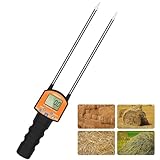
- 🌾 INSTANT & ACCURATE MOISTURE READINGS - Get precise hay moisture levels in seconds with ±0.5% accuracy and 0.1% resolution. Essential for preventing mold and spoilage in storage or transport.
- 🔋 LCD BACKLIT DISPLAY FOR LOW-LIGHT CONDITIONS - Bright digital screen with backlight ensures clear readings even in dim barns or warehouses—no guesswork needed during late-night checks.
- 🚜 COMPATIBLE WITH MULTIPLE HAY TYPES - Test alfalfa, leymus chinensis, orchard grass, straw, and more with specific calibration codes (CD0–CD3) for accurate results across different hay types.
- 📦 PORTABLE & EASY TO USE – AUTO POWER OFF - Lightweight and handheld with user-friendly controls. Insert the probes, press the button, and get readings. Auto shut-off saves battery during field use.
- 🌡️ SMART TECH WITH AUTO TEMPERATURE COMPENSATION - Advanced conductivity-based sensor with built-in temperature compensation ensures reliable results in varying weather or storage conditions.
Rank #3

- Probe Length: 20"
- Includes calibration clip
- Above and below moisture limit indications
- Illuminated LCD display
- Moisture range: 8% - 44%
Product prices and availability are accurate as of the date/time indicated and are subject to change. Any price and availability information displayed on Amazon at the time of purchase will apply.




