Recommended Free Tools
Freed’s reported 20,000 paying clinician users marked a notable milestone for a product that sells AI-assisted clinical documentation directly to clinicians and smaller practices. But that figure, reported in July 2025, was a company-reported snapshot—not an audited count of active users—and the market has since become more crowded. Freed’s website now claims more than 26,000 clinicians, while free, enterprise and EHR-integrated alternatives are competing for the same documentation work.
For a clinician weighing a subscription, or a practice deciding where to spend its software budget, the key question is no longer whether an AI tool can draft a note. It is whether the finished note saves time after review, fits the practice’s workflow, and meets its privacy and integration requirements at a price that makes sense.
As an Amazon Associate I earn from qualifying purchases.
What Freed’s 20,000-clinician figure actually means
On July 24, 2025, VentureBeat reported that Freed had reached 20,000 paying clinician users, citing a statement from CEO Erez Druk. That is a meaningful commercial milestone, but it should be read narrowly: it was a company-reported number of paying clinician users at that time. It does not establish that 20,000 clinicians were active every month or every day, nor that the users represented 20,000 separate organizations. VentureBeat’s July 2025 report also relayed Druk’s public claim of more than $20 million in annual recurring revenue in April 2025; that, too, was a company-reported figure, not independently audited financial disclosure.
Crashes, No Sound, or Screen Glitches?
Random freezes, missing sound and display glitches usually trace back to one bad driver. Find and replace yours safely.Free scan · under a minutePC Slower Than It Used to Be?
A free scan shows the junk files, broken settings and background clutter dragging Windows down - then fixes them in one click.Free scan · Windows 10 & 11Freed’s current website presents different scale indicators: more than 26,000 clinicians, more than 1,300 clinics and organizations, 32,589,627 patient visits transcribed in 2025, and 5.9 million hours returned to clinicians annually. These are first-party marketing claims. They do not, by themselves, establish active use, retention, revenue, or how the company calculated time returned. The site also uses more than one clinician-count formulation, so the figures should not be treated as directly comparable to the 2025 paying-user milestone. Freed’s homepage and clinician page state the current claims.
#1 Best Overall

- Optimized recording for professional dictation, speech recognition, and ambient voice recording. Supported by main speech recognition software solutions: software integration required to enjoy full PSM5000 Series functionality
- Four high-performance microphones for accurate speech recognition and ambient scribe documentation. Compact, wearable design for seamless stationary, mobile, and hands-free use
- Patented technology with speaker separation for natural, intelligible recordings. Including docking station and wireless adapter
- Plug-and-play backward compatibility with any application integrated with Philips SpeechMike dictation microphones. Supported by leading professional AI and speech recognition software solutions in the medical and legal arena
- All-day power with simple, flexible charging. Secure, encrypted communication with IT-compliant design for safe clinical use
The distinction matters for buyers and investors alike: paying users, registered users, active users, organizations, transcribed visits and annual recurring revenue measure different things. The available public figures indicate traction, but do not provide a complete view of usage or business performance.
What Freed does beyond transcription
Freed is an ambient documentation assistant, not simply a speech-to-text tool. In the workflow it describes, a clinician captures an encounter, the system transcribes and interprets the conversation, and it drafts a structured clinical note for the clinician to review and edit. Depending on the subscription and configuration, the clinician can also create coding suggestions, patient instructions, letters and referrals, and push content into an EHR. Freed lists specialty-specific and custom templates among its product capabilities. Its pricing page describes the plan features.
That distinction is important: a generated note is a draft, not an autonomous clinical decision or a substitute for the clinician’s documentation judgment. The clinician remains responsible for checking the content and finalizing the record.
Free tools Windows power users keep installed
One-click scans. No signup required.
Freed pricing: compare the billing basis and note limits
Freed’s pricing page displays both monthly and annual-billing price signals. The lower figures should not be assumed to be month-to-month prices. Its published plan descriptions include the following:
| Plan | Displayed price signals | Published features or limits |
|---|---|---|
| Starter | $39 per month with annual pricing shown; $59 monthly signal also displayed | One clinician; up to 40 notes per month |
| Core | $79 monthly; $59 annual-billing signal also displayed | Unlimited note generation, template builder and AI editing assistant |
| Premier | $119 monthly or $104 per month annually | EHR push, patient instructions, letters, referrals, coding and medical knowledge-base assistant |
| Groups | Custom | SSO, admin dashboards, onboarding, patient sharing and account management |
These are the price signals shown on Freed’s pricing page in the supplied 2026 commercial snapshot; confirm the live billing terms before purchasing, since the page displays more than one billing basis. A note cap can also change the effective cost: a clinician who regularly exceeds Starter’s 40 monthly notes needs to compare the cost of a higher tier against actual usage, rather than focusing only on the entry price. Check Freed’s current plan page for the offer and terms presented at checkout.
Rank #2
- Optimized recording for professional dictation, speech recognition, and ambient voice recording. Supported by main speech recognition software solutions: software integration required to enjoy full PSM5000 Series functionality
- Four high-performance microphones for accurate speech recognition and ambient scribe documentation. Compact, wearable design for seamless stationary, mobile, and hands-free use
- Patented technology with speaker separation for natural, intelligible recordings. Hygienic, low-maintenance design for safer handling and reduced operating costs
- Plug-and-play backward compatibility with any application integrated with Philips SpeechMike dictation microphones. Supported by leading professional AI and speech recognition software solutions in the medical and legal arena
- All-day power with simple, flexible charging. Secure, encrypted communication with IT-compliant design for safe clinical use
Freed’s pricing page says many clinicians report recovering five to 15 hours per week, while its clinician page cites users saving two or more hours per day. Those are company-site or user-reported outcomes, not guaranteed savings or controlled comparisons of Freed against other products. The time a particular clinician recovers depends on the amount of editing, encounter mix, audio, note style and how easily the draft reaches the EHR.
Why a self-serve product could appeal to clinicians
Freed’s model appears designed to make trial and purchase accessible without a health-system procurement process. Its public pricing, free-trial positioning, broad specialty coverage and template customization are relevant to independent clinicians and smaller practices that may not have dedicated IT staff. The product’s focus on clinical notes and related documents also offers more than raw transcription.
Those are plausible advantages of the product and its route to market, not proof that any one feature caused its adoption. A pricing page can show what the company sells; it cannot establish why clinicians subscribed, how many stayed, or whether the product performs equally well across specialties.
How the alternatives differ
“AI scribe” covers several kinds of tools. A free ambient note drafter, an enterprise platform deployed across a health system, a voice-command assistant and an EHR-native feature may all produce documentation, but they do not solve the same purchasing problem. The following comparison reflects the public positioning in the cited sources, not an independent product test.
| Option | Public price signal | Positioning and likely buyer | Key distinction to evaluate |
|---|---|---|---|
| Freed | Individual tiers display monthly and annual-billing signals; Groups is custom | Self-serve documentation for individual clinicians and smaller practices | Plan limits, templates, editing time and whether EHR push meets the practice’s needs |
| Doximity Scribe | Described by Doximity as free for eligible users | Verified U.S. clinicians already using or willing to use the Doximity platform | Eligibility, platform workflow, organizational approval and integration requirements |
| Abridge | Enterprise pricing not publicly listed in the cited material | Health systems seeking enterprise deployment and clinical workflow integration | Implementation, EHR integration, governance and system-wide support |
| DeepScribe | No reliable public individual price identified in the cited material | Specialty practices and organizations with complex documentation needs | Fit for the specialty and the implications of custom or enterprise purchasing |
| Suki | No reliable current official public price identified in the cited material | Organizations seeking voice commands and broader clinical workflow assistance | Whether pre-charting and workflow features are worth more than note drafting alone |
Doximity’s 2026 overview describes its own tool as free; eligibility and platform conditions still matter. Abridge presents itself as an enterprise clinical-intelligence platform and says it is trusted by more than 300 health systems, a vendor-reported figure. DeepScribe emphasizes specialty care and complex documentation. Suki describes a broader platform spanning pre-charting, documentation, clinical reasoning and partner integrations. Public positioning does not establish which product will be more accurate or less expensive for a given practice.
Rank #3

- | Comulytic AI Voice Recorder Notes Assistant | — Lifetime Free Starter Plan Comulytic Note Pro is a smart voice recorder, AI note taker, and AI recorder built for professionals, students, and journalists. One tap captures calls, interviews, lectures, and voice memos. Get Unlimited Transcription and Basic Summaries free on the Starter Plan (0/mo). Upgrade anytime to the optional Premium Plan to unlock Deep Dive Analysis, Ask Comulytic Assistant, and Contact Insight Hub (14.99/mo or $120/yr)
- Comulytic AI Recorder — Magnetic, Ultra-Slim, Always Ready This mini voice recorder is just 3 mm thin and slips into any pocket, notebook, or shirt. The 0.78-inch display is shielded by Corning Gorilla Glass, and the aluminum body feels premium in hand. Three magnetic accessories let you snap it to your phone, laptop, or meeting notebook — one tap and the AI starts recording. Pocket-sized power, office-quality sound
- Digital Voice Recorder with 10× Faster Wi-Fi Sync & 64GB Local Storage | Forget slow Bluetooth. Transfer recordings to the Comulytic app over Wi-Fi at up to 10× Bluetooth speed while you keep talking. 64GB of built-in storage holds thousands of hours of recordings, giving you room to record, review, and export files locally. Cloud sync and storage are available through the Comulytic app and depend on your plan
- AI Adaptive Recording with Triple-Mic Array, Noise Cancellation & 45-Hour Battery The AI note taker automatically detects calls, meetings, video conferences, and interviews — no manual mode switching. A triple-mic array with AI noise reduction captures every word clearly within 5 meters, even in a crowded room. 45 hours of continuous recording, 107 days of standby, and a full charge in just 90 minutes — built for back-to-back workdays
- AI Transcription — 98% Accurate, 113 Languages & Spanish Translator Built-In A vertical knowledge base (Insurance, Real Estate, Auto Sales, Financial Advisor, Lawyer, Headhunter, Consultant) captures industry terms precisely. The Comulytic app delivers fast transcription, AI summaries, action items, and to-do lists. Includes a real-time language translator device mode — a pocket traductor de idiomas and traductor de ingles espanol — for global travelers, ESL students, and bilingual pros
Why free distribution pressures standalone subscriptions
Doximity changes the comparison because it describes its ambient scribe as free for eligible clinicians in the United States and distributes it through an established physician platform. That can reset a buyer’s expectation for the price of basic note drafting and reduce reliance on standalone software marketing to reach clinicians. It does not make every paid product interchangeable with Doximity: eligibility, workflow, integration, support and a practice’s data requirements can be decisive.
Quick wins for a faster PC:
Scan for outdated or missing drivers - takes under a minuteDriver Scan →Repair Windows errors before they cause bigger problemsFix Now →The competitive pressure is strongest on the basic task—turning an encounter into a draft note. Paid vendors need to show value in the full workflow: better fit for a specialty, less time spent correcting the result, useful integrations, reliable support or governance features that a free tool does not provide for a particular buyer.
Enterprise and specialty platforms compete on a different layer
Large health systems may prioritize features that an individual clinician buying a monthly subscription does not need: EHR write-back, identity and access management, implementation support, analytics, procurement review and organization-wide controls. Abridge says it processes more than 100 million conversations annually and serves more than 300 health systems; these are Abridge’s own reported figures, not independently verified market-share data. Its pitch centers on enterprise deployment, integration, clinical context and multilingual support.
DeepScribe’s specialty focus addresses the possibility that one broad note workflow will not fit every clinical setting. Suki’s voice-assistant and broader workflow positioning may matter to organizations seeking more than encounter documentation. The long-term competitive threat to a standalone scribe also includes EHR-native tools: when documentation is built into the system clinicians already use, fewer handoffs and existing procurement relationships can matter as much as note-generation quality.
For a health system, therefore, a low individual list price is not a sufficient comparison with an enterprise contract. Implementation, security review, integrations and support are separate parts of the purchasing decision; the available cited material does not establish comparable contract prices for these vendors.
The Tool Desk
Outbyte Driver Updater FREEFix the driver behind crashes, sound loss and screen glitchesFind Drivers →Outbyte PC Repair FREEClear out junk files and repair common Windows errorsFree Scan →Rank #4

- [AI Smart Recorder for Work & Study] The AI voice recorder is ideal for meetings, interviews, lectures, and study sessions. Powered by advanced AI models, the app offers highly accurate transcription, smart summaries, and AI-generated mind maps to boost productivity. With the "Ask AI" feature, you can analyze recordings, identify key points, and gain actionable insights. Transcribe and summarize in 90+ languages, and translate conversations in real time across 91 languages to communicate more easily in international meetings, academic research, and cross-cultural settings.
- [Simple One-Touch Operation] Voice Recorder makes operation effortless — simply slide the power switch and press the red button, and recording starts in a split second. Press the same button again to save your file instantly with a time-stamped name, so you can capture important details during busy moments. For review, use A-B repeat and variable speed playback without distortion. Time-slot recording and voice activation are available in a clean, intuitive menu. Transfer files quickly via Boean app or USB-C for secure, hassle-free management.
- [Long Battery & Massive Storage] Operate this long-lasting portable recording device continuously for 30 hours on one charge and store up to 4700 hours of audio. Capture professional meetings, college lectures, field research, or interviews without battery and storage anxiety. Power-optimized for travelers and high-volume users. (Note: Bluetooth for file transfer, no Wi-Fi needed for recording)
- [Dual Mic Clear Voice Capture] Built with dual high-sensitivity microphones and AI noise reduction, AI voice recorder captures voices from 360°. Voice-activated recording starts when people speak and pauses during silence, helping reduce unnecessary storage usage.
- [Password Protection & Cloud Protection] The AI note taker keeps your recordings secure with the built-in password lock. Your private files stay protected even if the recording device is lost. With in-app access-controlled cloud storage, your cloud files remain private, secure, and fully under your control.
Accuracy, privacy and the review burden
Ambient tools can omit or misstate clinically important details, including medication names, dosages, laterality, dates and negations. They can misattribute a statement, blur patient history and clinician assessment, or include background conversation. Accents, multiple speakers, noisy rooms and poor microphones can make errors more likely; a verbose draft can create a different kind of burden by requiring extensive editing. Coding suggestions also need review.
A 2026 Berkeley technical report describes the prevailing workflow as clinicians reviewing and editing AI-generated notes, reinforcing that automation does not remove human oversight. Broader research on ambient documentation can inform expectations about the category, but it is not evidence that Freed itself will save a particular user time or produce a particular level of accuracy. Berkeley’s 2026 report and the npj Digital Medicine research provide context on ambient-scribe workflows and documentation.
Freed says it does not store patient recordings and describes its platform as HIPAA-compliant, SOC 2 Type II certified and HITECH-compliant. These are vendor claims; compliance statements do not establish clinical accuracy, legal immunity, or suitability for every organization. Before use, a practice should confirm the vendor’s current terms for audio, transcripts, prompts and generated notes, including retention, deletion, model training and other secondary use. It should also confirm whether the vendor will sign the required business associate agreement and what consent or notification process applies to its patient population and jurisdiction. Freed’s clinician page states its security and recording-retention claims.
An AAFP Graham Center comparison of AI scribes highlights that products differ in cost, integration, data retention, note quality and coding support. Those differences make vendor-specific policy review more useful than relying on a broad “HIPAA-compliant” label alone. The AAFP comparison is a useful framework, though its publication date means buyers should verify current commercial terms directly.
How to decide whether Freed is worth the subscription
A short pilot with the clinician’s real visits and EHR workflow is more informative than a generic accuracy claim. Evaluate the completed note, including the editing and transfer steps, rather than the transcript alone.
Best Value
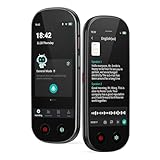
- 【Real-Time Voice-to-Text】The HUREWA AI voice recorder features advanced free voice-to-text (no time limit), supporting 13 major languages. Users can generate summaries from transcribed content and quickly export them as files, saving up to 80% of text organization time. Additionally, it includes translation capabilities. The AI voice recorder transcriber greatly boosts efficiency for students, professionals and travelers
- 【Clear Sound & Intelligent Experience】The dual-silicon microphone design, combined with intelligent noise reduction technology, effectively filters out ambient noise and precisely captures human voices, achieving a 95% transcription accuracy rate. In online recording mode, the digital voice recorder with transcription automatically identifies different speakers and allows picture insertion to link audio with visuals for more intuitive records
- 【User-Friendly & Powerful Performance】4.1-inch HD touchscreen for smooth operation, retaining traditional physical buttons to meet diverse needs. Built-in 1500mAh battery supports 5-7 hours of continuous recording. Equipped with 16GB internal storage and 64GB expandable storage capacity, capable of recording up to 300 hours of audio. The entire recording device runs smoothly without lag, delivering a worry-free user experience
- 【Break Down Language Barriers】The AI voice recorder with transcription supports real-time two-way translation(134 online, 15 offline languages) , covering most countries and regions around the world. It has a built-in 5-megapixel rear camera, supporting AI photo translation of 71 online languages and 12 offline languages. This feature perfectly meets all cross-language communication needs
- 【Multi-Layered Privacy Protection】Log in with your email to upload audio files to isolated cloud storage—all data processing needs user authorization. Claim 5GB cloud storage manually on first login, extra space requires subscription. The digital recorder supports local data encryption, once activated, a password is needed to access files via USB connection to computers or other devices
- Measure time after review. Compare the full documentation process with the existing workflow, including corrections, coding review and getting the final note into the record.
- Test representative encounters. Include the specialty, visit types, languages, accents, speaker patterns and audio conditions the practice actually handles.
- Check the EHR path. Determine whether the plan supports the needed push integration or whether staff must copy and paste. Confirm who is responsible for catching transfer errors.
- Price the actual volume. Compare the clinician’s monthly note count with plan caps and billing terms. Consider whether letters, referrals, instructions or coding tools replace other paid work in the practice.
- Review governance before recording patients. Confirm the BAA, consent process, retention and deletion rules, model-training terms, permissions and organizational approval.
- Set a quality threshold and stop rule. Decide in advance which errors are unacceptable and how much editing time would make the tool no longer worthwhile.
The AAFP comparison lists Freed alongside Nabla, Heidi, DeepScribe and other platforms, but product prices, retention policies and integrations can change; treat it as a comparison framework, not a current quote sheet.
Who Freed may suit—and who may need another approach
Freed is a plausible option for an independent clinician or small practice that wants public individual pricing, specialty templates, quick onboarding and documentation outputs beyond transcription. It is less compelling when a clinician sees too few patients to recover the subscription cost, prefers conventional dictation, or must manually move every note through an EHR workflow that adds more work than the draft saves.
A larger organization may prefer an enterprise platform or an EHR-native option if it requires deeper integration, centralized governance, analytics and implementation support. A specialty-heavy practice should test performance on its own complex encounters rather than assume broad specialty availability guarantees a good fit. For some high-complexity or high-liability documentation, a human scribe or transcription workflow may remain preferable.
The category is becoming harder to differentiate on transcription alone. Freed’s traction suggests clinicians will pay for an accessible documentation product, but its sustained advantage depends on the parts around the transcript: note quality after editing, specialty fit, trustworthy data practices and integration into the work clinicians already do.
Quick Recap
Product prices and availability are accurate as of the date/time indicated and are subject to change. Any price and availability information displayed on Amazon at the time of purchase will apply.




