Outdated Drivers Are Slowing You Down
One free scan finds every outdated or missing driver and matches the right update for your exact hardware.Free scan · exact hardware matchPC Slower Than It Used to Be?
A free scan shows the junk files, broken settings and background clutter dragging Windows down - then fixes them in one click.Free scan · Windows 10 & 11Earthmover is building managed infrastructure for large, multidimensional weather, climate and geospatial datasets. Its comparison with Snowflake describes an ambition—make difficult data easier to organize, update, govern and serve—not a claim that it is a general-purpose data warehouse or has reached Snowflake’s scale. For investors and technology buyers, the business question is whether organizations will pay for that specialized layer rather than assemble one themselves.
What Earthmover is trying to sell
Weather and Earth-observation data increasingly informs decisions in insurance, energy, risk analysis and machine learning. But the raw material is awkward to operate: it may arrive as enormous collections of files, change with each forecast run or new observation, and need to be queried by location, time, altitude, variable or model ensemble. A user often needs a small slice of a large dataset, not a download of the whole archive.
Earthmover’s thesis is that organizations should not each have to build their own systems for indexing, versioning, access control and delivery. The company packages those functions around scientific data formats and workflows. It describes its broader ambition as becoming a data layer for scientific AI, while weather, climate and geospatial data remain central to its positioning (Earthmover).
TechCrunch reported that typical customers had datasets in the tens to hundreds of terabytes. Earthmover’s website has also described a wildfire-risk modeling workload involving more than 130 TB; that is a company case-study figure, not a typical customer benchmark (TechCrunch; Earthmover).
#1 Best Overall
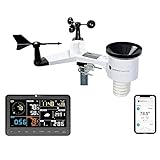
- COMPLETE WEATHER STATION: (1) Osprey Sensor Array with Rain Cup, and (1) Brilliant, Easy-to-Read LCD Color Display
- AUTHENTIC HYPER-LOCAL DATA: Monitor your actual home and backyard weather conditions with our wireless and Wi-Fi-enabled sensor array measuring wind speed/direction, temperature, humidity, rainfall, UV intensity, and solar radiation
- SMART HOME READY: Set up alerts, access your data remotely, and program your home based on weather conditions using IFTT, Google Home, Alexa, and more
- ENHANCED WIFI: Enables your station to transmit its data wirelessly to the world's largest personal weather station network (optional setting)
- JOIN THE COMMUNITY: Connect to Ambient Weather Network to customize your dashboard tiles, share hyperlocal weather conditions via social feeds and create your own forecasts (coming soon)
Why the Snowflake analogy fits—and where it breaks
The analogy is about abstraction. Snowflake helped businesses manage and analyze conventional enterprise data through a cloud platform rather than building every part of the warehouse themselves. Earthmover wants to simplify comparable infrastructure work for data that is naturally represented as multidimensional arrays rather than ordinary rows and columns.
A forecast dataset, for example, can have dimensions for initialization time, valid time, latitude, longitude, pressure level, weather variable, model run and ensemble member. Teams need storage layouts that support spatial-temporal slices, metadata that preserves coordinate meaning, and workflows that handle repeated updates. The problem is not merely storing files; it is making the right portion discoverable, consistent and usable across scientific Python tools, APIs, dashboards and machine-learning pipelines.
Earthmover’s founders have argued that conventional data-stack tools are primarily designed around tables, while scientific datasets are often labeled multidimensional arrays (Earthmover’s founding explanation). That is a fit-and-optimization argument, not proof that warehouses or lakehouses cannot handle geospatial workloads. General-purpose platforms may still work, but can require conversion, custom layouts or additional services.
So the more precise description is a specialized data-cloud layer for scientific and physical-world data. The Snowflake comparison should not lead buyers to assume SQL-first workflows, identical economics, broad warehouse functionality or comparable commercial maturity.
Do these 3 things before closing this tab:
1Fix the driver behind crashes, sound loss and screen glitches2Repair Windows errors before they cause bigger problems3Scan for outdated or missing drivers - takes under a minuteHow the product stack works
Earthmover’s commercial platform centers on Arraylake for cataloging and management, and Flux for query and delivery. It is built around open scientific-data tooling, particularly Zarr and Icechunk, and connects to the wider Xarray and Pangeo ecosystem.
A simplified flow is: GRIB, NetCDF, HDF, TIFF or Zarr sources → cataloging and version management → customer-owned or managed storage → query and API access → analysts, applications and ML systems. Earthmover lists zero-copy ingestion for those source formats (platform capabilities). Zero-copy means existing data may be used without copying it into a new storage system; it does not mean there is no indexing, metadata work, network transfer, compute or cost.
Rank #2

- [Color LCD Screen Weather Station] Newentor temperature & humidity monitor with a large color LCD display shows essential home weather information at a glance: indoor/outdoor temperature & humidity, daily high/low records, customizable alerts, time/date, alarm clock & snooze, weather forecast, moon phase, and barometric pressure.
- [Two Power Modes & Adjustable Backlight] To enjoy a 24/7 continuous always-on vibrant display, simply connect this home weather station to a wall outlet using the included DC power adapter. When operating on battery power only (batteries not included), the digital thermometer automatically enters an eco-energy-saving mode, where the screen lights up for a quick 15-second glance before dimming. It is the perfect bedside or living room clock designed to fit your power preference.
- [3-channel Home Weather Stations Wireless Indoor Outdoor] Wireless temperature forecast station supports up to 3 remote sensors to monitor inside outside temperature & humidity of multiple locations. Package contains one remote sensor.
- [Wireless Forecast Station] The weather forecast station calculates the weather forecast for the next 12-24 hours, 7 to 10 days calibration ensures an accurate personal forecast for your location.
- [Wireless Weather Station with Atomic Time&Date] Atomic alarm clock weather station can be used not only as a wireless indoor outdoor thermometer but also as an atomic clock with dual alarms.
Zarr: chunked arrays for cloud access
Zarr is an open format and software ecosystem for chunked, compressed multidimensional arrays. Instead of requiring a user to fetch an entire large file, chunking can support reading only the relevant portions from object storage. Zarr is closely associated with Xarray, which provides labeled data structures familiar to many scientific Python users, and with the Pangeo ecosystem. Earthmover says its team helps maintain Zarr and describes adoption across organizations and projects including NOAA, NASA-related work, NVIDIA, Google and Microsoft; that is the company’s characterization of ecosystem use, not a uniform claim that each organization runs Earthmover’s product (Earthmover open source; Earthmover platform).
Icechunk: versioning and transactional updates
Icechunk is Earthmover’s open-source transactional storage engine for Zarr data. Transactional behavior matters when forecasts and observations are updated repeatedly: concurrent writes, incomplete ingestion or corrections can otherwise leave users with inconsistent data. Versioning can help teams preserve reproducible snapshots, compare changes and roll back to earlier states.
Earthmover describes Icechunk as supporting version control and seamless updating for weather and geospatial workflows. Its performance claims should be treated as company claims unless accompanied by a benchmark methodology and independent testing (Earthmover open source).
Arraylake: catalog, governance and storage management
Arraylake is the management layer for organizing array-based assets, metadata, access permissions and versioned references. Earthmover says data can remain in a customer’s own cloud bucket or on-premises S3-compatible storage, or use Earthmover-managed storage. In the architecture described on its getting-started page, platform services run in Earthmover’s cloud while customer data can remain in the customer’s environment (deployment and pricing details).
Flux: querying and delivery
Flux is the access and delivery layer. Earthmover lists OGC API—specifically EDR—OPeNDAP, WMS and direct Xarray interaction among supported paths (platform capabilities). These interfaces can make subsets and data products available to applications or users without requiring each consumer to manage the source archive. Protocol support is not automatic interoperability: applications may still need to handle authentication, coordinate conventions, variable names, units, missing values and rate limits.
Why Earthmover leaned toward weather
Earthmover began with a broader climate and Earth-observation focus, then emphasized data that changes frequently. TechCrunch reported the strategic shift toward weather and other rapidly changing data. Forecast runs, wildfire conditions, satellite feeds and new observations create operational demands around ingestion, updates and timely access that can be more immediate than those associated with relatively static climate outputs (TechCrunch).
Quick wins for a faster PC:
Clear out junk files and repair common Windows errorsFree Scan →Fix the driver behind crashes, sound loss and screen glitchesFind Drivers →Repair Windows errors before they cause bigger problemsFix Now →Rank #3
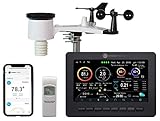
- Allows you to monitor your home and backyard weather conditions with TFT color display
- Wireless all-in-one integrated sensor array measures wind speed/direction, temperature, humidity, rainfall, UV and solar radiation
- Supports both imperial and metric units of measure with calibration available
- Enhanced Wi-Fi connectability option that enables your station to transmit its data wirelessly to the world's largest personal weather station network
- Console power provided by 5V DC adapter (included), and sensor array requires 3 x AAA batteries (not included)
That focus also creates a commercial hypothesis: when a business decision depends on fresh weather information, the cost of maintaining reliable pipelines may be easier to justify. The data platform can make information easier to access, but it does not by itself improve forecast accuracy, scientific validity or downstream model performance.
Who uses it, and what traction is established
TechCrunch reported more than ten paying customers in September 2025 and named Kettle, an insurance startup using the platform for wildfire-risk work, and RWE, a multinational energy company. Earthmover also promotes Eoliann in connection with physical climate-risk modeling and NASA-related work around Icechunk and cloud data access on its site (TechCrunch; Earthmover).
These examples show that the product addresses relevant workloads; they do not establish recurring revenue, retention, expansion, profitability or broad product-market fit. A customer case study, technical collaboration and paying commercial deployment are different kinds of evidence.
In September 2025, Earthmover announced a $7.2 million seed round led by Lowercarbon Capital, with participation from Costanoa Ventures and Preston-Werner Ventures. The company had previously announced a $1.7 million pre-seed led by Costanoa (Business Wire; TechCrunch). Funding supports product development and sales, but by itself says little about the company’s unit economics or durable demand.
What’s actually slowing this PC down?
Pick the symptom - the matching free tool is one click away.
The open-source strategy: adoption and tension
Earthmover’s use of Zarr and Icechunk and its connection to Xarray and Pangeo give technical teams familiar formats and a route to work outside a single hosted service. This can reduce migration risk and help a platform fit into existing scientific workflows. Icechunk is available as open-source software, while the commercial platform supplies management, governance and managed delivery (Earthmover open source).
Open formats do not eliminate lock-in. Customers may still rely on Earthmover-specific catalog metadata, APIs, permission settings, integrations, hosted services and operational support. Moving away can involve data transfer, application changes and compatibility work. The business challenge is also clear: open-source adoption creates credibility and a potential user base, but does not guarantee that users will pay for the managed layer; other vendors can build on the same components.
Rank #4
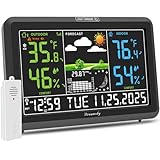
- Illuminated Indoor Outdoor Weather Station for Home with Large Colorful Display: The home weather station delivers large big numbers for weather forecast info, indoor outdoor temperature, atomic time, date, year and calendar day, which is super easy to read from afar.
- Indoor outdoor Thermometer Wireless with High/Low Temperature Alert: The digital weather station supports 3 outdoor sensors which helps to monitor temperature and humidity of multiple locations (one sensor included). With the high/low temperature alert function, the weather station clock keeps you informed about the changes of weather thermometer outdoor.
- WWVB Atomic Weather Station with Auto DST: Weather atomic clock with indoor/outdoor temp always keeps precise time and date by receiving the WWVB atomic signal. The self setting digital weather clock will automatically adjust to daylight saving time with auto DST feature, no more resetting twice a year.
- Personal Weather Forecast Station: This weather stations wireless indoor outdoor predicts the next 12-24 hours weather condition with a 7-day calibration through the pressure of your location which provides you a better outing experience.
- 5 Level Adjustable Backlight Brightness: The weather clock indoor outdoor temperature atomic with backlight dimmer function helps you avoid high-intensity light that disturb your sleep and easily check the weather situation during the day.
The Data Marketplace is a separate bet
Announced in January 2026, Earthmover’s Data Marketplace is intended to let providers offer open or proprietary weather and climate datasets with their own pricing, licensing and service-level terms, while giving buyers access to analysis-ready products. The stated motivation is that organizations often ingest and transform the same large GRIB or NetCDF archives independently (marketplace announcement).
The marketplace could complement the infrastructure business by connecting data providers and users, but its announcement does not establish how many datasets or providers are active, whether buyers are transacting at scale, how fees work, or how quality and service commitments are enforced. Those questions matter because a marketplace needs both useful supply and repeat buyer demand; a catalog alone does not prove liquidity or revenue.
The Tool Desk
Outbyte Driver Updater FREEFix the driver behind crashes, sound loss and screen glitchesFind Drivers →Outbyte PC Repair FREEClear out junk files and repair common Windows errorsFree Scan →What a buyer should evaluate
Earthmover is most plausible when the data is large, multidimensional, spatially or temporally indexed, repeatedly updated and used by multiple scientific, analytics or ML systems. It is less compelling for small or infrequently accessed collections, ordinary relational reporting, transactional applications, or one-off analysis that a team can handle with existing tools.
- Data and access pattern: Test real workloads such as spatial subsets, time windows, forecast-run selection, aggregation, backtesting and model-training reads—not just a demonstration against a sample dataset.
- Reproducibility and governance: Verify versioning, lineage, permission granularity, audit records, retention, rollback and immutable references for the data products that must be reproducible.
- Ingestion edge cases: Ask how partial writes, failed ingestion, late-arriving data, duplicate runs and historical corrections are handled, and how metadata stays consistent.
- Deployment constraints: Confirm supported regions, cloud compatibility, on-premises needs, data residency, customer-managed encryption, network design, disaster recovery and contractual availability commitments. Earthmover’s FAQ describes the Arraylake backend as deployed in AWS US-East-1 and says multi-region and multi-cloud Flux deployment is on the roadmap; this is a company-published, time-sensitive statement (Earthmover getting started).
- Total cost: Model platform charges alongside storage, requests, compute, egress, transformations and engineering labor. A managed platform may cost more than raw object storage while costing less than building and maintaining the full stack; the answer depends on usage.
- Rights and provenance: Check licenses for proprietary data, derivative products, redistribution and model training. Open formats do not change the legal terms attached to a dataset.
Pricing and the commercial trade-off
Earthmover does not publish a standard price list in the cited official material. Its getting-started page describes Arraylake as a monthly platform fee based on factors including team size, deployment configuration and enterprise integrations, while Flux pricing is usage-based on the volume of data queried. The company says it offers tailored proposals and discounts for nonprofits, academic users and small startups; it advertises no current free tier, though prospective customers can request an evaluation or trial (Earthmover pricing and evaluation).
This makes workload-specific pricing essential. A buyer should compare the invoice with the cost of object storage, cloud compute and transfer, plus the labor and risk of operating ingestion pipelines, catalogs, APIs and security. A small workload may be cheaper to self-manage; a large production system can make engineering time and reliability worth paying for.
Alternatives and the test of the business
Earthmover competes with approaches as much as with named vendors. Teams can build a self-managed stack from object storage, Zarr, Xarray, Icechunk, Dask, Pangeo, a catalog and custom APIs. That offers control, but the organization owns deployment, monitoring, governance, upgrades and incident response. A general-purpose warehouse or lakehouse offers mature enterprise integration but may require extra work for multidimensional access. Direct weather-data providers are a better fit when the main need is licensed forecasts or observations rather than infrastructure. Public cloud datasets can reduce data acquisition cost while leaving cataloging, versioning and production delivery to the user.
Free tools Windows power users keep installed
One-click scans. No signup required.
Earthmover’s commercial case depends on whether it can turn open-source credibility into recurring platform revenue, operate reliably for production workloads, make cloud costs predictable, and support customers’ security and regional requirements. It must also show that its marketplace and managed platform add value beyond cloud-provider catalogs and specialized data vendors. The available public evidence establishes product positioning and early customer traction, not long-term retention, gross margins or marketplace scale.
Quick Recap
Product prices and availability are accurate as of the date/time indicated and are subject to change. Any price and availability information displayed on Amazon at the time of purchase will apply.




