Quick wins for a faster PC:
Fix the driver behind crashes, sound loss and screen glitchesFind Drivers →Repair Windows errors before they cause bigger problemsFix Now →China’s leverage over rare earths, gallium and germanium comes from its place across supply chains—not just from mining. In 2024, China produced about 99% of the world’s primary gallium and 71% of mined rare earths, while it made 94% of sintered permanent magnets, according to the U.S. Geological Survey and the International Energy Agency. Gallium and germanium are not rare-earth elements; they are strategic minor metals whose concentrated supply chains face similar geopolitical risks.
China’s controls have changed over time: licensing for specified gallium and germanium products began in 2023, a U.S.-specific prohibition followed in December 2024, and rare-earth controls broadened in 2025. The controls create the power to delay or deny shipments, but a control is not automatically a worldwide embargo or an immediate shortage.
As an Amazon Associate I earn from qualifying purchases.
What are rare earths, gallium and germanium?
These materials are often discussed together because of their strategic importance and concentrated supply chains, not because they belong to the same chemical category.
The Tool Desk
Outbyte PC Repair FREEClear out junk files and repair common Windows errorsFree Scan →Outbyte Driver Updater FREEFix the driver behind crashes, sound loss and screen glitchesFind Drivers →| Material | What it is | Important uses | Supply-chain feature |
|---|---|---|---|
| Gallium | A minor metal recovered mainly as a byproduct of bauxite processing, and to a lesser extent zinc processing. | Gallium arsenide and gallium nitride semiconductors, radio-frequency and power electronics, LEDs, laser diodes, and some defense and aerospace systems. | Output depends largely on processing other materials, so new supply cannot be turned on simply by opening a gallium mine. |
| Germanium | A minor metal recovered mainly as a byproduct of zinc processing, as well as from coal-related residues and recycling. | Fiber-optic systems, infrared optics, semiconductor wafers, space solar cells and radiation detectors. | Recovery and refining capacity, along with application-specific substitution limits, constrain alternatives. The USGS Mineral Commodity Summaries 2026 describes these U.S. end uses. |
| Rare-earth elements | A group of 17 elements: the lanthanides, plus scandium and yttrium. | Permanent magnets, catalysts, batteries, displays, lasers and defense systems. | Mining is only one stage; separation, refining, alloying and magnet manufacture are also essential. |
Calling gallium or germanium a rare earth is incorrect. All three categories are commonly treated as critical or strategic materials, but their geology, production routes and end uses differ.
#1 Best Overall

- Assorted Multi‑Size Magnet Set for DIY & Craft Projects: This kit comes with a nice variety of magnet sizes to meet your different hobby‑project needs. Multiple sizes in one pack, convenient for crafts, handmade ornaments, 3D‑print accessories and small DIY modifications. Ideal choice if you need assorted small‑size magnets for light‑duty work
- Comes with Handy Storage Organizer Case: All magnets are stored in a reusable plastic case for easy classification and storage. Keep different‑size magnets organized, reduce unintended violent snapping‑together between magnets, help prevent chipping and loss during storage
- Good Performance for Light‑Weight Applications: Magnets attract strongly to each other. Suitable for holding paper, photos and lightweight decorations on ordinary steel metal surfaces. Note: magnet‑to‑metal holding power is weaker than magnet‑to‑magnet attraction. NOT for heavy‑duty hanging jobs
- Economical Value Pack for Hobby Users: Cost‑effective assorted magnet pack with sufficient quantity. Perfect for casual crafters, makers, science‑experiment use and household light‑duty use. Please note these are small‑dimension magnets; refer to product images and size chart for exact dimensions before purchasing
- Important Usage Reminder: Neodymium magnets are brittle. Do NOT allow magnets of different sizes to snap violently together, as impact may cause chipping or cracking. Keep away from pacemakers and electronic screens. Not suitable for small children without adult supervision. Not recommended for stainless‑steel / glass refrigerator doors.The magnetic flux of our product is below 50 kG²/mm²
Where is China’s leverage in the supply chain?
A mineral supply chain runs from extraction through the production of usable components. China is important at several points, and the balance differs by material.
- Mining and extraction: China accounted for approximately 99% of global primary gallium production and 71% of mined rare-earth production in 2024, according to the USGS.
- Conversion and refining: Ore and industrial residues must be processed into separated compounds and usable metals. A USGS supply-chain assessment put China’s share of refined germanium production at about 77% in 2023 and estimated that China supplied around 68% of global rare-earth compound and metal exports, based on 2020–2023 trade data. See the USGS assessment.
- Alloys and finished components: China accounted for 94% of global sintered permanent-magnet production in 2024, according to the IEA. These magnets are used in electric vehicles, wind turbines, robotics, electronics and defense systems.
Mining shares alone therefore do not show how difficult it would be to replace Chinese supply. A country can mine rare earths and still rely on China for separation, alloying or magnets. Technical expertise, industrial clusters, environmental permitting and established customer qualification all make midstream and downstream capacity hard to reproduce quickly.
What has China restricted, and when?
The legal form and scope of the controls matter. A licensing requirement is not the same as a destination-specific prohibition, and neither should be described as a worldwide ban unless the rules actually establish one.
What’s actually slowing this PC down?
Pick the symptom - the matching free tool is one click away.
Rank #2
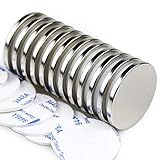
- Magnets Coated - Ni+Cu+Ni Triple Layer Coated. The Best Coating Available, which Provides a Shiny and Rust Resistant Protection for the Magnets.
- Strong Rare Earth Magnets - Made from Strong Magnetic Material, these magnets offer concentrated and durable magnetic force. Perfect for securing photos, lists, and tools—ideal for home displays, workspace organization, and creative projects.
- Magnets Dimensions - Diameter 32mm x Thick 3mm (approx. 1.26" x 0.126" ). Tolerances: 0.2mm x 0.2mm.
- Diy Projects & Science Experiments - Refrigerator Magnets, Shower Door, Work or Office, Scientific Purposes, Arts and Crafts or School Classroom.
- Multi Use - This super strong neodymium disc magnet with Epoxy Coating is made of rare earth materials, which has the powerful ability to attract all kinds of iron materials. With our free double-sided adhesive tape, it can be applied to almost all kinds of scenes in life,example for Refrigerator Magnets, DIY,Shower Door, Work or Office, Scientific Purposes, Arts and Crafts or School Classroom,etc.
- July 2023 — gallium and germanium licensing: China required export licenses for specified gallium- and germanium-related items. Exporters must provide details including the importer, end user, intended use and relevant contracts. The measure was a licensing regime, not a blanket global ban. The USGS review discusses the controls and their effects.
- December 3, 2024 — prohibition aimed at the United States: China prohibited exports to the United States of certain dual-use items related to gallium, germanium, antimony and specified superhard materials in principle. This was distinct from the earlier licensing requirement. The USGS China overview summarizes the measure.
- April 4, 2025 — specified rare-earth items: China imposed controls on items involving samarium, gadolinium, terbium, dysprosium, lutetium, scandium and yttrium. The specified products include metals, compounds, oxides, targets, alloys and permanent-magnet materials. See China’s Ministry of Commerce announcement.
- October–November 2025 — broader rare-earth controls and suspension: China announced broader controls covering additional elements, processing technologies and some products made outside China that contain Chinese-origin rare-earth materials or were produced using Chinese technology. The IEA says these October measures were suspended for one year in November 2025.
- January 2026 — controls affecting Japan: China tightened dual-use export controls affecting Japan, according to the IEA, indicating that the wider policy framework remained active even as the broader October 2025 measures were suspended.
The IEA’s account describes the later rare-earth measures and their status. As of August 18, 2026, the suspension does not mean that licensing risk or supply-chain concentration has disappeared.
Why can limited quantities matter so much?
Gallium, germanium and rare earths are used in specialized parts of larger products. Their share of a product’s mass or cost can be small, but a missing input can hold up a component that is difficult to redesign or qualify with another material.
- Substitution takes engineering work: Another material may work in a new design or a particular application without being a drop-in replacement for an existing, qualified component.
- Byproduct supply responds slowly: Gallium and germanium output depends on bauxite and zinc processing and the recovery of residues. A price increase may not make it economic to produce more if the host-material process does not expand.
- Qualification takes time: Buyers may need to test alternative suppliers’ materials for purity, reliability and performance before using them in production.
- Inventories can obscure the risk: Corporate and government stocks may bridge a temporary disruption. Once they fall, the shortage can become more visible if alternative processing capacity is limited.
- Licenses create uncertainty even when shipments continue: Delays, denials, paperwork, higher prices and uncertain delivery schedules can disrupt planning without stopping every shipment.
The relevant business risk is not only whether material exists somewhere; it is whether a company can secure a predictable quantity and specification in time for production.
Rank #3

- 【6 Different Size 】- Total of 255 Pcs can meet a variety of needs(3mm X 2mm X 88Pcs, 8mm X 2mm 70Pcs, 10mm X 2mm X 50Pcs, 12mm X 2mmX 25Pcs, 15mm X 2mm X 20Pcs, 32mm X 2mm X 2Pcs )
- 【Scratch-free Technology】- Each of our super strong neodymium magnets has a smooth surface, which can be easily removed without leaving scratches on your refrigerator or office board. Do not worry it might scratch the fridge or your new table anymore. Ideal as dry erase board magnets, push pins magnets, white board magnets, map magnets, note or photo walls, crafts, DIY materials, etc.The magnetic flux of our product is below 50 kG²/mm²
- 【High Quality Epoxy Coated Magnets】- The heavy duty disc magnets are made of brushed nickel silver finishing material, High Quality materials, more anti-corrosion and anti-oxidation effect compared with traditional silver magnets, which makes it perfectly meet your needs and have a longer service life
- 【Unlimited Uses】- You can use the small crafts magnets when displaying photos, greeting cards working session papers as an aid. Also can help storage things or fixate items like charging cables, fountain pens and sticky notes. The small fridge magnets are super useful for home and office
- 【Professional Brand】- We are professional Refrigerator Magnets Seller and you can find any magnets you want in our store. Any question please contact us freely. Give full play to your imagination, Try Magnets, Try everything!
How exposed is the United States?
Import reliance and imports directly from China are different measures. For 2024, the USGS estimated that the United States was 100% import-reliant for gallium, approximately 50% import-reliant for germanium, and approximately 80% import-reliant for rare-earth compounds and metals. It estimated that imports from China met 56% of U.S. rare-earth consumption, using its stated 2020–2023 averaging methodology. The figures are summarized by the USGS.
Import reliance means that imports meet a share of U.S. apparent consumption; it does not mean that the same share came in direct shipments from China. Material may be processed or routed through another country, or arrive embedded in a component. Import statistics can therefore conceal the origin of inputs used farther down the supply chain.
What do the economic-loss estimates mean?
Modeling illustrates potential exposure, not a guaranteed bill. A USGS study estimated U.S. economic losses of approximately $3.4 billion to $9.0 billion in modeled scenarios involving a complete disruption of Chinese gallium and germanium exports. The range depends on the scenario and whether one or both materials are restricted; it is not an estimate of losses already incurred. See the USGS study.
Rank #4

- MAGNETS COATED - Ni+Cu+Ni Triple Layer Coated. The Best Coating Available, which Provides a Shiny and Rust Resistant Protection for the Magnets.
- POWERFUL MAGNETS - Made of Strongest Magnetic Material! Strong Holding Power, Holding Power Magnet with Direct Touch and Direct Pull.
- MAGNETS DIMENSIONS - 60mm x 10mm x 3mm . Tolerances: ±0.2mm x ±0.2mm.
- DIY PROJECTS & SCIENCE EXPERIMENTS - Refrigerator Magnets, Shower Door, Work or Office, Scientific Purposes, Arts and Crafts or School Classroom.
- WARNING - The actual pulling force is affected by the size of the contact surface of the item and the smoothness of the contact surface of the magnet.
The IEA has estimated that full implementation of the October 2025 rare-earth controls could put $6.5 trillion in annual downstream production outside China at risk. That is the value of economic activity exposed in a severe-disruption scenario—not a forecast that $6.5 trillion would vanish or be lost immediately. The estimate and its assumptions are discussed in the IEA executive summary.
Independent reader supportYour contribution helps us test, update, and keep practical guides available for everyone.Can the United States and its partners replace Chinese supply?
Yes, but the work depends on the material and the supply-chain stage. New mines help only if there is also capacity to recover, refine and convert the output into materials that manufacturers can use.
Gallium
- Recover more gallium from bauxite and zinc-processing streams and expand refining in countries with those industries.
- Reclaim manufacturing scrap where recovery is practical.
- Redesign selected electronics around silicon, silicon carbide or other materials where performance requirements permit.
Because gallium is usually a byproduct, its supply cannot be expanded like a standalone commodity simply by finding a deposit and raising its price.
Best Value

- 【Stronger Magnetic Force】Compared with individual NdFeB countersunk magnets, cup magnets have the advantage of being smaller in size and stronger in magnetic force, the magnetic force is 5 times stronger than normal rare earth magnets.Per strong magnet can up to 150 pound holding power.
- 【Nice Design】The round countersunk hole magnet cup design increases the beauty of the product, the steel shell concentrates the strong magnetic force on one side only, the other three sides are almost non-magnetic, well greatly increase the holding power.
- 【Sturable】Neodymium magnets are very brittle, and the steel shell protects magnets so that strong magnets are not easily broken. The magnetic force is permanent and the service life is super long.
- 【Wide Application】Due to its excellent performance, strong cup magnets are widely used in home or industry, such as clips in automation equipment, door closers, tool holders, fixtures, providing magnetic base mounting for lamps, clocks, machines, mirrors and so on. Heavy duty also comes with 6 stainless steel screws to increase the range of product usage.
- 【Precautions】As the neodymium magnet is very fragile and strong magnetic, when you use it you must remove it in a flat position, and after removing it, it is forbidden to collide it with other metal objects (including another magnet) to avoid injury! We are a magnet supplier with professional strength. You can certainly find strong cup magnets with holes you want in my shop!
Germanium
- Recover more from zinc residues, coal-related materials and industrial waste.
- Increase recycling, including from infrared optics and fiber-optic manufacturing where collection and recovery make sense.
- Develop non-Chinese refining and qualify alternative optical and semiconductor materials for uses where substitution works.
Substitution is application-specific: silicon or gallium arsenide can replace germanium in some electronic uses, but not universally. The USGS 2026 summary discusses germanium uses and supply.
Rare earths
- Develop mines and separation and refining plants outside China, alongside metal and alloy capacity.
- Build magnet production and qualify suppliers in the United States and allied markets.
- Recover heavy rare earths from suitable deposits, including ionic clays, and recycle materials where viable.
- Reduce rare-earth loading in motors or use ferrite and other magnet technologies in applications where they meet performance needs.
- Use stockpiles to buffer short-term interruptions while longer-term capacity is built.
New projects face permitting, financing, waste-management and customer-qualification hurdles. A mine without separation, refining and component manufacturing does not provide a complete alternative supply chain.
What the controls show—and what they do not
The controls demonstrate that China can exert pressure through concentrated supply chains. They do not establish that Beijing can permanently halt all global supply without costs to its own producers or without encouraging customers to find alternatives. Nor does an announced control prove that every shipment will stop: implementation depends on product classification, destination, end user, licensing decisions and available inventories.
Recommended Free Tools
China has described its export-control actions in terms of national security, national interests and nonproliferation obligations. Other governments and industry observers have also interpreted mineral controls as a source of geopolitical leverage. Those rationales are not mutually exclusive; the commercial effect is the exposure that buyers face when access depends on policy decisions as well as production capacity.
The strategic challenge is to build durable alternatives across recovery, refining and manufacturing—not merely to locate more ore. Those stages determine whether companies can keep making semiconductors, optical systems, vehicles, turbines and other products when trade rules change.
Quick Recap
Product prices and availability are accurate as of the date/time indicated and are subject to change. Any price and availability information displayed on Amazon at the time of purchase will apply.




