As of October 8, 2026, the latest cited market snapshot is a rally on October 6: December corn settled at $5.08 per bushel, November soybeans at $13.03, and December soft red winter wheat at $7.04¼. The University of Illinois Extension report also said national corn and soybean harvest progress trailed five-year averages, with weather delays in Iowa. The October 2026 USDA supply-and-demand report was still upcoming, scheduled for October 9 at noon Eastern.
Why are grain futures moving?
Grain futures respond to several influences at once: expected crop supply, the pace of harvest, weather, demand, and broader macroeconomic or geopolitical developments. A price move on a given day does not, by itself, identify which factor caused it. USDA cautions in its publication description for Price Reaction after Crop Reports that prices may reflect information beyond NASS reports and are ultimately determined by supply and demand.
The October 6 market snapshot
University of Illinois Extension’s October 6, 2026 Closing Market Report described a rally across corn, soybeans, and wheat. It reported these settlements for that date:
| Contract | October 6 settlement | Change that day |
|---|---|---|
| December corn | $5.08 per bushel | Up 10¾ cents |
| November soybeans | $13.03 per bushel | Up 22¼ cents |
| December soft red winter wheat | $7.04¼ per bushel | Up 12 cents |
These are reported settlements for October 6, not live prices or a description of trading on October 8. The report is available from University of Illinois Extension.
What’s actually slowing this PC down?
Pick the symptom - the matching free tool is one click away.
#1 Best Overall

- Direct readout for 40 different grain scales
- Test high moisture grain up to 40%
- Illuminated multilingual display - English, Spanish, French, German, Italian, Portuguese, Swedish
- Includes Protective carrying case with shoulder strap
- Single-point or Precision multi-point calibration to match local elevator
Why longer-period performance is different
CME Group’s September 2026 update reported August monthly returns of 17.91% for Chicago wheat, 15.82% for corn, and 8.40% for soybeans, calculated from rolling front-month futures. CME discussed geopolitical tensions alongside crop estimates, domestic crush, export purchases, ethanol, and biofuel policy. Those returns describe August, not October, and do not establish why prices moved on October 6. They are also a different measure from a single contract’s settlement and daily change. See CME Group’s September 2026 update.
How is weather affecting the corn and soybean harvest?
The October 6 Illinois Extension report summarized USDA crop-progress data as showing corn and soybean harvest progress behind national five-year averages, with significant weather-related delays in Iowa. The retrieved report text did not provide exact percentages, so a specific share harvested cannot be stated here. Nor does this summary establish local precipitation totals or a complete account of conditions across the Corn Belt.
Rank #2
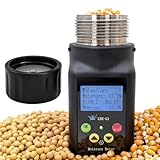
- AGRICULTURAL GRAIN CHECKS: This portable corn moisture tester and grain moisture meter supports on-farm reference checks for farmers, grain handlers, and grain or feed processors
- 25 CROP PROFILES: Select the matching profile for corn, wheat, soybeans, paddy rice, barley, oats, sorghum, and other supported crops before each measurement
- CONSISTENT SAMPLE PREPARATION: Use a representative sample, fill the clean and dry chamber evenly, and tighten the cap securely without overtightening for more consistent readings
- AUTOMATIC TEMPERATURE COMPENSATION: Built-in ATC adjusts the displayed result for sample temperature; for better consistency, let the meter and sample reach similar temperatures before testing
- USER-ADJUSTABLE CORRECTION: When a trusted reference method shows a consistent difference, use the correction setting to adjust the displayed value; the setting remains saved after power-off
Separate harvest pace from crop condition
Harvest progress measures how much of a crop’s seasonal work—such as harvesting—has been completed. Crop condition is a separate assessment. A slow harvest does not, on its own, tell a reader that crop quality or yield has changed; weather can delay fieldwork without proving a particular change in the crop outlook.
Use the right USDA report for the question
USDA/NASS issues Crop Progress weekly during the April–November growing season, reporting planting, development, harvest progress, and overall crop condition by crop and state. Its publication catalog listed the October 5, 2026 report as the latest release at the October 8 reference date: USDA/NASS publications.
Rank #3
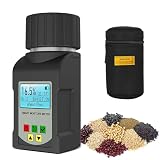
- 【SUPPORT 25 GRAINS】: The grain moisture tester is specifically designed to measure the moisture content of 25 different grains, including soya beans, voffee, lentils, grass seed rye grass, and more. Get accurate measurement results to help you make better agricultural practice decisions.
- 【PRECISE MEASUREMENT】: The smart grain moisture meter has a built-in high-precision sensor. Achieve accurate grain moisture readings with an industry-leading accuracy of ±0.5%, even under diverse environmental conditions. Ensure every measurement is reliable, demonstrating excellent reliability and accuracy, giving you full confidence in the quality of your grains.
- 【AUTOMATIC TEMPERATURE COMPENSATION】: This moisture meter for seeds comes equipped with automatic temperature compensation, which ensures consistent and accurate measurements regardless of changes in ambient temperature, making it ideal for indoor and outdoor use.
- 【BACKLIT DIGITAL DISPLAY】: Using backlight liquid crystal display technology, clear display and low power consumption, fast measurement speed, showing clear content in different lights. Whether for field or lab use, this moisture tester offers simplicity and efficiency, streamlining moisture measurement processes.
- 【VOICE BROADCAST】During measurement, it precisely announces the moisture value, enabling you to get key data without staring at the screen. If the lid isn't closed securely, the voice function gives a prompt, averting measurement errors from lid problems
For weather context, USDA’s Weekly Weather and Crop Bulletin provides national and state summaries along with current temperature and precipitation information. The catalog listed an October 6, 2026 issue: USDA/NASS publication catalog. A weather observation describes conditions already recorded; a forecast describes expected conditions. Neither should be presented as the other.
Read crop-progress maps with care
USDA/NASS says its gridded crop-progress layers are fully synthetic representations of confidential county-level data, with an archive covering growing-season weeks from 2015 onward. They can provide modeled spatial context, but they are not raw county-level observations. See NASS Crop Progress Gridded Layers documentation.
Rank #4
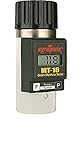
- TESTING EQUIPMENT: Specially calibrated to provide accurate moisture results for grains, the AgraTronix grain tester is reliable equipment that is commonly used by cultivators, farmers and sellers.
- UNIQUE DESIGN: The grain humidity tester is equipped with back lit display with multilingual settings for precise readings even in dark. It has an easy basic mode and advanced precision calibration mode to match local elevator.
- CONVENIENT TO USE: This is a handheld moisture tester for grain can be used with 16 different grain scales. It works well in moisture range of 5% to 40%, depending on the type of grain. Each scale is adjustable to match the local elevator.
- PRECISE READINGS: The MT-16 moisture tester automatically averages up to 99 test results. It has high-frequency capacitive circuit that improves the overall accuracy.
- PRODUCT SPECIFICATIONS: The grain moisture meter has 0.1% moisture display resolution. It can be operated using two 9V batteries. It works well with 32° to 113°F temperature range. It is supplied with protective carrying case with a shoulder strap.
What could the next USDA release clarify?
USDA’s October 2026 World Agricultural Supply and Demand Estimates (WASDE) report was scheduled for October 9 at 12:00 p.m. Eastern—one day after the October 8 reference date. Its figures were therefore not yet available as of October 8.
WASDE is a monthly report of annual supply-and-use forecasts for U.S. and world wheat, rice, coarse grains, and oilseeds, among other commodities. It can update the balance-sheet context traders use to assess supply and demand, but it is a forecast report, not a record of a single day’s harvest or weather. The schedule and report scope are described by USDA’s World Agricultural Outlook Board.
The Tool Desk
Outbyte Driver Updater FREEScan for outdated or missing drivers - takes under a minuteDriver Scan →Outbyte PC Repair FREEClear out junk files and repair common Windows errorsFree Scan →Quick Recap
Best Value

- High Precision & Consistency: Achieve accurate grain moisture readings with an industry-leading accuracy of ±0.5%, even under diverse environmental conditions. Ensure every measurement is reliable, giving you full confidence in the quality of your grains.
- Supports 25 Types of Grains: GS25A is versatile and supports the measurement of 25 different grain types, including wheat, corn, rice, coffee beans, and more. Easily switch between grains to get precise moisture content, tailored to your specific crop.
- User-Friendly & Portable Design: The lightweight, compact design and intuitive LCD display make GS25A easy to carry and operate in the field or storage. The straightforward interface allows anyone to perform accurate measurements with minimal setup.
- Automatic Temperature Compensation: With built-in automatic temperature compensation, GS25A ensures consistent and precise measurements, regardless of changes in ambient temperature, making it ideal for both indoor and outdoor use.
- Long Battery Life & Convenient Power Options: Powered by 4 AAA batteries and an additional CR-2032 battery (Package does not include batteries), GS25A is designed for extended field use. Stay productive without the constant worry of battery replacement.
How to interpret the numbers without mixing them up
- Settlement versus return: The October 6 contract settlements and daily changes are point-in-time market figures. CME’s August percentages are monthly returns for rolling front-month futures. They cover different periods and measures.
- Observation versus forecast: Crop Progress and weather summaries report conditions or progress available for their stated reporting periods. WASDE provides supply-and-use forecasts; a weather forecast concerns future conditions.
- Progress versus condition: Harvest pace and crop condition answer different questions. A delay does not establish a yield or quality outcome.
- Data versus interpretation: A report supplies observations or estimates; explanations of how those figures relate to prices are analysis, not proof that one release or weather event caused a market move.
Product prices and availability are accurate as of the date/time indicated and are subject to change. Any price and availability information displayed on Amazon at the time of purchase will apply.




