What’s actually slowing this PC down?
Pick the symptom - the matching free tool is one click away.
Airloom Energy began building its first utility-scale wind pilot near Rock River, Wyoming, on June 25, 2025. Despite headlines calling it a “first power plant,” the project is more accurately described as a research, development and demonstration facility—not a proven commercial wind farm.
The Wyoming installation is designed to test Airloom’s unusual low-profile wind system and determine whether it can produce electricity reliably while reducing the transportation, crane and construction challenges associated with conventional turbines.
As an Amazon Associate I earn from qualifying purchases.
What Airloom is building in Wyoming
Airloom’s site is near Rock River, northwest of Laramie. The company says the pilot will validate power production, efficiency, deployment costs and maintenance requirements under real-world conditions. The project was announced as the company’s first utility-scale pilot installation.
Quick wins for a faster PC:
Scan for outdated or missing drivers - takes under a minuteDriver Scan →Repair Windows errors before they cause bigger problemsFix Now →That distinction matters. Airloom had not established a commercial fleet or a fully proven commercial power station when construction began. The purpose of the Rock River project is to generate the operating data needed to decide whether the design can scale.
#1 Best Overall

- Designed Beginner Kit:6 Pcs mini Generator motor,6 Pcs Motor Mounting Bracket Holder,6 Pcs 2mm Shaft Propeller(3 Pcs 4 Vanes and 3 Pcs 3 Vanes,Color random),9 Pcs LED(Red,Yellow,Green),6 Pcs Quick Connector,Color English Manual
- Different voltage corresponds to different speed, Voltage:DC 3V;Rated Speed:1500 RPM;Voltage:DC 4.5V;Rated Speed:2500 RPM;Voltage:DC 12V;Rated Speed:6500 RPM;Motor Body Diameter:24mm/0.94";Motor Height:22.21mm/0.87";Shaft Size:8.25x2.0mm/0.32"x0.08";Line length:14cm/5.51in
- This is a multi-functional beginner's Kit. It can be driven by wind, gears and pulleys to generate current to light up LEDs. It can also be driven by solar panels or batteries to make various solar and electric toys.
- Using the parts in our kit, you can assemble a simple wind power generation model, which can be used to test whether the motor in the kit is damaged, and it can also explain how wind energy is converted into electrical energy, which is then converted into light energy through LEDs.
- Warning: If you have purchased a rocker switch, please pay attention to the product picture to avoid short circuit caused by wrong wiring. High temperature will cause the battery box to melt. Children should use it under the supervision of an adult. When you are not using it, please disconnect the power supply.
A June 2026 Wyoming legislative document said Airloom was nearly finished building a full-scale demonstration unit at Rock River. That statement does not independently establish that the system was operating, producing electricity or meeting its projected output.
TechCrunch reported the groundbreaking and pilot details, while Airloom’s project announcement describes the intended validation work.
How Airloom’s wind system works
A conventional wind turbine uses a tall tower and a horizontal rotor with several long blades. Airloom takes a different approach: shorter, vertically oriented airfoils travel continuously around an elongated oval or racetrack-shaped track.
The system still relies on the familiar aerodynamic principle of extracting energy from moving air. Its proposed innovation is the geometry and logistics of the machine rather than a fundamentally different source of energy.
- The airfoils are much shorter than the blades on large conventional turbines.
- A cable or track guides the moving airfoils around the oval.
- The structure is designed to remain relatively close to the ground.
- The track can be lengthened to increase swept area and potential output.
TechCrunch described the pilot’s straight sections as roughly 100 meters long. A future 3-megawatt design discussed by Airloom’s chief executive, Neal Rickner, would use straightaways of approximately 500 meters. Utility Dive described the trackway as about 80 feet above the ground, with airfoils approximately 30 feet long. TechCrunch described the overall structure as roughly 60 feet high; these figures reflect different descriptions of the system’s components and layout rather than a conventional turbine tower height.
Rank #2

- FIFTH-GENERATION WIND TURBINE KIT: Updated version of the best-selling STEM kit about wind power and energy, kids can make their own wind turbine to explore this renewable energy source.
- OPTIMIZED FOR INDOOR & OUTDOOR USE: Design includes a new blade hub and gear ratio to enhance performance in outdoor wind and with indoor fan setups.
- WHAT YOU LEARN: Dive into the technology behind one of the most promising sources of clean energy, how it has been used it the past, and how it is used today.
- INCLUDES ELECTRIC MODEL CAR: Use your turbine to generate and store electricity to power a model car in just two minutes—no batteries required!
- GUIDED JOURNEY THROUGH WIND POWER: The 32-page, full-color manual provides illustrated step-by-step assembly instructions and easy-to-understand explanations about the scientific concepts at work.
The pilot’s capacity numbers need context
Public descriptions give two important figures for the Wyoming demonstration:
| Figure | What it refers to | Status |
|---|---|---|
| About 150 kilowatts | Output described by Airloom CEO Neal Rickner to TechCrunch | Reported pilot configuration |
| 1 megawatt | Demonstration-device objective in Wyoming’s funding description | State award description |
| 3 megawatts | Future system example discussed by the company | Not demonstrated output |
These figures should not be treated as proof that the same operating unit was simultaneously a 150-kilowatt and 1-megawatt plant. The 150-kilowatt description appears to concern the initial pilot configuration, while the Wyoming award describes the broader demonstration objective. The public materials do not provide enough detail to reconcile the figures into one independently verified capacity rating.
Nor should capacity be confused with annual electricity production. A nameplate rating describes maximum output under specified conditions. The more important commercial measures will be the system’s power curve, capacity factor, uptime and yearly generation.
Why Airloom believes the design could matter
Modern onshore wind has become more competitive partly by using taller towers and longer blades. That strategy can capture stronger, steadier winds, but it also creates logistical problems. Oversized blades and towers may require specialized roads, bridges, ports, heavy-haul transport and large cranes.
Airloom’s lower-profile design is intended to use smaller components that could be easier to manufacture, transport and install. The company says that could make the technology useful where conventional turbines are difficult to deploy, including:
Rank #3

- Wind-Powered LED Light Display: This small wind-mill generator powers a 10-meter colorful tape lights used to decorate the backyard. Mount it in an open place and the colorful tape lights will light up with the wind without batteries or external power supply. The brightness of the tape lights varies with the strength of the wind. The stronger the wind, the brighter the lights. Add a touch of dynamic color to your backyard on windy evenings. It needs to be installed in an open area for better performance
- Interactive Backyard Experience: Assemble this small wind-mill generator and fix it in an open space, making wind power practical in your yard. You will watch the strip lit up on every windy night, which is fun
- Durable Construction and Easy Installation: Most of its parts are DIY assembled. It can withstand super strong winds. It can be fixed to your railings, higher places, or other open areas with the complimentary flange and 4 screws. The use of brushless motor makes the windmill rather durable. The blades are made of anti-aging materials of ASA/PC
- All-Weather Durability: It is rain-proof and age-resistant, and can be used outdoors for a long time. Further, it is noise-free. A wind blowing from any direction can be used efficiently as the tail vane enables the blades adapt themselves to different directions
- Simple Assembly and Smart Design: It needs to be installed in an open area for better performance. It is cleverly designed and constructed, and is easy to assemble with straightforward instructions for quick setup
- Military bases and defense facilities with height restrictions;
- Remote locations with limited road or crane access;
- Islands and mountainous terrain;
- Sites near large electricity users, including prospective data-center developments;
- Locations where visual impact or aviation constraints limit taller structures.
Airloom also says land inside the track could potentially remain available for agriculture or solar panels. Those are design propositions, not demonstrated commercial results. A lower system may avoid some transport and height constraints, but it may also encounter weaker winds than a much taller turbine.
What the pilot must prove
The key question is not whether the airfoils can turn or whether the project can produce some electricity. A commercially useful power system must be reliable, affordable and financeable over many years.
- Power performance: Does actual output match the predicted power curve across different wind speeds?
- Capacity factor: How much electricity does the system generate over a full year, rather than at peak conditions?
- Reliability: Can cables, airfoils, bearings, drives and controls operate continuously?
- Weather durability: Can the equipment withstand Wyoming’s wind, snow, ice, dust and temperature extremes?
- Maintenance: Are components genuinely easier and cheaper to access and replace?
- Mechanical losses: How much energy is lost as the airfoils move through the bends and transitions of the oval?
- Control performance: Can the system remain stable when wind direction and speed change?
- Land efficiency: Does the track produce enough energy for the land it occupies?
- Cost: Does actual capital spending approach the company’s modeled target?
- Commercial deployment: Can the design obtain permits, insurance, grid interconnection and long-term power contracts?
Potential failure modes include cable fatigue or derailment, airfoil damage from icing or debris, track deformation, excessive vibration or noise near ground level, and maintenance downtime that offsets easier component access. Scaling from a short pilot to a much longer 3-megawatt track could create additional engineering and cost challenges.
What Bill Gates’ backing means
“Bill Gates-backed” is shorthand for investment by Breakthrough Energy Ventures. It should not be read as evidence that Gates personally designed, operates or guarantees Airloom’s technology.
Airloom announced $7.5 million in equity financing in 2024. The listed participants included Lowercarbon Capital, Breakthrough Energy Ventures, Wyoming Venture Capital, Crosscut Ventures, WovenEarth Ventures, Adiuvans and the Kutnick Family Office.
The Tool Desk
Outbyte Driver Updater FREEScan for outdated or missing drivers - takes under a minuteDriver Scan →Outbyte PC Repair FREEClear out junk files and repair common Windows errorsFree Scan →Rank #4
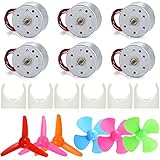
- Designed Beginner Kit: 6 PCS mini dc motor, 6 PCS Motor Mounting Bracket Holder and 3 PCS different colors 4 Vanes shaft propellers and 3 PCS 3 Vanes shaft propellers
- Parameter: Different voltages correspond to different speeds. Voltage: DC 3V, rated speed: 1500 RPM, voltage: DC 4.5V, rated speed: 2500 RPM, voltage: DC 12V, rated speed: 6500 RPM. Color: silver. Motor Body Diameter: 24mm/0.94"
- Two-way Conversion: When the bearing rotates, it generates electricity, when receiving power, the bearing will rotate. This mini wind generator set enables the conversion of kinetic and electrical energy
- Good Present: This learning toy is good for curious kids, let the children know the driving principle of the motor, how the propeller rotates to produce wind. Cultivate children's practical ability, so that knowledge is no longer theoretical
- Warning: Suitable for 8+ years, please see the picture carefully, use the correct circuit diagram to avoid short circuit, short circuit will produce high temperature and cause the battery holder case to melt and burned, the kids must use under the supervision of adults
The company also announced a $5 million Wyoming Energy Matching Fund award and a $1.25 million non-dilutive U.S. Department of Defense contract. Together with the equity financing, those announced sources represented $13.75 million in support. The Wyoming Energy Authority described its award as supporting a 1-megawatt demonstration device.
Public funding reduces some development risk, but a grant or government contract does not prove that the turbine will ultimately compete with established wind technology.
Independent reader supportYour contribution helps us test, update, and keep practical guides available for everyone.Airloom’s cost and commercialization claims
Airloom has previously modeled an energy cost of approximately $13 per megawatt-hour and has discussed an objective of reaching roughly one-third the cost of conventional wind. It has also promoted lower deployment complexity, higher energy density and faster construction as potential advantages.
These are company models, targets or claims—not independently demonstrated operating results. They should not be used as current investment returns, a guaranteed electricity price or evidence that Airloom has already beaten commercial wind projects on cost.
Crashes, No Sound, or Screen Glitches?
Random freezes, missing sound and display glitches usually trace back to one bad driver. Find and replace yours safely.Free scan · under a minutePC Slower Than It Used to Be?
A free scan shows the junk files, broken settings and background clutter dragging Windows down - then fixes them in one click.Free scan · Windows 10 & 11The company’s public roadmap lists prototype work in 2023, pilot design in 2024, pilot operations in 2025 and a commercial demonstration in 2027. Earlier reporting discussed a commercial-scale system in 2027 or 2028. The schedule is therefore best described as a target that has evolved, not a guaranteed delivery date.
Best Value

- Build and experiment with a real, working 3-foot tall wind turbine to learn how wind is one of the most promising sources of clean, renewable energy available today.
- Single-piece blade construction for improved durability and better aerodynamics.
- Generate electricity to charge a battery and power a small model car.
- New weatherproof battery box can be left outside!
- Includes stakes to secure the turbine to the ground.
Timeline
- 2023: Airloom’s roadmap lists prototype work.
- 2024: The company lists pilot design work and announces financing, Wyoming support and a DoD contract.
- June 25, 2025: Airloom announces the Rock River, Wyoming, groundbreaking.
- 2025: The company roadmap lists pilot operations.
- June 2026: A Wyoming legislative document says the full-scale demonstration unit was nearly complete, without independently confirming operation or output.
- 2027: Airloom’s current roadmap targets a commercial demonstration.
What this means for investors and energy buyers
For climate-tech investors, Airloom represents an early-stage hardware opportunity with potentially valuable intellectual property and possible applications in constrained sites. It also carries the risks common to first-of-a-kind infrastructure: schedule delays, cost overruns, certification hurdles, manufacturing complexity and uncertain bankability.
For data-center developers, military planners and other large electricity users, the relevant question is whether the system can provide dependable power at a predictable lifecycle cost. A lower visual profile or easier transport could be valuable, but only if those benefits survive real-world operation and financing requirements.
Airloom may prove especially useful in locations where conventional wind cannot be installed economically. That does not mean it will outperform mature turbines at every ordinary wind-farm site. A niche advantage can still be commercially important, but it is different from replacing conventional wind across the market.
Bottom line
Airloom has moved beyond laboratory concepts and modeling to construction of a meaningful field demonstration in Wyoming. Its low-profile, oval-track design could address transport, crane, height and siting constraints that affect conventional wind projects.
But the Rock River project was a pilot, not a proven commercial power plant. The decisive evidence will be measured annual energy production, reliability, maintenance cost, durability and capital cost. Until those results are independently documented, Airloom should be viewed as a promising but unproven wind-energy technology.
Quick Recap
Product prices and availability are accurate as of the date/time indicated and are subject to change. Any price and availability information displayed on Amazon at the time of purchase will apply.




